
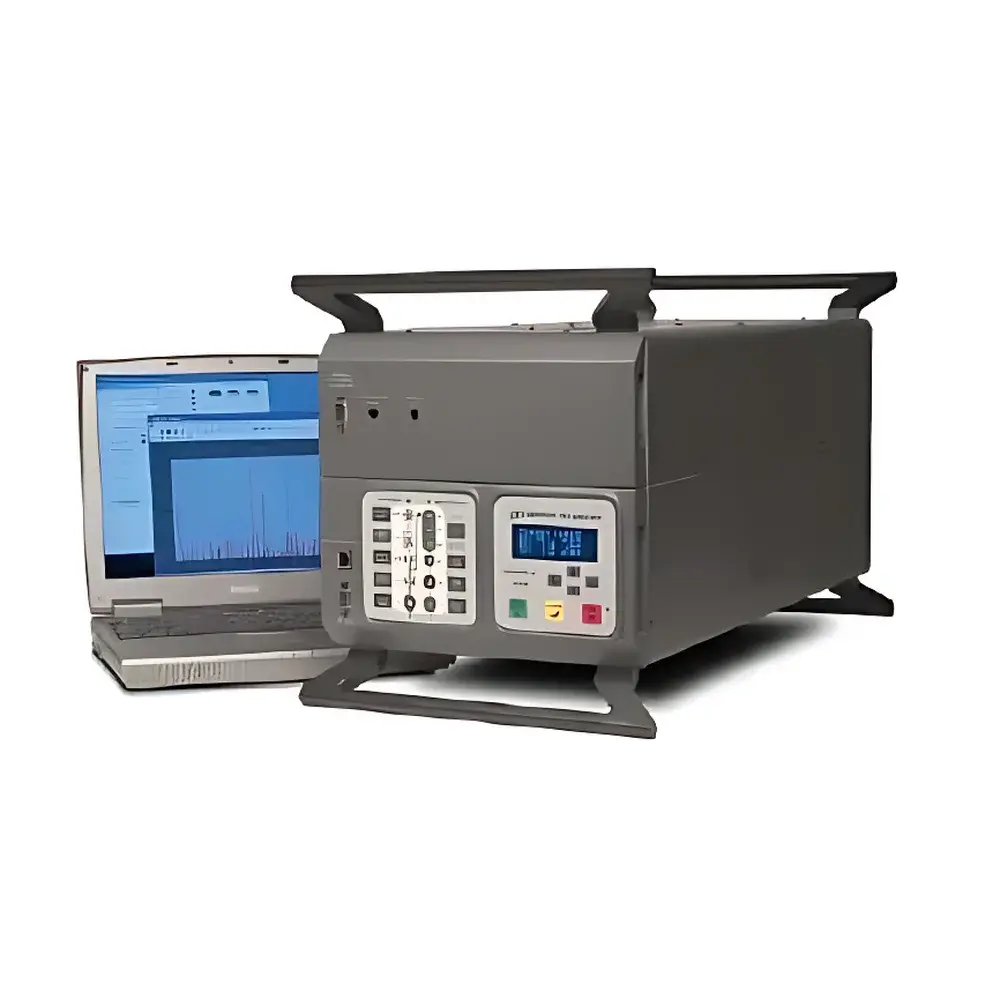
SRS UGA Series Quadrupole Residual Gas Analyzer
| Brand | SRS (Stanford Research Systems) |
|---|---|
| Origin | USA |
| Model | UGA Series |
| Type | Portable Residual Gas Analyzer |
| Mass Range Options | 100 amu / 200 amu / 300 amu |
| Resolution | Better than 0.5 amu (at 10% peak height) |
| Detection Limit | <1 ppm |
| Operating Pressure Range | 1×10⁻⁶ Torr to 760 Torr (via configurable inlet) |
| Inlet Configurations | Stainless-steel capillary (1–760 Torr), tubular channel (10⁻¹–10⁻⁴ Torr), 2.75" CF flange (<10⁻⁴ Torr) |
| Flow Rate | 1–10 sccm (at STP) |
| Detector | Faraday Cup & Electron Multiplier |
| Vacuum Pumping System | Integrated Turbo-Molecular Pump + Low-Pressure Diaphragm Pump |
| Interface | GPIB, RS-232 |
| Software | Windows-based RGA Control Suite with Real-Time Spectral Acquisition, Leak Detection Mode, Time-Pressure Plotting, and Multicomponent Quantitative Analysis |
Overview
The SRS UGA Series Quadrupole Residual Gas Analyzer is a high-performance, portable mass spectrometer engineered for real-time, multicomponent gas analysis across an exceptionally broad pressure range—from atmospheric conditions down to ultra-high vacuum (UHV) environments (≤5×10⁻⁶ Torr). Unlike conventional electrochemical or NDIR-based gas detectors, the UGA leverages quadrupole mass filter technology—operating on the principle of mass-selective ion transmission under precisely controlled RF/DC voltage fields—to resolve and quantify individual gaseous species by their mass-to-charge ratio (m/z). This enables unambiguous identification and quantification of volatile compounds—including halogenated refrigerants (e.g., CFCs, HFCs), hydrogen-containing species (H₂, NH₃, H₂O), corrosive gases (HF, HCl, Cl₂), hydrocarbons, solvents, and process byproducts—without cross-sensitivity or calibration drift typical of sensor-based analyzers. Its modular inlet architecture and dual-detector system (Faraday cup for high-concentration stability and electron multiplier for trace-level sensitivity) ensure robust performance in both dynamic process monitoring and static vacuum diagnostics.
Key Features
- Three selectable mass ranges: 100 amu, 200 amu, or 300 amu—optimized for semiconductor process gases, environmental VOC screening, or specialty chemical analysis.
- High mass resolution: ≤0.5 amu at 10% peak height—enabling baseline separation of adjacent isotopes (e.g., ²⁸N₂ vs. ²⁸CO) and critical industrial gas pairs (e.g., 44 CO₂ vs. 44 N₂O).
- Wide operational pressure span: Direct sampling from 1 Torr to 760 Torr via stainless-steel capillary; transition to 10⁻¹–10⁻⁴ Torr using tubular conductance limiting; UHV-compatible 2.75″ CF flange interface for integration into vacuum chambers.
- Integrated vacuum system: Compact turbo-molecular pump (nominal speed ≥200 L/s) paired with a chemically resistant diaphragm backing pump—eliminating external roughing requirements and enabling rapid pump-down from atmosphere to base pressure (<10 min).
- Dual detection modes: Faraday cup for linear, stable response up to 100% partial pressure; electron multiplier for sub-ppm detection limits with >10⁶ gain and low-noise amplification.
- Real-time spectral acquisition at ≥10 spectra/sec—supporting transient event capture during leak testing, purge validation, or reaction kinetics studies.
Sample Compatibility & Compliance
The UGA Series is validated for analysis of reactive, condensable, and corrosive gases—including but not limited to HF, Cl₂, NH₃, SO₂, silanes, and fluorocarbons—thanks to its all-stainless-steel ion source, gold-plated quadrupole rods, and chemically inert detector housing. Inlet path materials comply with ASTM E1527-21 specifications for vacuum system compatibility. Data acquisition and reporting functions support GLP/GMP-aligned workflows: software timestamps, user-access logs, audit-trail-enabled method storage, and export-ready CSV/TXT formats compatible with LIMS integration. While not certified as a Class I Div 1 hazardous-area instrument, the UGA meets CE marking requirements for EMC Directive 2014/30/EU and Low Voltage Directive 2014/35/EU. It is routinely deployed in facilities operating under ISO 14644 cleanroom protocols and SEMI S2 safety guidelines.
Software & Data Management
The included Windows-based RGA Control Suite provides full instrument control, spectral visualization, and quantitative analysis without third-party dependencies. Core modules include: (1) Continuous Scan Mode for full-mass-range survey; (2) Peak Jump Mode for targeted m/z monitoring with programmable dwell times; (3) Leak Detection Wizard—automated helium-response mapping with differential pressure correlation; (4) Time-Resolved Quantitation—generating concentration-vs.-time profiles for up to 32 user-defined masses; (5) Calibration Manager supporting single-point and multi-point response factor tables per gas. All data files embed metadata (instrument ID, operator, timestamp, vacuum status, detector mode) and are stored in a structured binary format (.rga) with lossless compression. Export options include ASCII, Excel-compatible CSV, and PNG/SVG spectral plots—fully compliant with FDA 21 CFR Part 11 requirements when deployed with domain-authenticated Windows accounts and enabled electronic signature logging.
Applications
- Semiconductor manufacturing: Real-time effluent monitoring of PECVD, etch, and ALD tools—tracking SiF₄, NF₃, BCl₃, and residual O₂/H₂O in abatement streams.
- Fuel cell R&D: In-situ cathode/anode gas composition analysis during polarization curve sweeps and durability testing—detecting CO poisoning, membrane crossover, and reformate impurities.
- Pharmaceutical lyophilization: Headspace gas profiling (N₂, O₂, H₂O vapor) inside freeze-dryer chambers to validate stopper sealing integrity and residual moisture endpoints.
- Environmental emissions verification: On-site screening of landfill gas (CH₄, CO₂, H₂S), biogas digesters, and incinerator stack gases—complementing EPA Method 25A compliance protocols.
- Vacuum system diagnostics: Base pressure verification, virtual leak identification, and outgassing rate quantification per ASTM E595-23 for spacecraft component qualification.
- Fermentation bioprocess control: Dissolved gas headspace tracking (CO₂, ethanol vapor, acetone) in lab-scale bioreactors to infer metabolic state and optimize feeding strategies.
FAQ
What vacuum level is required before initiating mass spectral acquisition?
The UGA achieves optimal signal-to-noise ratio below 5×10⁻⁶ Torr; however, the integrated turbo pump enables stable operation down to 1×10⁻⁷ Torr. For atmospheric-pressure sampling, the capillary inlet restricts flow to maintain analyzer chamber pressure within operational limits.
Can the UGA distinguish between isobaric species such as N₂ and CO?
Yes—its mass resolution of better than 0.5 amu allows baseline separation of N₂ (28.006 amu) and CO (27.995 amu) under standard tuning conditions, confirmed via calibrated reference gas mixtures.
Is remote operation supported over Ethernet or USB?
The UGA natively supports GPIB and RS-232 interfaces. Ethernet connectivity requires optional IEEE-488.2-to-TCP/IP gateway hardware; USB is not directly supported due to timing-critical spectral acquisition constraints.
How often does the electron multiplier require replacement?
Under typical UHV use (≤10⁻⁶ Torr, 90% gain stability for ≥2 years; lifetime decreases proportionally with exposure to high partial pressures (>10⁻³ Torr) of reactive gases.
Does the software support automated calibration against certified gas standards?
Yes—the Calibration Manager module accepts user-defined response factors and supports batch import of NIST-traceable calibration certificates; it also calculates relative sensitivity factors (RSFs) from sequential standard injections.
Related Products







