
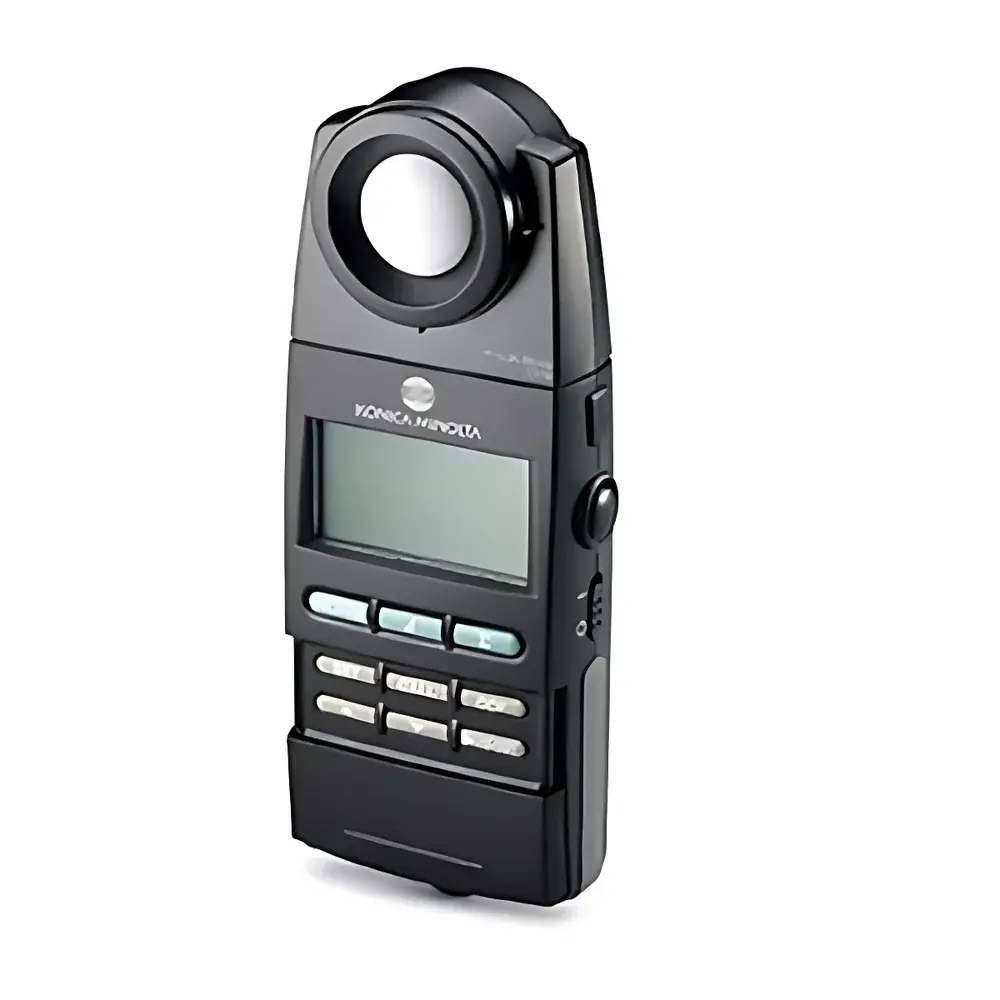
Konica Minolta T-10 Advanced Illuminance Meter
| Brand | Konica Minolta |
|---|---|
| Origin | Japan |
| Model | T-10 |
| Compliance | JIS C 1609-1:2006 Class AA (except f₂), DIN 5032-7 Class B |
| Measurement Range | 0.01–299,900 lx |
| Cosine Error (f₂) | ≤3% |
| Spectral Mismatch (f₁′) | ≤6% |
| Output | USB + Analog (1 mV/digit, max 3 V) |
| Operating Temp | −10–40°C |
| Battery Life | ≥72 h (alkaline) |
Overview
The Konica Minolta T-10 Advanced Illuminance Meter is a precision-grade, modular photometric instrument engineered for traceable, high-fidelity illuminance measurement in R&D, quality assurance, and regulatory compliance environments. Based on the fundamental principle of photopic luminous detection—where a silicon photodiode is spectrally weighted to match the CIE standard photopic luminosity function V(λ)—the T-10 delivers metrologically robust data across a broad dynamic range (0.01–299,900 lx). Its design adheres strictly to JIS C 1609-1:2006 Class AA requirements for general-purpose illuminance meters (excluding cosine response specification f₂, which is separately validated at ≤3%), as well as DIN 5032-7 Class B for photometric instrumentation classification. This dual-standard conformance ensures suitability for accredited laboratory use, lighting system validation, and third-party verification under ISO/IEC 17025 frameworks. Unlike basic handheld lux meters, the T-10 supports synchronized multi-point acquisition via detachable probes—enabling spatial illuminance mapping without requiring multiple independent instruments.
Key Features
- Modular architecture with separable probe and main unit, connected via shielded LAN-style cable (standard lengths: 1 m, 5 m, or 10 m)
- Support for scalable multi-point measurement systems (2–30 channels) using a single controller unit
- Dual probe variants: T-10A (standard probe), T-10MA (miniature probe, Ø16.5 mm), T-10WSA/T-10WLA (IP67-rated waterproof miniature probes)
- PWM-compatible measurement capability—accurately captures time-averaged illuminance from pulse-width modulated LED sources without aliasing or integration error
- Auto-ranging digital measurement with five manual analog output ranges; 3–4 digit LCD display with auto-backlight
- User-configurable CCF (Color Correction Factor) scaling (0.500–2.000×) to compensate for non-standard spectral distributions
- Analog output: 1 mV per digit, max 3 V, 10 kΩ output impedance, 90% response time ≤28 ms
- Integrated data logging functions: illuminance difference (ΔE), ratio (%), integral illuminance (lx·h), integral time (h), and mean illuminance (lx)
Sample Compatibility & Compliance
The T-10 is validated for use with conventional incandescent, fluorescent, HID, and solid-state light sources—including white LEDs, OLEDs, and laser-based illumination systems. Its low f₁′ spectral mismatch (≤6%) and superior cosine correction (f₂ ≤3%) ensure minimal angular and spectral dependence when measuring diffuse or directional fields. The instrument meets essential photometric calibration traceability requirements for applications governed by IEC 62471 (photobiological safety), EN 12464-1 (lighting of work places), and ISO 8995 (interior lighting standards). While not inherently GLP/GMP-certified, its audit-ready data output (USB + analog), stable analog signal path, and user-accessible calibration parameters support integration into FDA 21 CFR Part 11–compliant workflows when deployed with validated software and procedural controls. Waterproof probe variants (T-10WSA/WLA) extend usability to outdoor lighting audits, streetlamp maintenance, and industrial facility inspections where environmental exposure is routine.
Software & Data Management
The T-10 operates standalone but interfaces seamlessly with Konica Minolta’s proprietary SpectraMagic™ NX software (Windows-based) for advanced analysis, report generation, and batch export. Raw measurements are timestamped and stored internally with metadata including probe ID, CCF setting, range selection, and ambient temperature/humidity (via optional external sensor). USB communication enables direct CSV export for integration into LIMS or statistical process control platforms (e.g., JMP, Minitab). Analog output supports real-time connection to PLCs, DAQ systems, or oscilloscopes for closed-loop lighting control validation. All firmware updates and configuration files are distributed via Konica Minolta’s secure technical portal—ensuring version-controlled deployment aligned with ISO 9001 documentation practices.
Applications
- Photometric validation of architectural lighting designs in offices, hospitals, schools, and retail spaces per EN 12464-1 and IESNA RP-1
- LED luminaire R&D: PWM dimming characterization, flicker index assessment, and spatial uniformity mapping
- Regulatory testing for energy efficiency labeling (e.g., EU Ecodesign Directive, ENERGY STAR)
- Maintenance auditing of public infrastructure: street lighting, tunnel illumination, emergency egress signage
- Calibration reference for secondary illuminance sensors in building management systems (BMS)
- Optical safety evaluation: UV/visible irradiance screening in laboratory and manufacturing cleanrooms
- Integration as a calibrated photodetector subsystem in goniophotometer or integrating sphere setups
FAQ
Does the T-10 require annual recalibration to maintain JIS AA compliance?
Yes. While the instrument maintains inherent stability, JIS C 1609-1:2006 mandates periodic verification against NIST-traceable standards—at minimum annually or per organizational quality policy.
Can the T-10 measure pulsed or stroboscopic light sources accurately?
It measures time-averaged illuminance of PWM-driven LEDs reliably. For transient analysis (e.g., rise/fall times, frequency-dependent flicker), a fast-response photometer or oscilloscope-coupled sensor is recommended.
Is the waterproof probe suitable for submersion?
T-10WSA and T-10WLA probes meet IP67 (1 m for 30 min), but cable glands and connectors must remain unimmersed; continuous underwater operation is not supported.
What is the impact of cable movement during measurement?
Mechanical stress on the probe cable induces microphonic noise in the analog signal path—causing short-term instability. Secure mounting and strain relief are mandatory per Konica Minolta’s operating guidelines.
How does the CCF function improve measurement accuracy for non-white-light sources?
CCF applies a linear multiplier to compensate for known deviations between the probe’s spectral responsivity and V(λ), particularly useful for narrowband sources (e.g., red/blue horticultural LEDs) where f₁′ error would otherwise dominate uncertainty.




