
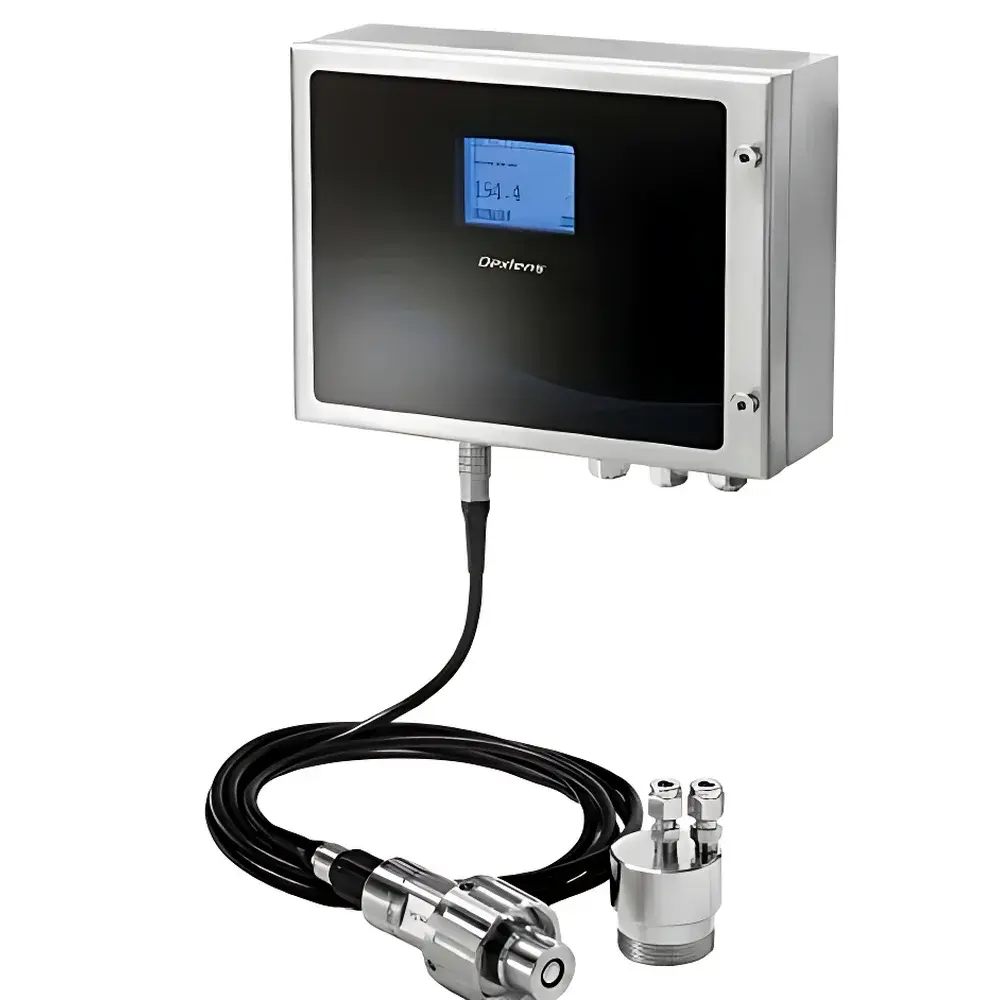
Dextens 62101/64101/65101 Thermal Conductivity Gas Analyzer for CO₂, N₂, and H₂
| Origin | Switzerland |
|---|---|
| Manufacturer Type | Authorized Distributor |
| Origin Category | Imported |
| Model Numbers | 62101, 64101, 65101 |
| Power Supply | 85–230 VAC, 50/60 Hz |
| Power Consumption | <20 W |
| Operating Temperature | −5 °C to +50 °C |
| Enclosure | Stainless Steel, IP65 / NEMA 4X |
| Weight | 3.0 kg |
| Dimensions | 230 mm × 180 mm × 75 mm |
| Display | Real-time temperature, measurement value, timestamp, and membrane type |
| Liquid-phase Resolution | 0.01 ppm (CO₂), 0.01 ppb (H₂, N₂) |
| Gas-phase Resolution | 0.01 ppb |
| Liquid-phase Ranges | CO₂: 0–15 g/kg |
| H₂ | 0–10 ppm |
| N₂ | 0–350 ppm |
| Gas-phase Ranges | CO₂: 0–10 bar |
| H₂ | 0–12 bar |
| N₂ | 0–20 bar |
| Membrane Types | 82952, 82956 |
| Thermal Cut-off | Factory-set at +40 °C (adjustable via software) |
| Calibration | Single-point air calibration or direct span calibration |
| Alarm Outputs | High/Low or High/High |
| Communication Interfaces | RS-232, RS-485 |
| Sensor Modules | CO₂ Sensor 52401, H₂ Sensor 52201, N₂ Sensor 52501 |
Overview
The Dextens 62101/64101/65101 Thermal Conductivity Gas Analyzer is a precision-engineered, continuous online instrument designed for quantitative determination of carbon dioxide (CO₂), nitrogen (N₂), and hydrogen (H₂) in both gaseous and liquid-phase process streams. Leveraging the fundamental physical principle of thermal conductivity differential—where gas composition alters the rate of heat dissipation from a heated filament—the analyzer delivers stable, drift-resistant measurements without chemical reagents or consumables. Its modular architecture integrates Dextens’ proprietary thermal conductivity sensor modules (52401 for CO₂, 52201 for H₂, 52501 for N₂) with selective permeation membranes (types 82952 and 82956) to isolate target analytes from complex matrices. This configuration enables trace-level detection in liquids (down to 0.01 ppb for H₂/N₂; 0.01 ppm for CO₂) and full-scale quantification in pressurized gas environments (up to 20 bar for N₂). The instrument is purpose-built for industrial process control, pharmaceutical purge validation, semiconductor inerting monitoring, and high-purity gas quality assurance where long-term stability, minimal maintenance, and compliance-ready operation are non-negotiable.
Key Features
- Stainless steel IP65/NEMA 4X enclosure rated for harsh industrial environments, including washdown and outdoor deployment
- Real-time dual-domain measurement: simultaneous reporting of temperature, concentration, timestamp, and active membrane identification
- Configurable alarm logic with programmable high/low or high/high thresholds across full measurement range; relay outputs (125 VAC / 20 VDC) support integration into PLC or DCS safety systems
- Secure parameter management via password-protected interface—prevents unauthorized modification of calibration, alarm setpoints, or display units
- Auto-ranging capability with seamless span switching between low-ppb and percent-level concentrations without manual intervention
- Thermal cut-off protection preset at +40 °C and adjustable via embedded firmware to prevent sensor damage during exothermic process excursions
- Low power consumption (<20 W) enables operation in energy-constrained facilities or remote installations with UPS backup
Sample Compatibility & Compliance
The analyzer supports direct inline installation in gas lines or immersion probe configurations for liquid-phase applications. Its membrane-based sample introduction system ensures compatibility with corrosive, particulate-laden, or condensing streams by physically isolating the thermal conductivity cell from bulk phase contaminants. All sensor modules and membranes comply with ISO 8573-1:2010 (compressed air purity classes) and meet material requirements per ASTM F2096 for elastomeric components in pharmaceutical gas systems. The device’s firmware architecture supports audit trail generation and electronic signature functionality aligned with FDA 21 CFR Part 11 principles when integrated with validated SCADA platforms. It is routinely deployed in GMP-compliant cleanrooms, bioreactor off-gas monitoring loops, and nitrogen blanketing systems where adherence to USP and EP 2.2.47 gas purity standards is mandated.
Software & Data Management
Configuration, calibration, and diagnostics are managed through an embedded web server accessible via Ethernet or serial link (RS-232/RS-485). Firmware updates and historical data export (CSV format) are supported without external software dependencies. Each measurement cycle logs timestamped values with sensor health indicators—including filament resistance deviation and thermal offset drift—to enable predictive maintenance scheduling. Data retention includes up to 30 days of minute-interval records onboard; extended archiving is achieved via Modbus TCP or OPC UA integration into enterprise MES or LIMS infrastructure. Calibration events are digitally signed and appended with operator ID, ambient conditions, and reference standard traceability—fulfilling GLP documentation requirements for regulated laboratories.
Applications
- Pharmaceutical: Monitoring residual O₂ and N₂ levels in lyophilizer chambers and vial headspace analysis
- Power Generation: Detection of H₂ coolant leakage in turbine generator housings (IEC 60034-11)
- Food & Beverage: Quantifying CO₂ saturation in carbonated beverage lines and modified atmosphere packaging (MAP) verification
- Semiconductor: Inert gas purity validation for CVD and ALD tool purging (SEMI F21-0217)
- Chemical Processing: Real-time H₂ concentration tracking in hydrogenation reactors and synthesis gas streams
- Environmental: Continuous emission monitoring (CEM) of CO₂ in flue gas bypass lines following ISO 14064-1 protocols
FAQ
What gases can this analyzer measure simultaneously?
It measures one gas species per configured sensor module—CO₂, N₂, or H₂—selected at time of ordering. Multi-gas capability requires parallel installation of multiple units or custom OEM integration.
Is field calibration possible without certified gas standards?
Yes—single-point zero calibration using ambient air is supported for CO₂ and N₂; H₂ calibration requires certified zero gas due to atmospheric interference. Span calibration remains optional but recommended annually per ISO/IEC 17025 guidelines.
Can the instrument operate submerged in liquid?
No—it is rated for IP65 ingress protection only. For liquid-phase analysis, use the dedicated immersion probe accessory (model DP-6210-LIQ) with compatible membrane housing.
Does the analyzer support Modbus RTU over RS-485?
Yes—Modbus RTU is natively implemented with configurable slave ID, baud rate (up to 115.2 kbps), and register mapping per Dextens Protocol Specification Rev. 3.2.
What is the typical response time (T90) for trace H₂ detection in water?
Under standard conditions (25 °C, 1 atm, 82956 membrane), T90 is ≤ 120 seconds for 0–10 ppm transitions in deionized water.
Related Products







