
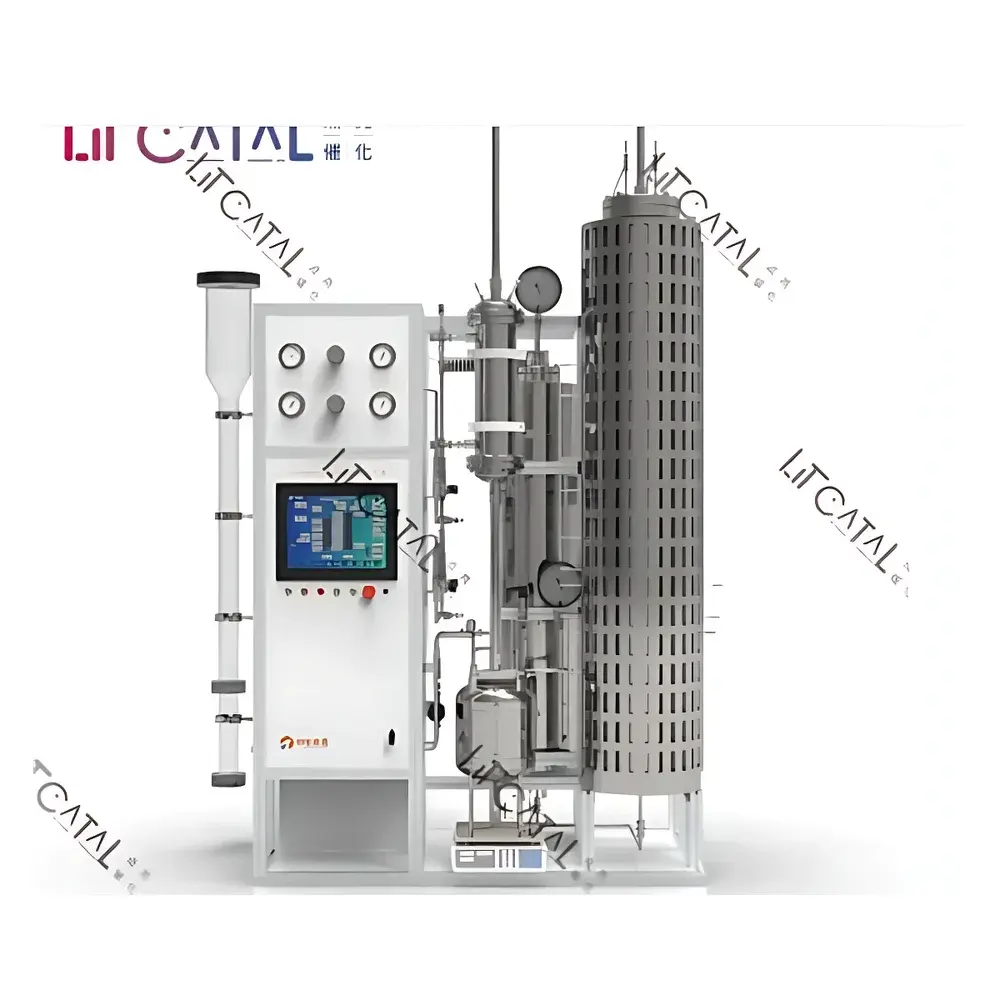
CEL-GPPCF Fluidized-Bed Heat-Exchange Reaction System (Custom-Engineered)
| Brand | CEAULIGHT |
|---|---|
| Origin | Beijing, China |
| Manufacturer Type | OEM Manufacturer |
| Country of Origin | China |
| Model | CEL-GPPCF |
| Pricing | Upon Request |
| Dimensions | 1690 mm × 800 mm × 2543 mm |
| Construction Frame | Anodized Aluminum Extrusion with Six Swivel Casters |
| Piping Material | ASTM A312 TP316L Stainless Steel |
| Reactor Tube Material | ASTM A213 TP310S Stainless Steel |
| Vaporizer Temp. Range | 0–800 °C |
| Steam Preheater Temp. Range | 0–950 °C |
| Reactor Zone Temp. Range | 0–950 °C |
| Jacket/Trace Heating Temp. Range | 0–200 °C |
| Operating Pressure | Ambient (Atmospheric) |
| Liquid Feed Flow Rate (Fully Vaporized) | ≤100 mL/min |
| Gas Flow Capacity | 0–100 SLPM (scalable via additional mass flow controllers) |
| Catalyst Bed Volume | <1500 mL |
| Gravimetric Monitoring | 0–30 kg Load Cell (0.1 g resolution) |
| Safety Systems | Proportional Pressure Relief Valve, Rupture Disc, Dual-Stage Overtemperature Alarms with Interlocked Shutdown |
Overview
The CEL-GPPCF Fluidized-Bed Heat-Exchange Reaction System is a custom-engineered, modular laboratory-scale platform designed for catalytic process development under dynamically controlled gas–solid, liquid–solid, and gas–liquid–solid reaction conditions. It operates on the fundamental principle of fluidization—where upward-flowing gas or vapor suspends solid catalyst particles in a turbulent, homogenized state—enabling high interfacial area, uniform temperature distribution, and rapid heat/mass transfer. Unlike fixed-bed reactors, this system minimizes axial temperature gradients and hot-spot formation, making it especially suitable for exothermic reactions, catalyst deactivation studies, and kinetic investigations requiring precise thermal management. The integrated heat-exchange architecture allows simultaneous reaction and thermal regulation via electrically heated zones (vaporizer, preheater, reactor, and trace heating), each independently programmable for multi-step temperature ramps per ASTM E2070 and ISO 11357-3 protocols.
Key Features
- Modular, fully customizable configuration supporting single- or multi-stream feed (gas, liquid, or co-fed), with scalable mass flow control up to 100 SLPM per gas line
- Triple-zone independent temperature control: vaporizer (0–800 °C), steam preheater (0–950 °C), and main reactor (0–950 °C), all with ±1 °C stability and ramp rates programmable from 0.1 to 20 °C/min
- High-integrity fluid handling: 316L stainless steel piping with electropolished internal finish; TP310S reactor tube rated for continuous operation at 950 °C in oxidizing and mildly reducing atmospheres
- Real-time gravimetric monitoring via 30 kg load cell (0.1 g resolution) for condensate collection and product accumulation tracking, synchronized with time-stamped data logging
- Integrated safety architecture compliant with IEC 61511:2016—dual redundant overtemperature sensors, pressure-relief manifold with proportional unloading valve and certified rupture disc, automatic interlock-triggered shutdown on fault detection
- Industrial-grade HMI: 15.6″ ruggedized touch-panel IPC running Windows OS with embedded control software supporting recipe-based operation, event-driven scripting, and audit-trail-enabled execution logs
Sample Compatibility & Compliance
The CEL-GPPCF accommodates heterogeneous catalysts in powder, extrudate, or pellet form (particle size range: 50–2000 µm), with bed volumes configurable up to 1500 mL. It supports operation with H₂, CO, NH₃, CH₄, O₂, N₂, air, steam, and organic vapors—including corrosive or condensable species when paired with appropriate trap and scrubber modules. All wetted materials conform to ASME BPE-2022 surface finish standards (Ra ≤ 0.4 µm). The system meets mechanical design requirements per PED 2014/68/EU (Category I) and electrical safety per UL 61010-1. For regulated environments, optional 21 CFR Part 11-compliant software packages are available, providing electronic signatures, role-based access control, and immutable audit trails required for GLP/GMP-aligned catalyst screening workflows.
Software & Data Management
Control and data acquisition are managed through CEAULIGHT’s proprietary ReactionSuite™ v4.2 software—a deterministic real-time application built on TwinCAT 3 runtime. It provides synchronized sampling across 32 analog/digital channels at 100 Hz, with timestamp alignment traceable to NTP-synchronized system clock. Raw sensor data (T, P, flow, weight, valve position) are stored in HDF5 format with embedded metadata (unit, calibration date, operator ID). Automated report generation includes PDF/Excel exports compliant with ISO/IEC 17025 documentation templates. Integration with third-party analytical instruments—including GC, GC-MS, FTIR, and online MS—is achieved via Modbus TCP or OPC UA, enabling closed-loop feedback control (e.g., adjusting H₂ flow based on real-time CO₂ signal).
Applications
- Kinetic modeling of Fischer–Tropsch synthesis, methanol-to-hydrocarbons (MTH), and ammonia decomposition
- Catalyst lifetime assessment under cyclic redox conditions (e.g., chemical looping combustion)
- Steam reforming and autothermal reforming of bio-oils and light hydrocarbons
- Thermocatalytic CO₂ hydrogenation to C₁–C₃ oxygenates
- Supported metal oxide redox cycling for solar thermochemical fuel production
- Process intensification studies involving reactive distillation or coupled reaction–separation units
FAQ
Can the CEL-GPPCF operate under vacuum or elevated pressure?
No—the standard configuration is rated for atmospheric pressure only. Pressure-rated variants (up to 10 bar(g)) are available as custom builds upon engineering review.
Is remote monitoring supported?
Yes. The system includes embedded Ethernet connectivity and supports secure remote access via VPN-tunneled VNC or browser-based dashboard using HTTPS/TLS 1.2.
What catalyst characterization tools can be directly interfaced?
TPR/TPD, in situ Raman, SPV, and transient pulse chemisorption modules are offered as coordinated add-ons, with shared timing synchronization and unified data ingestion into ReactionSuite™.
Does the system comply with explosion protection directives for H₂ service?
The base unit is designed for Class I, Division 2 / Zone 2 environments. ATEX-certified versions with purged enclosures and intrinsically safe I/O are available for hazardous area deployment.
How is calibration traceability maintained?
All critical sensors (RTDs, load cells, MFCs) ship with NIST-traceable calibration certificates. Onboard verification routines support periodic field validation without disassembly.
Related Products



