
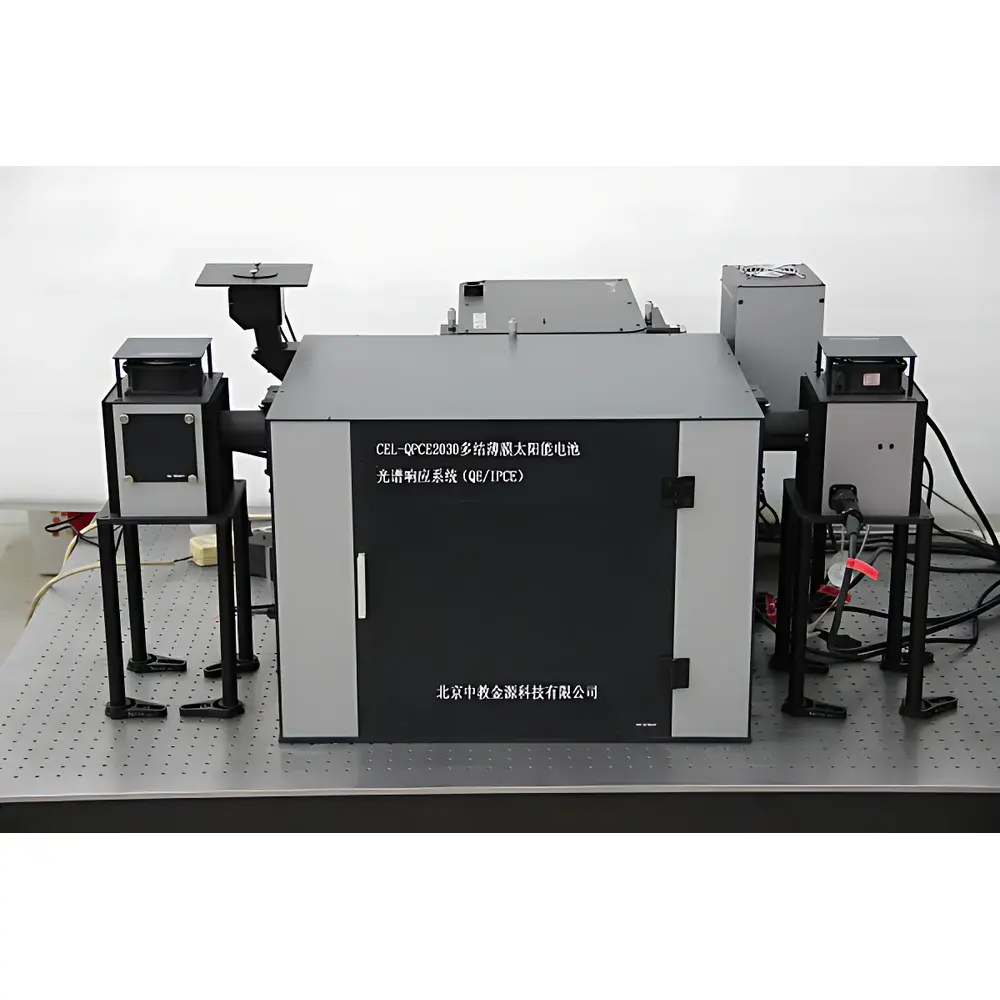
CEL-QPCE2030 Multi-Junction Thin-Film Solar Cell Quantum Efficiency & Incident Photon-to-Current Efficiency (QE/IPCE) Measurement System
| Brand | CEAULIGHT (Zhongjiaojinyuan) |
|---|---|
| Origin | Beijing, China |
| Manufacturer Type | OEM Manufacturer |
| Product Category | Domestic |
| Model | CEL-QPCE2030 |
| Pricing | USD 49,800 (FOB) |
| Trigger Mode | Steady-State Operation |
| Spectral Range | 200–1700 nm |
| Wavelength Resolution | ≥1 nm (continuously adjustable) |
| Scan Mode | Fully Automated Monochromator Sweep |
| Repeatability | <0.3% (short-circuit current, J<sub>sc</sub>) |
| Bias Light Options | Up to 2 independent bias sources (Xe or halogen), each with configurable optical filtering |
| Bias Voltage Range | ±3 V (resolution: ±1 mV) |
| Temperature Control Stage | 5–40 °C (±0.5 °C stability, optional) |
| Monochromator Focal Length | 300 mm (standard), 150 mm (optional) |
| Detection Modes | DC and AC (chopper frequency: 5–1000 Hz) |
| Stray Light Suppression | Patented multi-order elimination optical design |
| Signal Processing | Correlated detection for low-signal amplification and SNR enhancement |
| Sample Holder | Universal thin-film cell fixture with low-contact-resistance electrodes and minimal electromagnetic interference |
Overview
The CEL-QPCE2030 is a fully automated, high-precision quantum efficiency (QE) and incident photon-to-current efficiency (IPCE) measurement system engineered specifically for multi-junction thin-film photovoltaic devices. It operates on the principle of monochromatic photocurrent spectroscopy—illuminating the device under test (DUT) with tunable, narrowband light while simultaneously applying calibrated bias illumination and electrical bias to isolate the spectral response of individual subcells within tandem or triple-junction architectures. The system integrates a high-stability continuous-output broadband light source, a double-grating monochromator (300 mm focal length, optionally 150 mm), and a correlated lock-in amplifier architecture to resolve weak photocurrent signals across the full UV–NIR range (200–1700 nm). Its steady-state trigger mode ensures thermal equilibrium during measurement, critical for reproducible characterization of temperature-sensitive thin-film absorbers such as GaInP/GaAs/Ge, perovskite/Si, or CIGS-based stacks.
Key Features
- Steady-state broadband illumination source with flat spectral output—no sharp emission peaks—to minimize wavelength-dependent artifacts and ensure measurement repeatability (Jsc repeatability <0.3%).
- Dual independent bias light channels (configurable as Xe or halogen), each equipped with motorized filter wheels containing 3 short-pass and 4 long-pass interference filters—enabling selective activation of individual subcells without reliance on scarce or custom-cut bandpass optics.
- Patented optical dispersion path with multi-order suppression, achieving high wavelength accuracy (<±0.2 nm) and low stray light (<10−5 relative to peak intensity), essential for accurate QE quantification in overlapping absorption regions.
- Correlated detection electronics optimized for low-current signal recovery (down to pA-level), significantly improving signal-to-noise ratio (SNR) in AC mode (chopper frequency 5–1000 Hz) and enabling reliable measurement of thin-film cells with low internal quantum yield.
- Universal sample stage with spring-loaded, low-resistance electrode contacts and EMI-shielded cabling—designed to accommodate substrates from 1 cm² to 10 × 10 cm², including flexible and rigid thin-film formats, without mechanical stress or contact-induced recombination artifacts.
- Fully integrated control software supporting automated spectral scan, background subtraction, bias light sequencing, voltage sweep, and real-time Jsc integration under AM1.5G reference spectrum.
Sample Compatibility & Compliance
The CEL-QPCE2030 supports single-junction, dual-junction, triple-junction, and higher-order thin-film solar cells—including but not limited to amorphous Si, microcrystalline Si, CIGS, CdTe, perovskite, GaAs, and III–V multilayer heterostructures. Its bias configuration logic aligns with IEC 60904-8 Ed. 3 (2022) and ASTM E2848-22 guidelines for multi-junction QE measurement, where subcell isolation requires spectrally selective biasing to maintain forward bias conditions across non-measured junctions. The system’s ±1 mV voltage resolution and programmable ±3 V bias range meet requirements for precision dark J–V pre-characterization and series resistance correction. Optional temperature-controlled stage (5–40 °C, ±0.5 °C) enables thermal coefficient analysis per IEC 61215-1-2 and supports GLP-compliant lab documentation workflows.
Software & Data Management
The proprietary QPCE-Studio software provides a validated, audit-ready environment compliant with basic data integrity principles aligned with FDA 21 CFR Part 11 expectations (user authentication, electronic signatures, change logs, and immutable raw-data archiving). All measurements are timestamped, metadata-tagged (bias settings, lamp hours, monochromator calibration status), and exportable in CSV, HDF5, and JSON formats. Automated report generation includes absolute spectral response (A/W), external/internal QE (%), subcell-specific Jsc integration (under AM1.5G), and comparative overlay plots. Scripting API (Python-compatible) allows integration into automated R&D pipelines or statistical process control (SPC) frameworks.
Applications
- Subcell-resolved QE analysis for process development and yield optimization in multi-junction thin-film PV manufacturing.
- Interface recombination loss quantification via comparison of front- and rear-junction QE profiles.
- Evaluation of anti-reflection coating performance and parasitic absorption in transparent conductive oxides (TCOs).
- Calibration and validation of solar simulators against spectral mismatch criteria (IEC 60904-9).
- Low-light and temperature-dependent QE mapping for space-grade and building-integrated PV qualification.
- Research on emerging architectures such as perovskite/silicon tandems, where precise bias light selection is critical to avoid photochemical degradation during testing.
FAQ
What bias light configurations are supported for triple-junction cells?
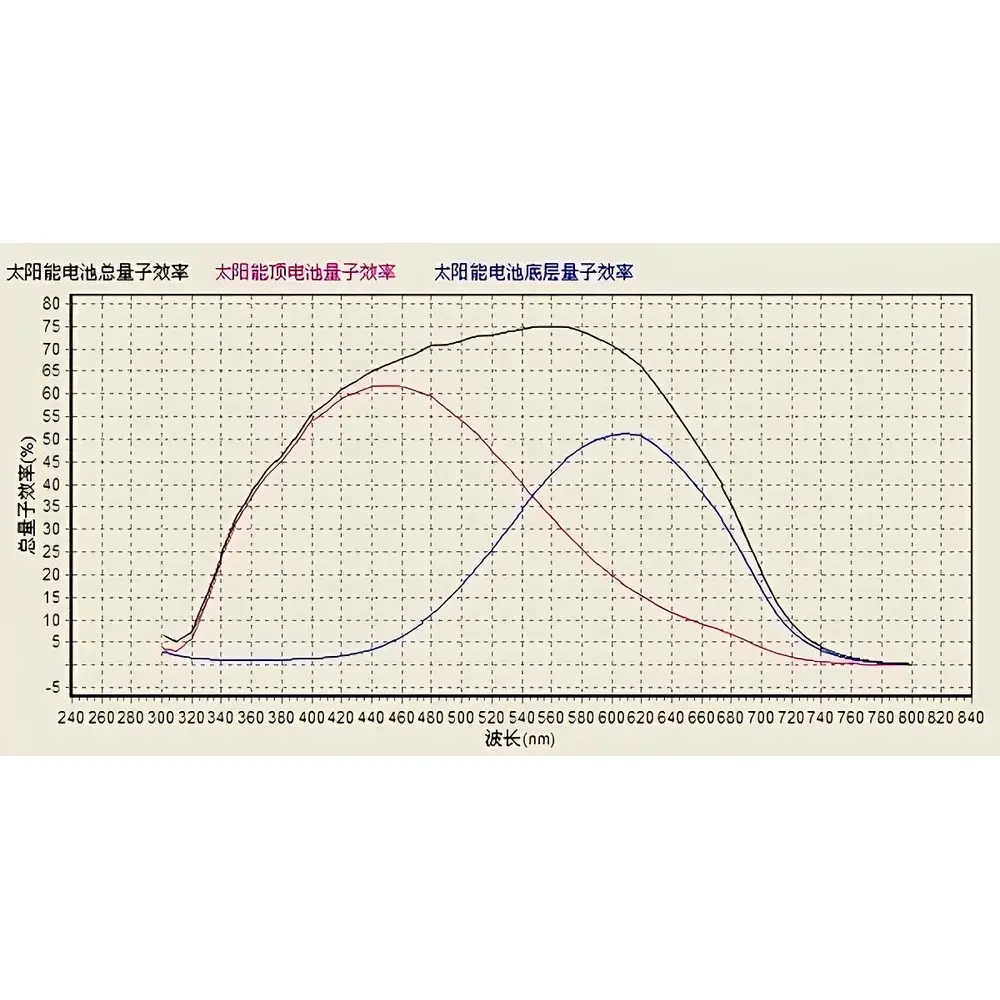
The system supports up to two independently controllable bias sources. For triple-junction devices (e.g., GaInP/GaAs/Ge), one bias channel can illuminate the top junction while the second activates the middle junction—leaving the bottom junction unbiased during its measurement—enabling sequential, artifact-free subcell isolation.
Can the system measure both external and internal quantum efficiency?
Yes. With optional reflectance accessory (integrating sphere + calibrated photodiode), the system calculates internal QE by normalizing measured photocurrent against absorbed photons, using simultaneous reflectance/transmittance spectra.
Is spectral calibration traceable to NIST standards?
All monochromator calibrations are performed using NIST-traceable Hg/Ar/Ne emission line sources, with certificate of calibration provided per installation. Wavelength accuracy is verified at ≥5 points across 200–1700 nm.
Does the software support automated compliance reporting for ISO/IEC 17025 labs?
While not certified, the software architecture supports required elements: user access levels, instrument usage logs, raw data immutability, and report templates aligned with ISO/IEC 17025 clause 7.7 (results reporting) and clause 8.9 (nonconforming work). Validation packages available upon request.
What maintenance is required for long-term wavelength accuracy?
Annual recalibration is recommended. The monochromator’s kinematic grating mount and thermally stabilized housing minimize drift; typical wavelength shift is <0.05 nm/year under controlled lab conditions (23 ±2 °C, <50% RH).





