
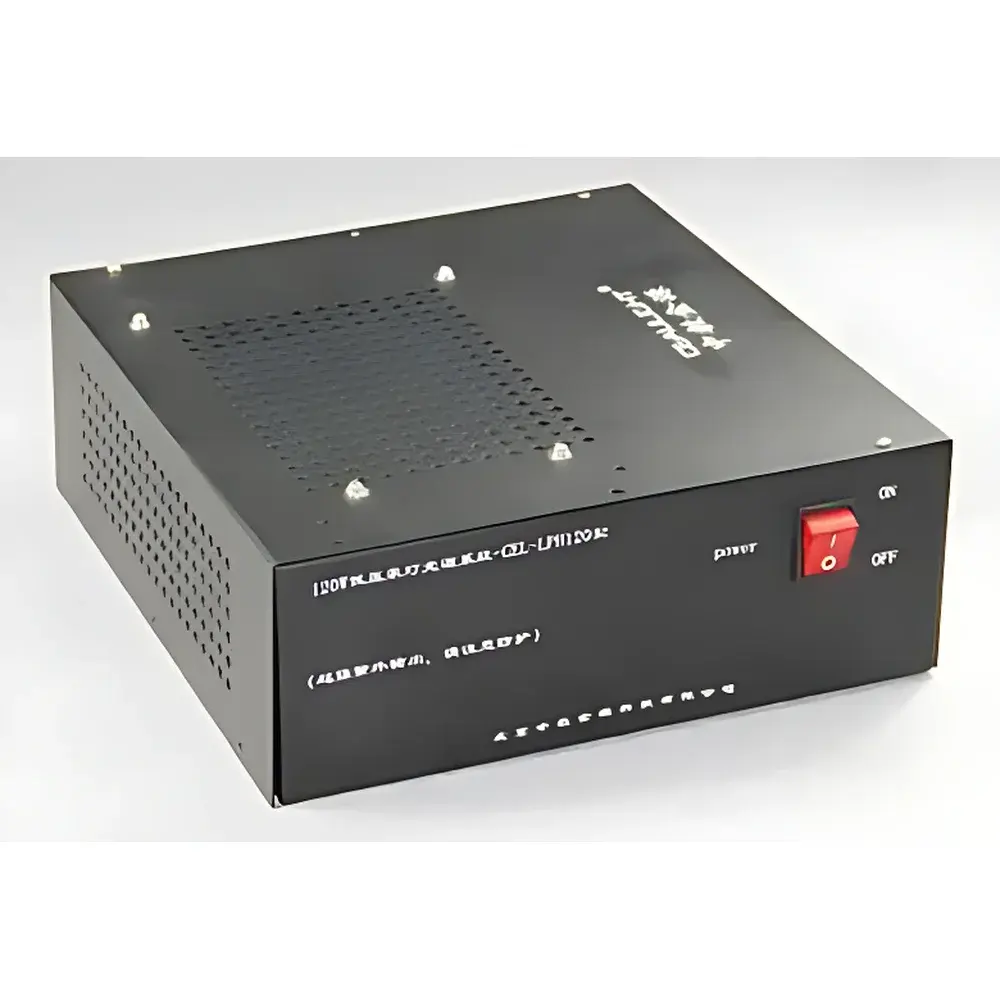
CEL-LPH120-185 / CEL-LPH120-254 Low-Pressure Mercury Lamp Light Source System
| Brand | CEL (China Education Goldsource) |
|---|---|
| Origin | Beijing, China |
| Manufacturer Type | Direct Manufacturer |
| Model Variants | CEL-LPH120-185, CEL-LPH120-254 |
| Light Source Type | Low-Pressure Mercury Lamp |
| Illumination Mode | External Irradiation |
| Output Wavelengths | 185 nm and 254 nm (selectable) |
| Rated Power | 120 W |
| Radiant Intensity | ≥50 mW/cm² (at 254 nm, measured at 10 cm distance) |
| Illuminated Area | 128 mm × 128 mm (uniform irradiance) |
| Lamp Geometry | Serpentine-shaped fused silica lamp tube |
| Lamp Lifetime | ≥5,000 hours |
| Operating Temperature | Up to 105 °C ambient |
| Lamp Current | 1200 mA |
| Envelope Material | Low-OH Synthetic Fused Silica |
| Dimensions (H×W×D) | 288 mm × 180 mm × 100 mm |
| Startup Method | Preheat ignition required |
| Compliance | Designed for laboratory-grade UV photolysis, photocatalysis, and sterilization applications under controlled environments |
Overview
The CEL-LPH120 series is a benchtop low-pressure mercury vapor lamp system engineered for stable, high-intensity ultraviolet (UV) irradiation in controlled optical and photochemical laboratories. Based on the well-established principle of mercury vapor discharge in low-pressure argon-mercury plasma, the system emits narrow-band spectral lines predominantly at 185 nm (vacuum UV, VUV) and 254 nm (germicidal UV-C), with minimal broadband background. Its serpentine-shaped low-hydroxyl synthetic fused silica lamp tube ensures optimal UV transmission—particularly critical for 185 nm output, which is strongly absorbed by atmospheric oxygen and standard quartz. The integrated design delivers spatially uniform irradiance across a 128 mm × 128 mm active area, supporting both top-down (transmissive) and lateral (side-irradiation) configurations. Unlike conventional linear or U-bend lamps, the CEL-LPH120’s mechanically stabilized serpentine geometry eliminates “necking” at bends—a common cause of localized irradiance drop—and maintains consistent photon flux density over extended operational lifetimes.
Key Features
- Two selectable emission variants: CEL-LPH120-185 (optimized for 185 nm VUV output) and CEL-LPH120-254 (optimized for 254 nm UV-C output), each with dedicated lamp tube specifications and filtering considerations
- 120 W nominal power, driven by constant-current electronic ballast ensuring ±1.5% current stability and minimizing spectral drift during thermal equilibration
- ≥50 mW/cm² radiant exitance at 254 nm (measured at 10 cm perpendicular distance, calibrated with NIST-traceable UV radiometer)
- Fused silica envelope with 85% transmittance at 185 nm and >92% at 254 nm
- Thermally robust construction: operates continuously at ambient temperatures up to 105 °C without degradation in output intensity or spectral profile
- Compact monolithic housing (288 × 180 × 100 mm) integrates lamp, ballast, cooling ducts, and electrical interfaces—no external driver cabinet required
- Preheat-start ignition protocol ensures reliable cold-start performance and extends electrode life beyond 5,000 hours
Sample Compatibility & Compliance
The CEL-LPH120 is designed for integration into photochemical reactors, UV curing stations, surface decontamination rigs, and catalyst evaluation platforms. Its external irradiation architecture allows direct coupling with quartz reaction vessels, flow cells, or custom sample holders. For 185 nm operation, use in nitrogen-purged or vacuum environments is mandatory due to O₂ absorption; 254 nm operation is compatible with ambient air. The system meets mechanical and electrical safety requirements per IEC 61010-1:2010 for laboratory equipment. While not certified for medical device use, its output stability and repeatability support GLP-compliant photocatalytic activity testing per ISO 22197-1 (photocatalytic air purification) and ASTM E2433 (UV disinfection validation). Lamp replacement follows standardized procedures documented in the user manual, with traceable lot numbers for quality control.
Software & Data Management
The CEL-LPH120 operates as a standalone hardware module with no embedded firmware or digital interface. All operational parameters—including lamp current, thermal status, and runtime—are monitored via analog indicators on the front panel. For automated experiments, users integrate the system into larger workflows using external programmable power supplies or PLC-controlled relays. Time-stamped irradiation logs can be generated via external UV radiometers (e.g., International Light ILT2400) connected to data acquisition systems compliant with FDA 21 CFR Part 11 when used in regulated GMP environments. Calibration certificates for optional radiometric sensors are provided with NIST-traceable uncertainty statements.
Applications
- Photocatalytic degradation studies (e.g., TiO₂-mediated mineralization of organic pollutants under UV-A/UV-C)
- UV-induced DNA crosslinking and microbial inactivation assays (E. coli, S. aureus, B. subtilis spores)
- Surface modification of polymers and thin films via VUV-assisted oxidation
- Calibration and verification of UV-sensitive detectors, dosimeters, and spectroradiometers
- Accelerated aging tests for UV-stable materials per ISO 4892-3 (fluorescent UV exposure)
- Photochemical synthesis requiring selective bond cleavage (e.g., C–Br, N–NO₂) under monochromatic UV excitation
FAQ
What safety precautions are required when operating the CEL-LPH120 at 185 nm?
Direct exposure to 185 nm radiation generates ozone from ambient oxygen; operation must occur in ventilated fume hoods or nitrogen-purged enclosures. Skin and eye protection rated for VUV (e.g., polycarbonate + MgF₂-coated goggles) is mandatory.
Can the CEL-LPH120 be used with optical filters to isolate specific emission lines?
Yes—standard interference filters (e.g., 254 ± 5 nm bandpass, OD6 blocking) can be mounted externally; however, filter selection must account for thermal load and UV-induced degradation of adhesives and substrates.
Is lamp alignment adjustable after installation?
No—the serpentine lamp is factory-aligned and rigidly fixed within the housing. Re-alignment requires disassembly and recalibration by authorized service personnel.
How is lamp lifetime defined and verified?
Lifetime is specified as time to 70% initial radiant output at 254 nm under continuous operation at rated current and temperature; validated via periodic radiometric measurement using traceable reference standards.
Does the system include electromagnetic compatibility (EMC) shielding?
Yes—the metal enclosure provides Class B EMC compliance per EN 55011; conducted and radiated emissions remain below limits for laboratory environments.




