
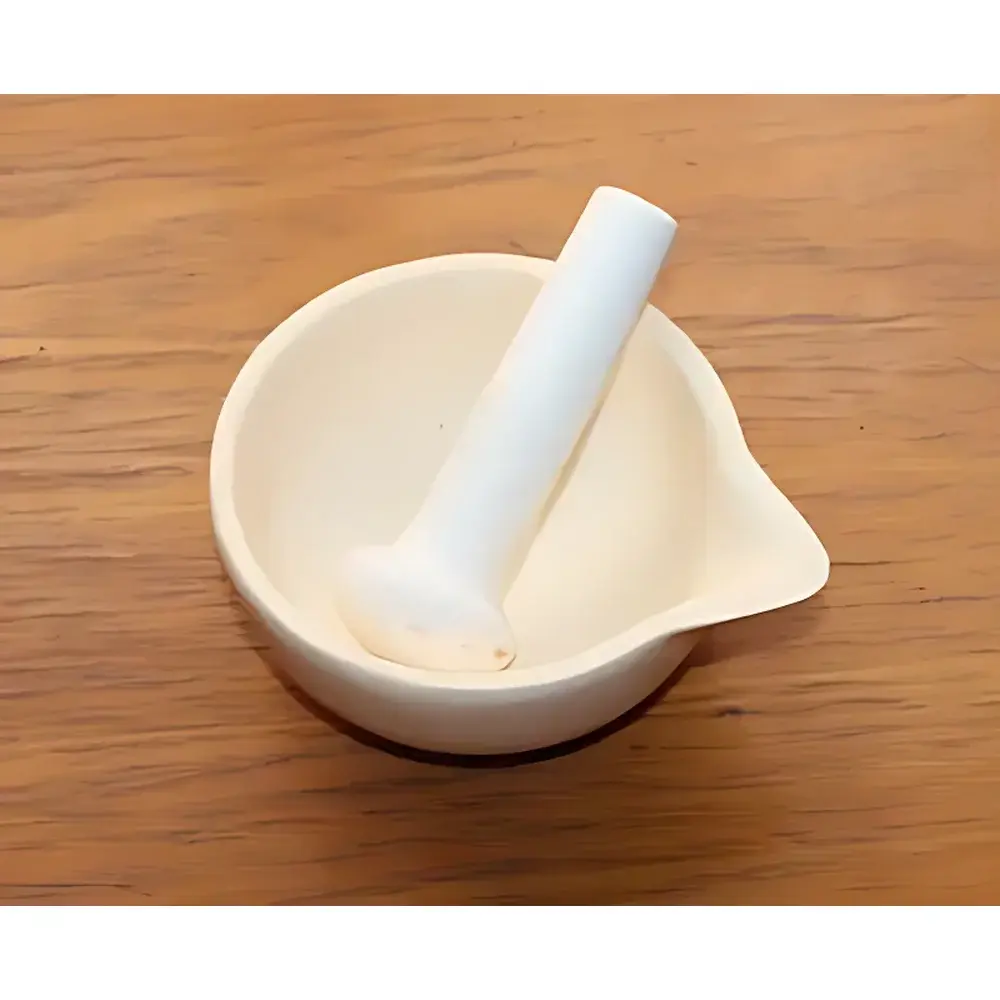
Alumina Mortar (99% Al₂O₃), Ceramic Grinding Mortar
| Brand | Zhongke Aobo |
|---|---|
| Origin | Beijing, China |
| Model | Φ12–300 mm |
| Material Composition | ≥99% Al₂O₃, ≤0.2% R₂O, ≤0.1% Fe₂O₃, ≤0.2% SiO₂ |
| Bulk Density | ≥3.80 g/cm³ |
| Apparent Porosity | <1% |
| Flexural Strength | >350 MPa |
| Compressive Strength | >12,000 MPa |
| Dielectric Constant (1 MHz) | ~9.8 |
| Hardness (HRA) | 88 |
| Max. Input Particle Size | 20 mm |
| Min. Output Particle Size | 0.5 mm |
| Batch Capacity | 100 mL |
| Sample Type | Hard, brittle, non-ferrous, high-purity materials |
| Compliance | Suitable for ISO/IEC 17025-accredited labs requiring inert, non-contaminating sample preparation |
Overview
The Alumina Mortar (99% Al₂O₃) is a high-performance ceramic grinding tool engineered for precision sample preparation in analytical, pharmaceutical, and materials science laboratories. Constructed from fully dense, sintered alpha-alumina (Al₂O₃ ≥99 wt%), this mortar operates on the principle of mechanical attrition—transferring controlled compressive and shear forces between the mortar bowl and pestle to fracture hard, brittle solids without introducing metallic or organic contamination. Its inert composition eliminates leaching of trace elements, making it indispensable for applications demanding ultra-high purity, such as reference material homogenization, catalyst precursor milling, and USP compliant pharmaceutical excipient processing.
Key Features
- Ultra-High Purity Matrix: Composed of ≥99% Al₂O₃ with strictly controlled impurities (Fe₂O₃ ≤0.1%, R₂O ≤0.2%, SiO₂ ≤0.2%), ensuring minimal background interference in elemental analysis (e.g., ICP-MS, XRF).
- Exceptional Mechanical Robustness: Exhibits flexural strength >350 MPa and compressive strength >12,000 MPa—among the highest for monolithic ceramics—enabling repeated use with abrasive samples including silicon carbide, fused quartz, and rare-earth oxides.
- Low Porosity & High Density: Apparent porosity <1% and bulk density ≥3.80 g/cm³ minimize liquid absorption and particle entrapment, supporting reproducible dry grinding and easy cleaning under GLP-compliant protocols.
- Chemical Inertness: Resistant to concentrated acids (HCl, HNO₃, HF-free media), alkalis (NaOH, KOH), and organic solvents at ambient temperature—validated per ASTM C20 and ISO 6474 standards for advanced ceramics.
- Dimensional Versatility: Available in standardized diameters (Φ100, Φ120, Φ150, Φ200, Φ250, and Φ300 mm), with custom non-standard geometries (e.g., tapered bowls, recessed bases) manufacturable upon technical specification submission.
Sample Compatibility & Compliance
This alumina mortar is validated for grinding hard, non-ductile materials with Mohs hardness up to 9, including but not limited to: fused silica, borosilicate glass frits, zirconia powders, lithium cobalt oxide (LiCoO₂), and pharmaceutical APIs (e.g., paracetamol, ibuprofen). It is unsuitable for ductile metals, polymers, or hygroscopic salts without cryogenic pre-treatment. The mortar complies with ISO 17025 clause 6.4.2 regarding equipment suitability for intended use and supports audit-ready documentation for GMP Annex 15 and FDA 21 CFR Part 211.111 requirements on sample integrity during batch release testing.
Software & Data Management
As a passive, manually operated tool, this alumina mortar does not incorporate embedded electronics or software interfaces. However, its dimensional consistency and material traceability (batch-specific CoA available upon request) enable integration into digital lab workflows via LIMS or ELN systems. Each unit is laser-engraved with a unique serial number linked to raw material certification (per ISO 10012), sintering log data, and post-sintering NDT inspection reports—facilitating full-chain traceability required under ISO/IEC 17025:2017 clause 7.7.
Applications
- Preparation of homogeneous sub-samples for X-ray diffraction (XRD) quantitative phase analysis (per ASTM E1421).
- Milling of high-purity ceramic precursors prior to sintering trials in materials development labs.
- Homogenization of geological reference materials (e.g., NIST SRM 278) for geochemical assay validation.
- Particle size reduction of brittle pharmaceutical intermediates prior to dissolution testing (USP ).
- Contamination-free grinding of battery cathode materials for SEM-EDS cross-validation studies.
FAQ
Can this mortar be used with a mechanical pestle driver?
Yes—when paired with low-RPM (<60 rpm), torque-limited motorized pestles, provided impact loading is avoided. Continuous high-force percussion may induce microcracking; manual operation is recommended for optimal longevity.
Is cleaning validation data available?
Certificate of Cleaning Validation (per ASTM E3097) can be supplied for specific solvent protocols (e.g., acetone → isopropanol → deionized water) upon formal request and purchase of ≥5 units.
Does the mortar meet USP requirements for pharmaceutical grinding tools?
It satisfies USP criteria for “non-reactive, non-shedding surfaces” and is routinely deployed in facilities maintaining USP method validation records for solid dosage form development.
What is the expected service life under routine lab use?
With proper handling (no thermal shock, no metal-on-ceramic impact), typical service life exceeds 5 years in QC labs performing ≤20 grinding cycles/day—verified by annual visual inspection per ISO 13356 Annex B.



