
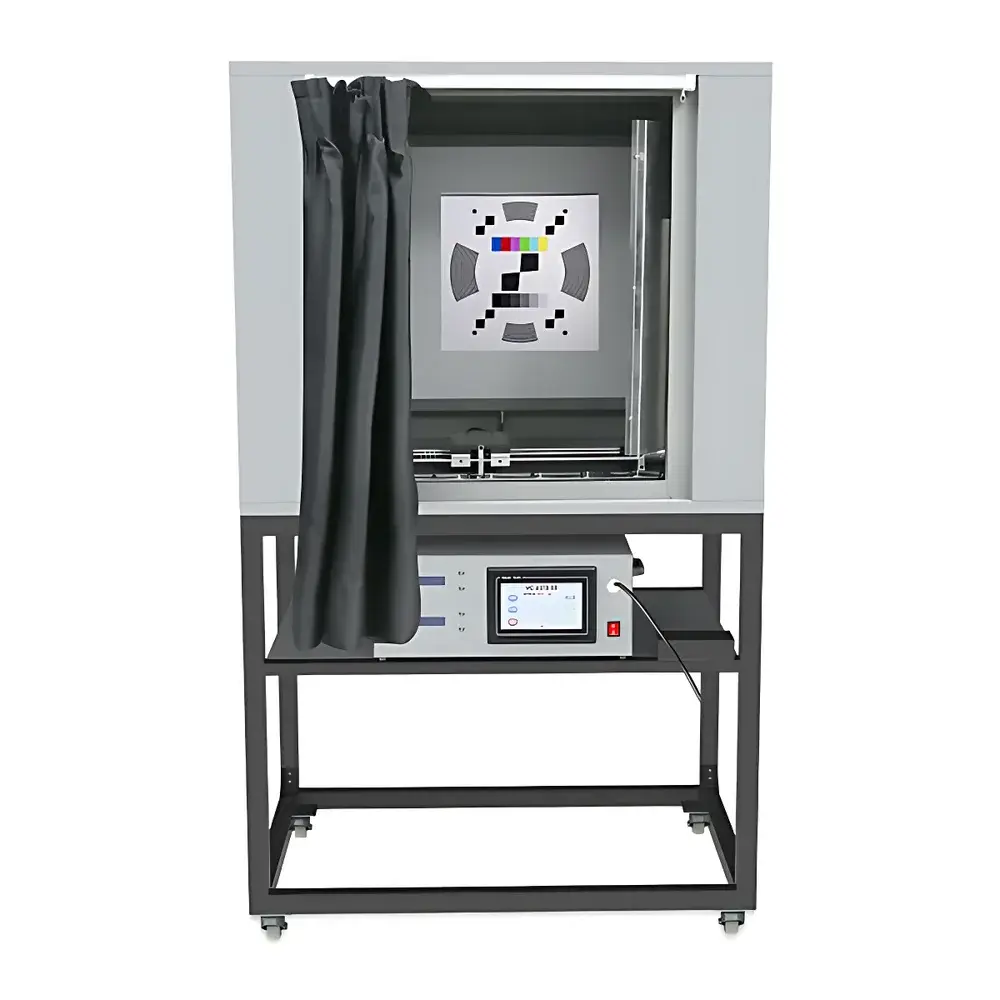
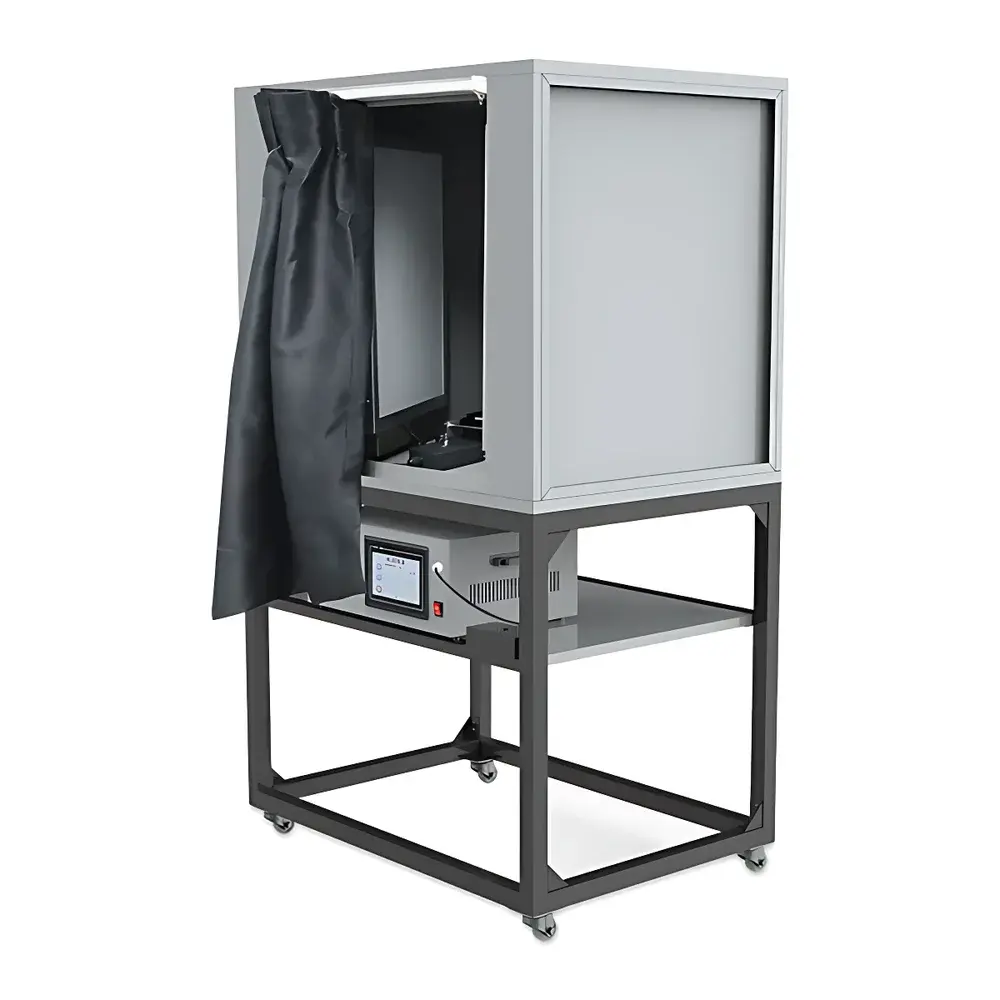
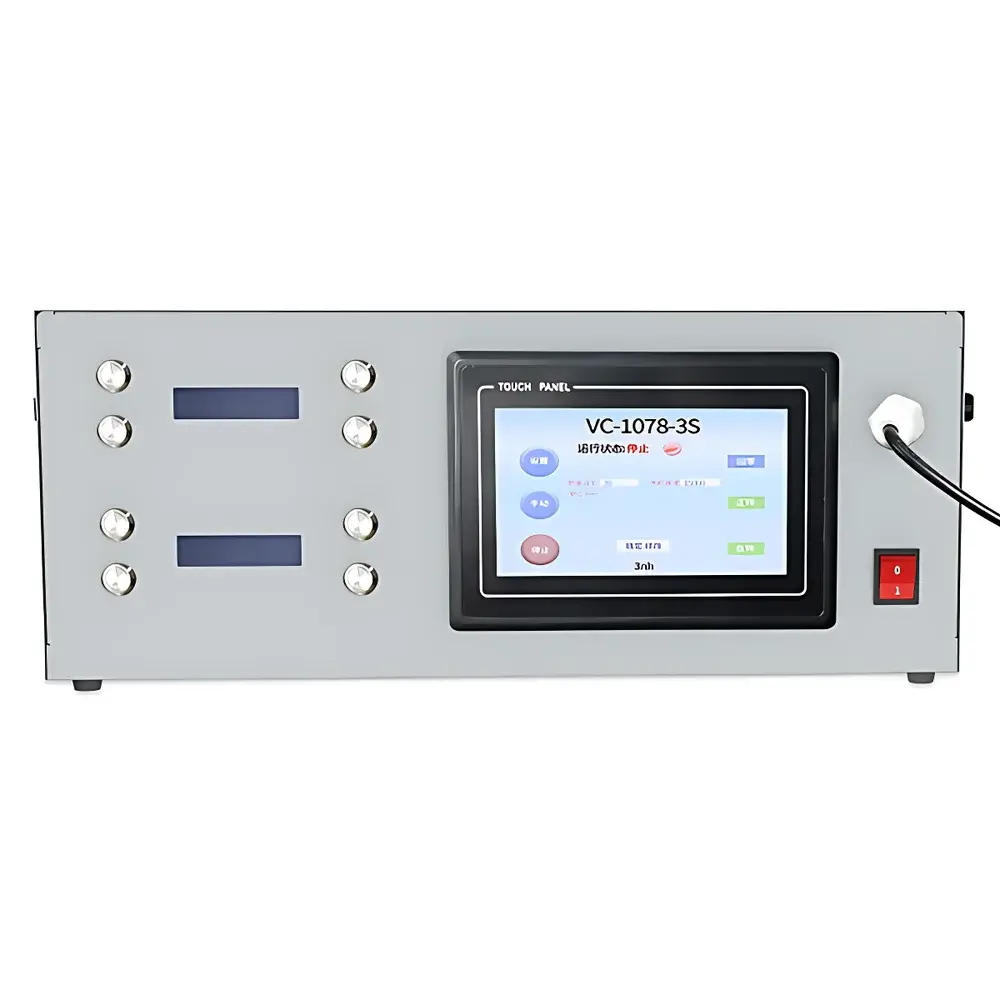
3nh VC-1078-3S Camera Test Illumination & Color Matching Light Cabinet
| Brand | 3nh |
|---|---|
| Origin | Guangdong, China |
| Manufacturer Type | Manufacturer |
| Product Type | Domestic |
| Model | VC-1078-3S |
| Price | ¥28,800 |
| Color Temperature | 6500K ±300K |
| Front Illuminance | ≥100,000 lx |
| Side Illuminance | ≥10,000 lx |
| Frequency Adjustment Range | 1–15 kHz |
| Uniformity | ≥90% |
| LED Lifetime | ≥10,000 h |
| Dimensions (L×W×H) | 1008×715×1650 mm |
| Internal Chamber (L×W×H) | 964×670×800 mm |
| Viewing Window | 650×730 mm |
| Control Box | 503×352×201 mm |
| Operating Environment | 0–40°C, ≤85% RH (non-condensing) |
| Input Voltage | AC 210–240 V, 50/60 Hz |
| Max Power Consumption | 1050 W |
| Net Weight | 120 kg |
Overview
The 3nh VC-1078-3S Camera Test Illumination & Color Matching Light Cabinet is a purpose-built optical evaluation system engineered for rigorous validation and calibration of imaging sensors, mobile phone cameras, automotive ADAS modules, and industrial machine vision systems. Unlike general-purpose light booths, the VC-1078-3S integrates precision photometric control with dynamic mechanical positioning—enabling standardized, repeatable illumination conditions essential for objective camera performance benchmarking. Its core architecture relies on high-CRI (≥95), flicker-free, thermally stabilized LED arrays operating at a tightly controlled correlated color temperature (CCT) of 6500K ±300K—aligned with ISO 13655:2017 (M1 measurement condition) and CIE Standard Illuminant D65 spectral distribution. The cabinet’s optical design ensures uniform irradiance across the test field via optimized reflector geometry and diffuser layering, supporting both spectral radiance consistency and spatial homogeneity required for ISO 17321-1:2019-compliant color fidelity assessment.
Key Features
- Stabilized D65-equivalent illumination: 6500K ±300K CCT with CRI ≥95, maintained via active thermal regulation and constant-current LED drivers.
- Adjustable photometric output: Front-facing illuminance ≥100,000 lx; side-mounted auxiliary sources ≥10,000 lx—both independently controllable in intensity and modulation frequency (1–15 kHz).
- Motorized precision translation stage: Integrated high-resolution linear actuator enables programmable X-axis movement of camera mounting platform (travel range: 0–300 mm; speed: 0.1–50 mm/s; repeatability: ±0.02 mm).
- Optical uniformity ≥90% across full viewing window (650 × 730 mm), verified per ASTM E308-22 Annex A3 methodology using calibrated spectroradiometer scans.
- Long-life LED modules rated for ≥10,000 hours at L70 (lumen maintenance), with thermal derating logic to sustain chromatic stability under continuous operation.
- Rugged steel-framed enclosure with matte-white PTFE-coated interior surfaces (reflectance >98% at 400–700 nm) minimizing stray light and spectral contamination.
Sample Compatibility & Compliance
The VC-1078-3S accommodates camera modules up to 250 mm in diagonal dimension and supports standard M4/M6 mounting interfaces. Its internal chamber (964 × 670 × 800 mm) allows integration with tripod adapters, gimbal rigs, and automated focus-stacking stages. The system complies with foundational requirements of IEC 62676-5 (video surveillance equipment testing), ISO/IEC 17025:2017 (for accredited lab use when paired with traceable photometric instrumentation), and GB/T 3978–2008 (Chinese national standard for standard illuminants). While not certified to FDA 21 CFR Part 11, its hardware-based control architecture—without cloud connectivity or user-modifiable firmware—facilitates audit-ready operation in regulated R&D environments requiring deterministic behavior and change-controlled configurations.
Software & Data Management
The VC-1078-3S operates via an embedded ARM-based controller with tactile membrane keypad and OLED status display. All illumination parameters (intensity, frequency, ramp profiles) and motor position commands are set locally—no external PC dependency. Optional RS-485 interface enables integration into factory automation systems (e.g., PLC-triggered test sequences) and supports Modbus RTU protocol for centralized monitoring. Firmware updates are performed via USB port using signed binary packages; version history and calibration timestamps are stored in non-volatile memory. Audit trails—including power-on cycles, LED runtime hours, and motor actuation logs—are retained for ≥12 months and exportable as CSV for GLP/GMP documentation.
Applications
- Mobile device OEMs performing ISP (Image Signal Processor) tuning under standardized lighting.
- Automotive Tier-1 suppliers validating low-light SNR and auto-exposure convergence of surround-view and driver-monitoring cameras.
- Industrial vision integrators certifying lens distortion correction and white balance stability across batch production.
- Academic labs conducting perceptual image quality studies requiring controlled, spectrally defined stimulus fields.
- Quality assurance departments executing incoming inspection of CMOS sensor modules against luminance uniformity and chromaticity shift specifications.
FAQ
What standards does the VC-1078-3S align with for camera testing?
It conforms to the photometric and geometric requirements of ISO 17321-1:2019 (color rendering evaluation), ISO 13655:2017 (spectral measurement conditions), and IEC 62676-5 (surveillance camera test protocols), with D65 spectral match validated per CIE Publication 15:2018.
Can the motorized platform be synchronized with external trigger signals?
Yes—the RS-485 interface supports hardware-triggered motion start/stop and position reporting via Modbus function codes 03/06, enabling tight synchronization with frame capture events from external vision systems.
Is spectral data provided for the LED sources?
Each unit ships with a factory-measured relative spectral power distribution (SPD) report, traceable to NIM (National Institute of Metrology, China) via calibrated spectroradiometer (Instrument Systems CAS 140D), covering 380–780 nm at 1 nm resolution.
What maintenance intervals are recommended for optical calibration?
Annual verification of illuminance uniformity and CCT drift is advised using a NIST-traceable handheld spectroradiometer; no user-serviceable recalibration is required—the LED driver maintains factory-set current profiles throughout service life.
Does the system support multiple simultaneous illumination modes (e.g., D50 + UV)?
No—the VC-1078-3S is configured exclusively for D65-spectrum operation; multi-illuminant capability requires the VC-1078-5S variant with five independently addressable LED channels.





