
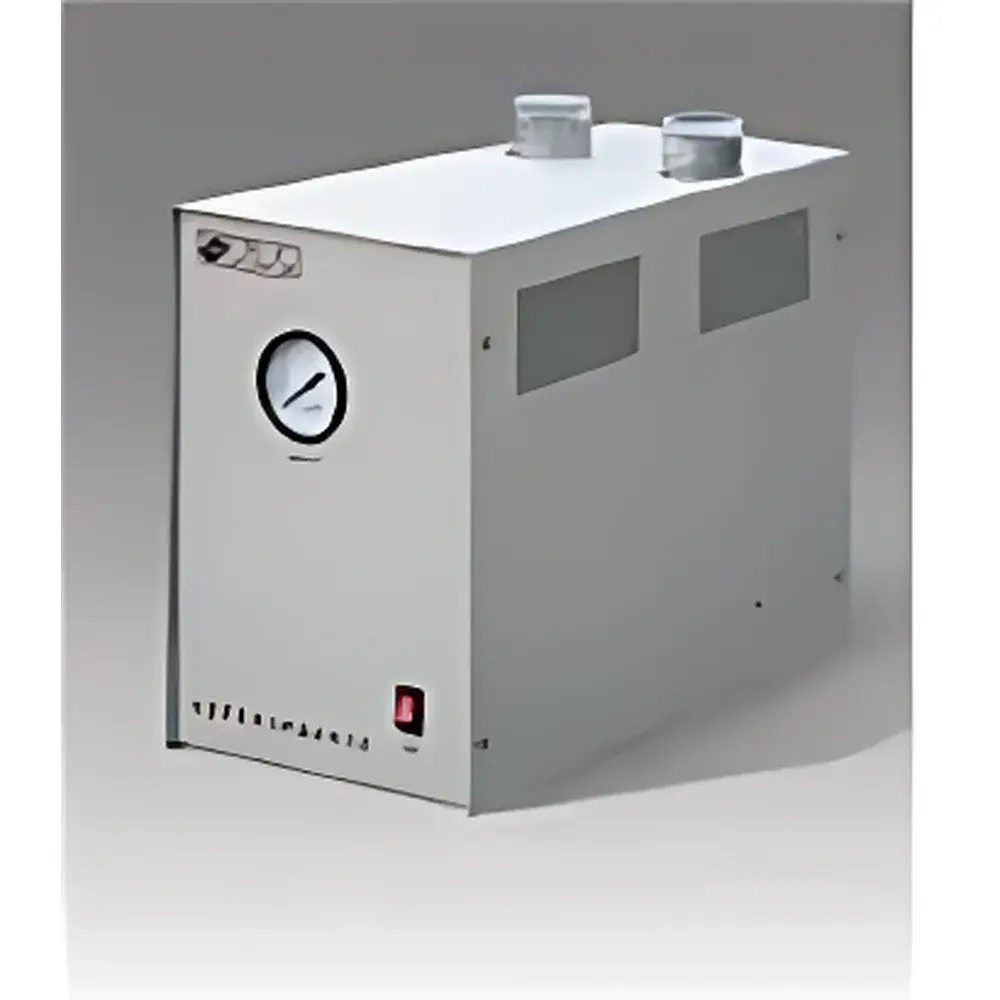
SPB-3S Fully Automatic Air Generator
| Output Flow | 0–2000 mL/min @ 0.4 MPa |
|---|---|
| Output Pressure | 0–0.4 MPa |
| Pressure Stability | < 0.003 MPa |
| Noise Level | < 35 dB(A) |
| Power Consumption | 175 W |
| Input Voltage | 220 V ±10% |
| Dimensions (W×D×H) | 400 × 180 × 250 mm |
| Net Weight | ~15 kg |
| Operating Environment | 0–45 °C, RH ≤85% (non-condensing, dust-free, non-corrosive atmosphere) |
| Compliance | Designed for GLP-compliant laboratory environments |
Overview
The SPB-3S Fully Automatic Air Generator is an engineered solution for laboratories requiring continuous, high-purity, low-noise compressed air supply—specifically optimized for gas chromatography (GC), GC–MS, nitrogen–phosphorus detectors (NPD), flame photometric detectors (FPD), and other pneumatic-driven analytical instruments. Unlike conventional compressors or cylinder-based systems, the SPB-3S employs a dual-stage oil-free piston compression architecture coupled with integrated pressure regulation, automated moisture management, and sulfur-free gas conditioning. Its core function is to generate clean, dry, particle-free air meeting ISO 8573-1 Class 2 specifications (maximum 0.1 µm particles, dew point ≤ −40 °C, oil content ≤ 0.01 mg/m³) without external drying or filtration accessories. The system operates on a closed-loop pressure feedback control principle, maintaining stable output across variable demand conditions typical in multi-instrument lab networks.
Key Features
- Dual independent pressure stabilization circuitry ensures flow consistency under dynamic load changes—critical for retention time reproducibility in GC applications.
- Intelligent electromagnetic valve sequencing enables fully automated condensate drainage without mechanical solenoid chatter, eliminating the 45–60 Hz tonal noise common in legacy air generators.
- Self-regulating water removal cycle activates based on real-time humidity sensor input and runtime algorithms—no manual intervention or scheduled maintenance required.
- Low-sulfur silicone O-rings and stainless-steel wetted-path components (dual 5-µm sintered stainless filters + reinforced 0.6 MPa-rated storage tank) prevent trace sulfur contamination that compromises detector baseline stability and column longevity.
- Compact footprint (400 × 180 × 250 mm) and lightweight design (~15 kg) facilitate benchtop integration in space-constrained analytical labs or mobile testing units.
- Thermal management system maintains internal temperature within safe operational limits across ambient ranges of 0–45 °C, ensuring consistent performance in non-climate-controlled environments.
Sample Compatibility & Compliance
The SPB-3S delivers instrument-grade air suitable for all major GC detector types—including FID, TCD, ECD, NPD, and FPD—where stable combustion air or makeup gas is essential. Its output meets the air purity prerequisites defined in ASTM D4057 (standard practice for manual sampling of petroleum and petroleum products) and USP for residual solvent analysis. While not certified to ISO/IEC 17025, the unit’s pressure stability (< ±0.003 MPa), low particulate emission, and absence of hydrocarbon/oil carryover support adherence to GLP and GMP documentation standards when paired with routine logbook entries and preventive maintenance records. It complies with IEC 61000-3-2 harmonic current emission limits and EN 61326-1 for electromagnetic compatibility in laboratory settings.
Software & Data Management
The SPB-3S operates as a standalone hardware platform with no embedded firmware or digital interface. All operational parameters—including pressure setpoint, runtime hours, and automatic drain event timestamps—are monitored via analog gauges and status LEDs. For laboratories implementing electronic lab notebooks (ELN) or LIMS integration, optional external pressure transducers (0–0.6 MPa, 4–20 mA output) can be installed upstream to feed real-time air supply metrics into centralized data acquisition systems. Audit trails for maintenance activities must be manually documented per institutional SOPs; the device does not support FDA 21 CFR Part 11-compliant electronic signatures or automated event logging.
Applications
- Primary air source for flame ionization detectors (FID) in environmental, petrochemical, and pharmaceutical QC labs.
- Makeup gas supply for electron capture detectors (ECD) where oxygen and moisture content directly affect sensitivity and noise floor.
- Carrier gas auxiliary in GC–MS systems requiring ultra-low sulfur background to prevent filament oxidation and spectral interference.
- Pressurized purge gas for autosampler vial septa and inlet liners in high-throughput screening workflows.
- Lab-wide centralized air distribution node when cascaded with pressure-reducing manifolds and point-of-use filters.
FAQ
What is the maximum continuous duty cycle for the SPB-3S?
The unit is rated for uninterrupted operation at full load (2000 mL/min, 0.4 MPa) for up to 16 hours per day, provided ambient temperature remains below 35 °C and relative humidity stays below 70%.
Does the SPB-3S require periodic filter replacement?
Yes—the dual stainless-steel sintered filters should be inspected every 6 months and ultrasonically cleaned or replaced if pressure drop exceeds 0.02 MPa across the assembly.
Can this generator be used with helium or nitrogen-based GC systems?
No. The SPB-3S produces compressed ambient air only and is not designed for inert gas generation or blending. It serves exclusively as an air supply—not a gas separator or synthesizer.
Is the output air suitable for FTIR or laser spectroscopy applications?
Not without additional purification. While meeting GC-grade specifications, it lacks the sub-ppb hydrocarbon removal needed for mid-IR optical path integrity; supplemental hydrocarbon traps are recommended.
How is calibration verified for pressure and flow accuracy?
Factory calibration is performed using NIST-traceable deadweight testers and laminar flow elements. End users should verify pressure stability annually with a calibrated digital manometer and flow with a primary-standard bubble meter or thermal mass flowmeter.



