
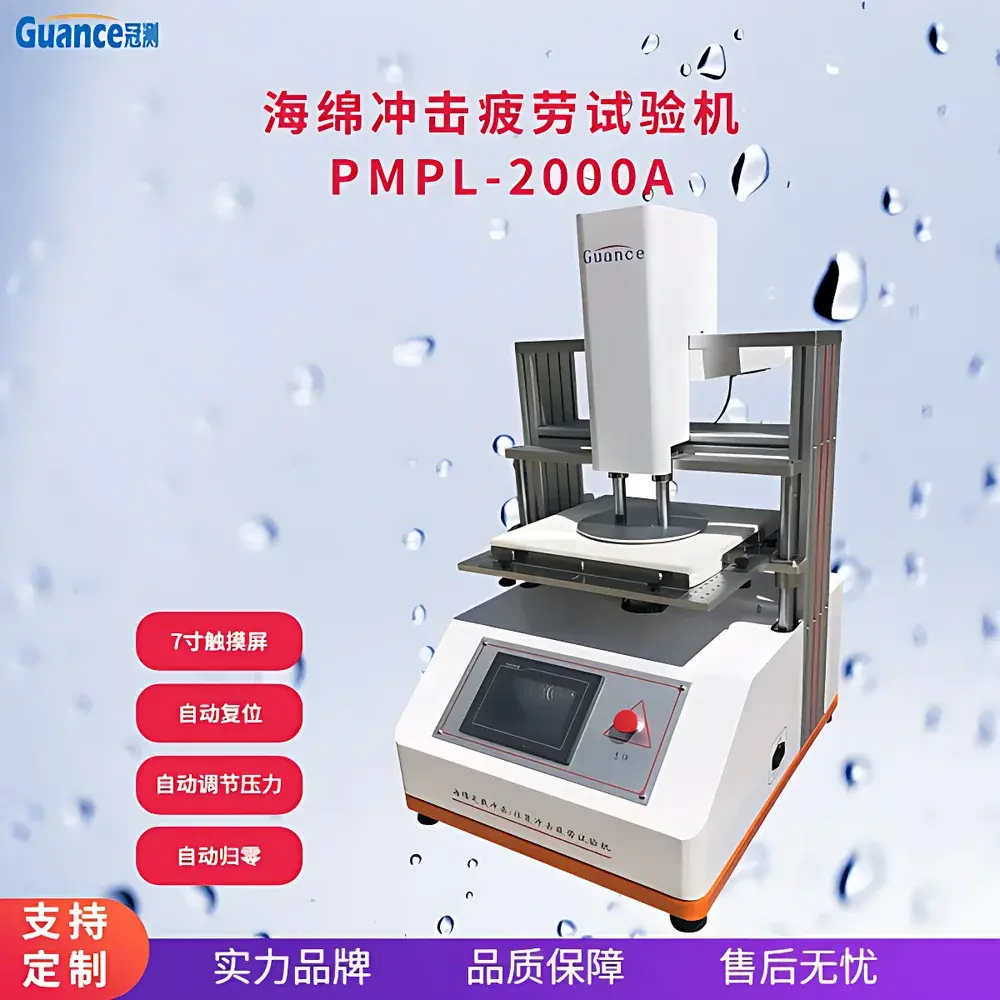
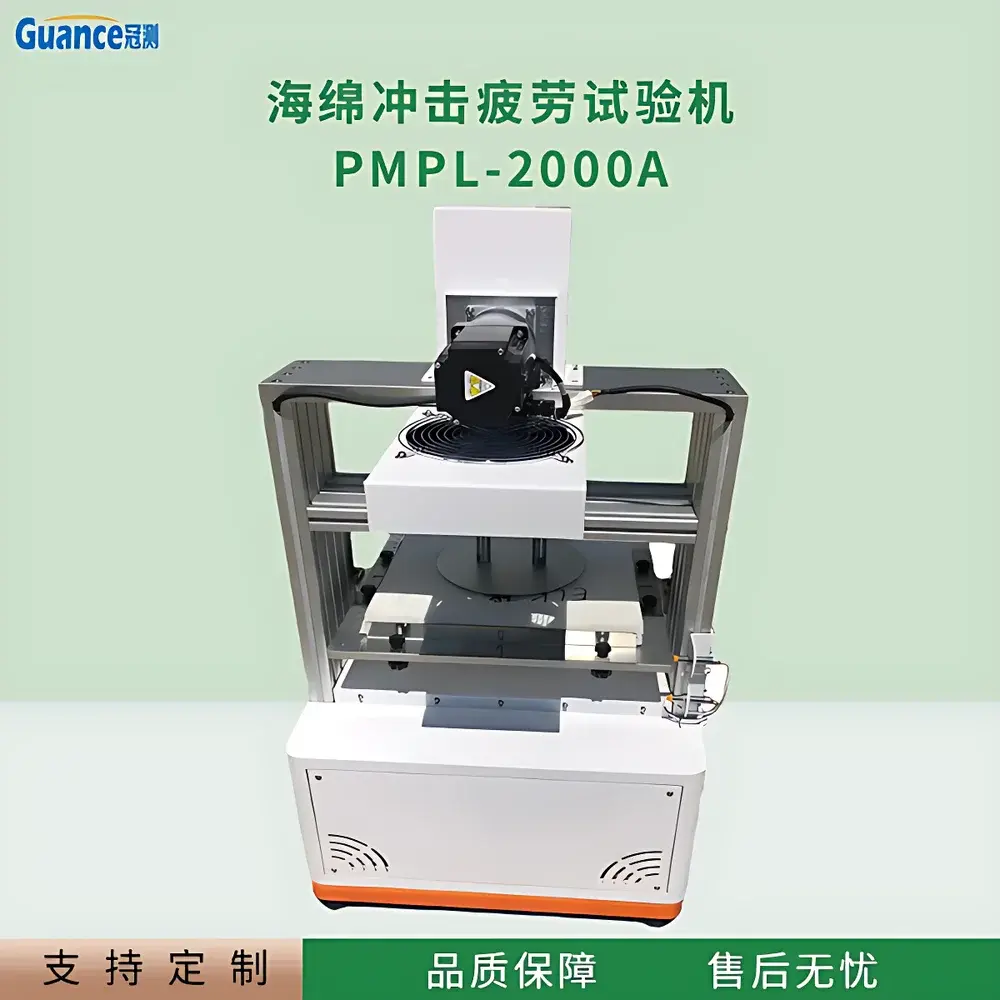
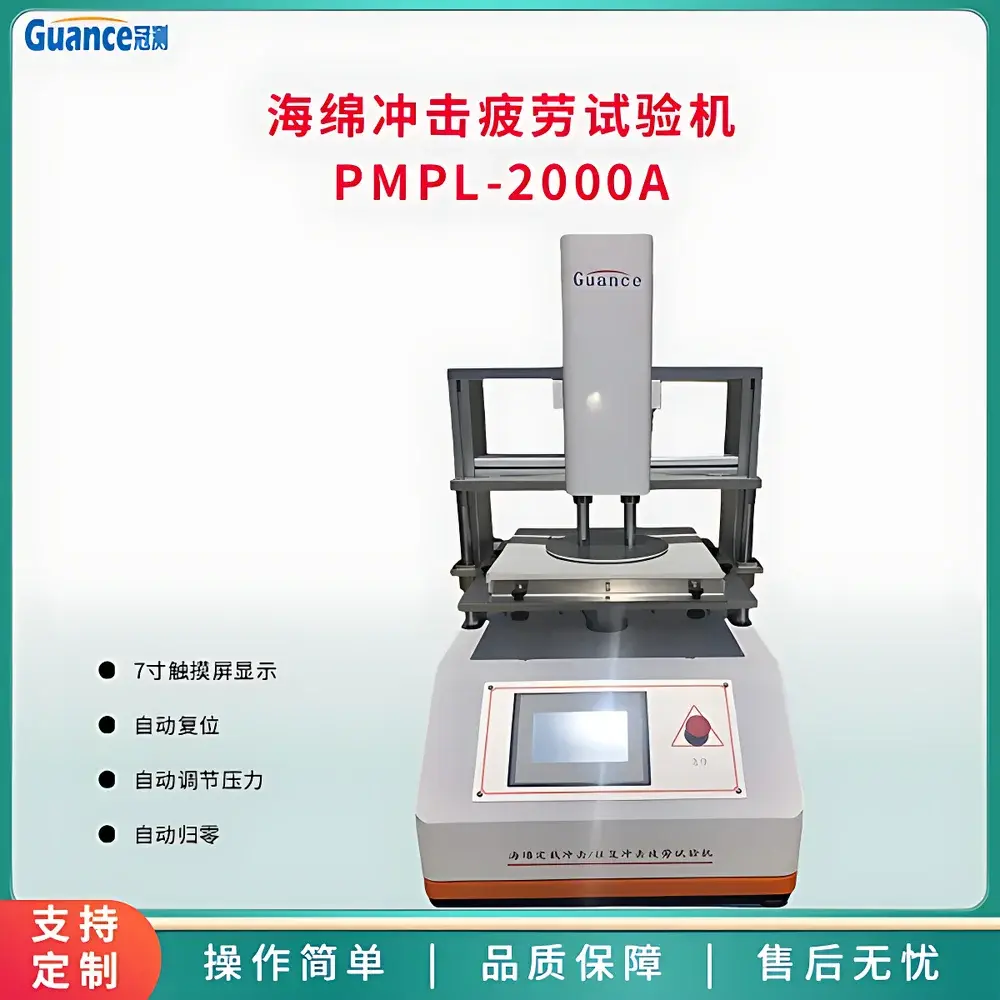
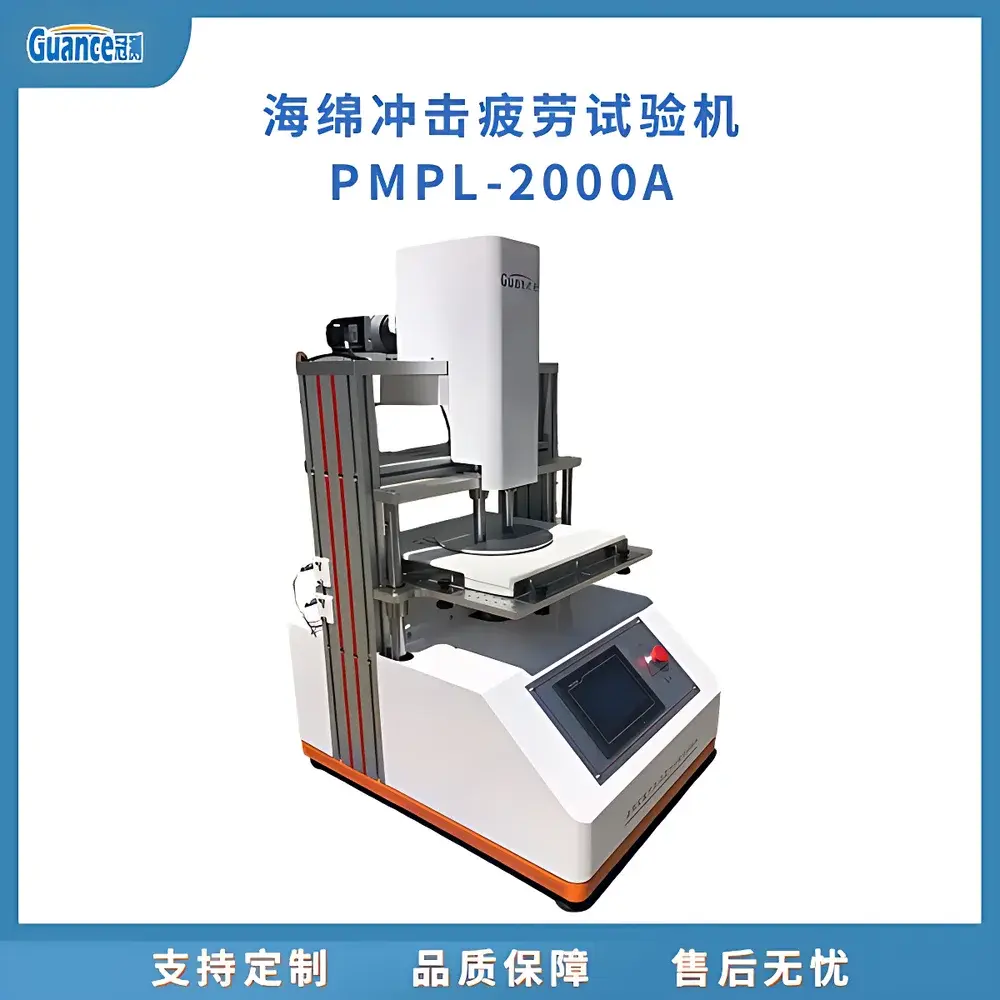
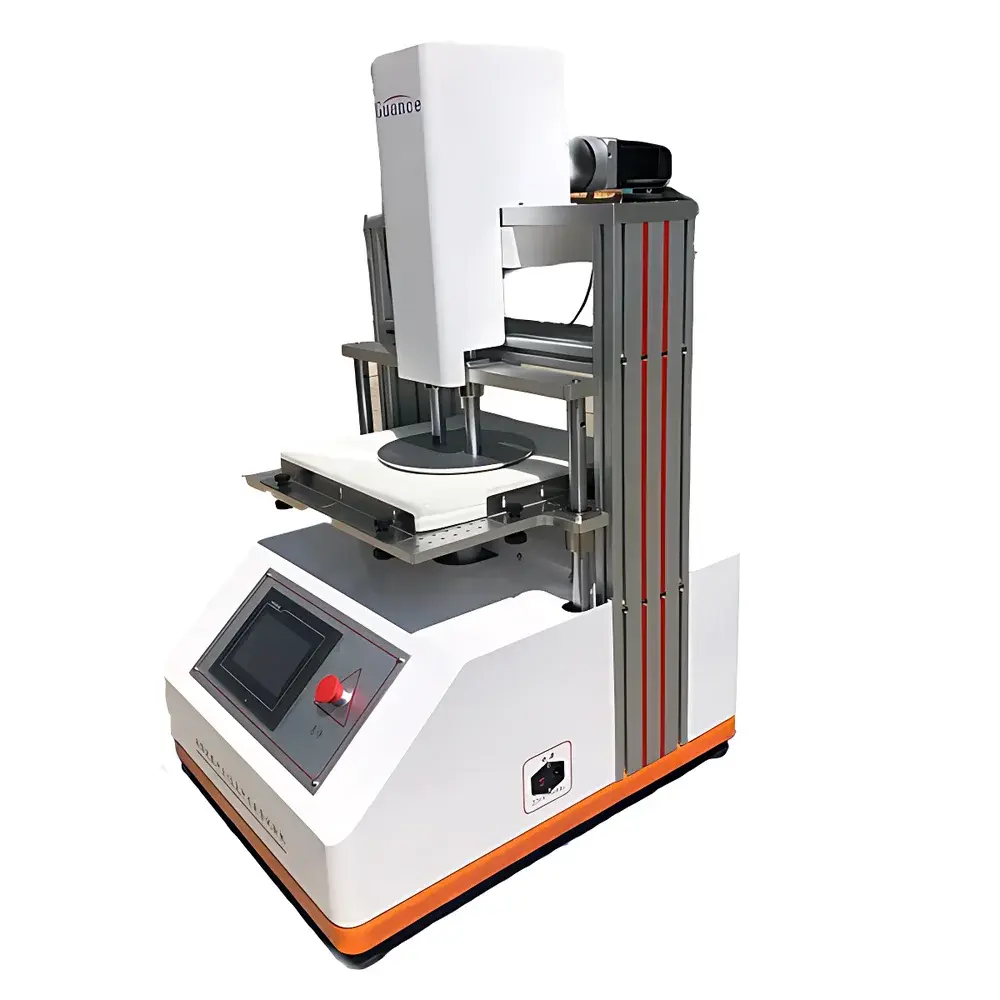
GuanCe Instruments PMPL2000A2 Constant-Load Impact Fatigue Tester for Flexible Polymeric Foams
| Brand | GuanCe Instruments |
|---|---|
| Origin | Beijing, China |
| Manufacturer Type | Authorized Distributor |
| Country of Origin | China |
| Model | PMPL2000A2 |
| Price Range | USD 1,400 – 7,000 |
| Instrument Category | Specialized Fatigue Testing Machine |
| Maximum Test Force | 0–2000 N |
| Frequency Range | 0–100 cycles/min (Standard Compliance: 70 ± 5 cycles/min) |
| Unit Weight | 100 kg |
Overview
The GuanCe Instruments PMPL2000A2 Constant-Load Impact Fatigue Tester is an electromechanical testing system engineered for the standardized evaluation of dynamic mechanical degradation in flexible polymeric foams under repeated compressive loading. It operates on the principle of controlled, cyclic impact compression—applying a user-defined constant load to a foam specimen while maintaining precise displacement tracking and real-time force feedback. Designed in strict accordance with international test standards—including ISO 3385, GB/T 18941, QB/T 2819–2006, QC/T 56–93, and JASO B408–84—the instrument quantifies two primary fatigue indicators: permanent thickness loss (residual deformation) and reduction in indentation hardness after defined cycle counts. Its closed-loop servo-motor-driven actuation system, integrated with Siemens S7-1200 PLC control logic and a 7-inch industrial touchscreen HMI, ensures high reproducibility across long-duration tests (>100,000 cycles), making it suitable for R&D laboratories, quality assurance departments, and automotive component validation facilities.
Key Features
- Constant-load mode with automatic height compensation: The test platform dynamically adjusts vertical position in real time to maintain setpoint load tolerance—even as specimen creep or compression-set evolves during extended cycling.
- Dual test modes: Supports both constant-force (load-controlled) and constant-thickness-reduction (displacement-controlled) protocols per user specification.
- Precision actuation: High-resolution servo motor drive delivers stable frequency output from 10 to 100 cycles/min, calibrated to meet the standard requirement of 70 ± 5 cycles/min.
- Robust mechanical architecture: 250 mm diameter loading platen (±1 mm tolerance, R25 mm edge radius) and 500 × 500 mm perforated support table (6.35 mm holes on 20 mm centers) ensure uniform stress distribution and airflow management during testing.
- Real-time data acquisition: Peak force values are continuously displayed and logged; end-of-test conditions trigger audible alarm and automatic return-to-zero positioning of the loading assembly.
- Compliance-ready interface: All parameter inputs, test logs, and event timestamps are traceable via the embedded HMI—supporting internal GLP documentation practices and audit-readiness for ISO/IEC 17025-accredited labs.
Sample Compatibility & Compliance
The PMPL2000A2 accommodates standard foam specimens measuring 500 mm × 500 mm × (50 ± 2) mm, conforming to dimensional requirements specified in ISO 3385 and QC/T 56–93. Its modular sample retention design prevents lateral drift during prolonged cycling, ensuring consistent loading geometry throughout test duration. The system is validated for use with open-cell polyurethane, viscoelastic memory foams, latex blends, and other resilient elastomeric materials commonly employed in seating systems, mattress cores, and automotive interior components. Regulatory alignment includes full technical compliance with ISO 3385:2014 (determination of fatigue by constant-load impact method), GB/T 18941–2003 (Chinese national adoption of ISO 3385), and JASO B408–84 (Japanese automotive industry standard for seat cushion durability). While not FDA-regulated, its data structure supports integration into GMP-aligned quality records when paired with external LIMS or ELN platforms.
Software & Data Management
The embedded Siemens-based control firmware provides local configuration, execution, and monitoring without requiring external PCs. All test parameters—including target load (N), cycle count, frequency (cpm), and termination criteria—are configured via the 7-inch capacitive touchscreen interface. Force readings are sampled at ≥100 Hz and displayed as real-time peak values. Upon test completion, the system generates a summary report containing total cycles executed, final thickness measurement (if externally measured), peak load deviation history, and timestamped event log (e.g., “Load maintenance activated at Cycle #24,891”). Export functionality is limited to USB-stick-based CSV dump of raw time-series force and cycle counter data—intended for post-processing in MATLAB, Python, or Excel. No cloud connectivity or remote access is implemented; all data remains locally stored and compliant with on-premise IT security policies typical in regulated manufacturing environments.
Applications
- Automotive seating development: Validation of long-term resilience in OEM seat cushions per QC/T 56–93 and JASO B408–84.
- Furniture foam qualification: Comparative fatigue resistance assessment across PU, HR, and gel-infused formulations per ISO 3385.
- Medical support surface testing: Evaluation of pressure-relief mattress performance under simulated patient weight cycling.
- Material formulation screening: Correlation of polymer crosslink density, filler content, and blowing agent selection with dynamic compression-set behavior.
- Quality control in foam production lines: Batch-to-batch consistency verification using fixed-cycle pass/fail thresholds.
FAQ
What standards does the PMPL2000A2 directly support?
ISO 3385:2014, GB/T 18941–2003, QB/T 2819–2006, QC/T 56–93, and JASO B408–84.
Can the system operate unattended for >100,000 cycles?
Yes—mechanical design and thermal management enable continuous operation up to 200,000 cycles without intervention, provided ambient temperature remains within 15–30 °C and relative humidity stays below 80% RH.
Is force calibration traceable to national standards?
The load cell is factory-calibrated with certificate of conformity; users must perform periodic verification using certified dead-weight standards per ISO 7500-1 Class 1 requirements.
Does the instrument support ASTM D3574 or similar U.S. standards?
While not pre-configured for ASTM D3574 Annex A5 (fatigue by constant deflection), the dual-mode control allows manual adaptation to equivalent test protocols with appropriate setup validation.
What maintenance intervals are recommended?
Lubrication of linear guide rails every 6 months; inspection of platen surface flatness and support table hole integrity annually; verification of servo motor encoder resolution biannually.
Related Products



