
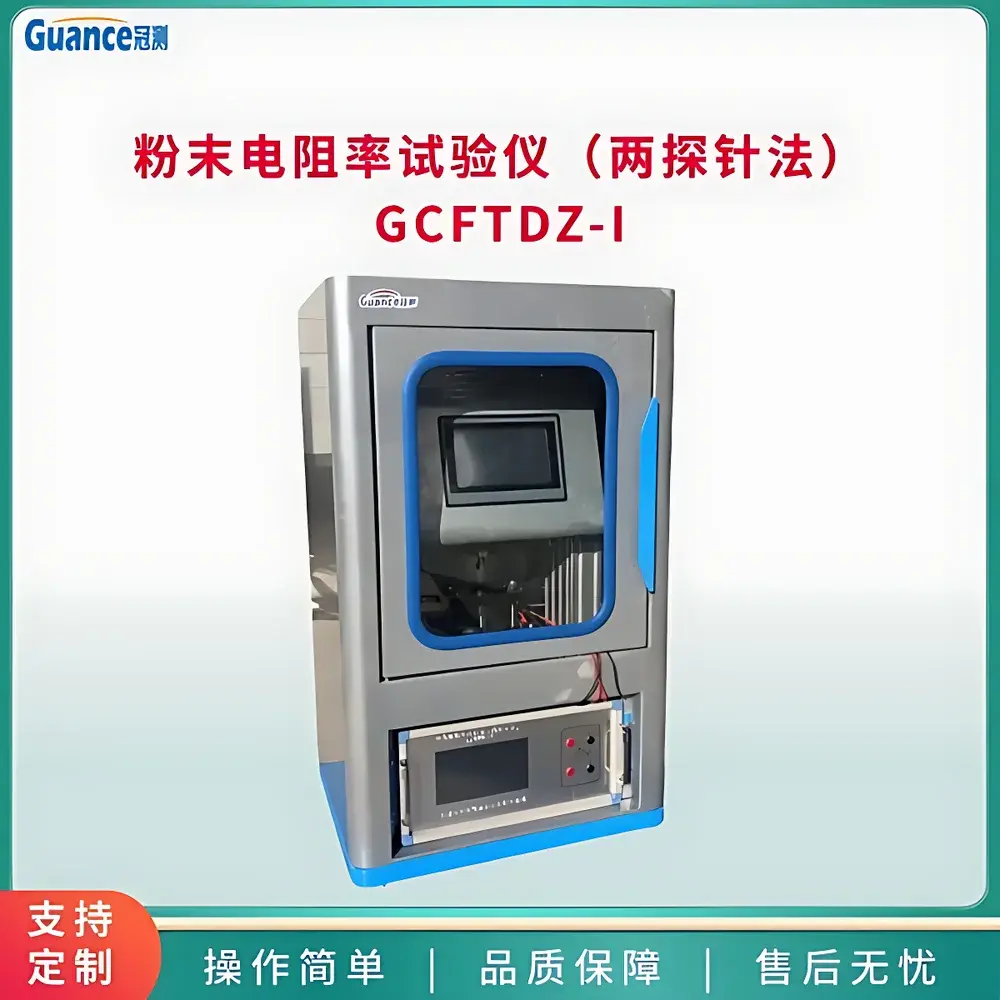
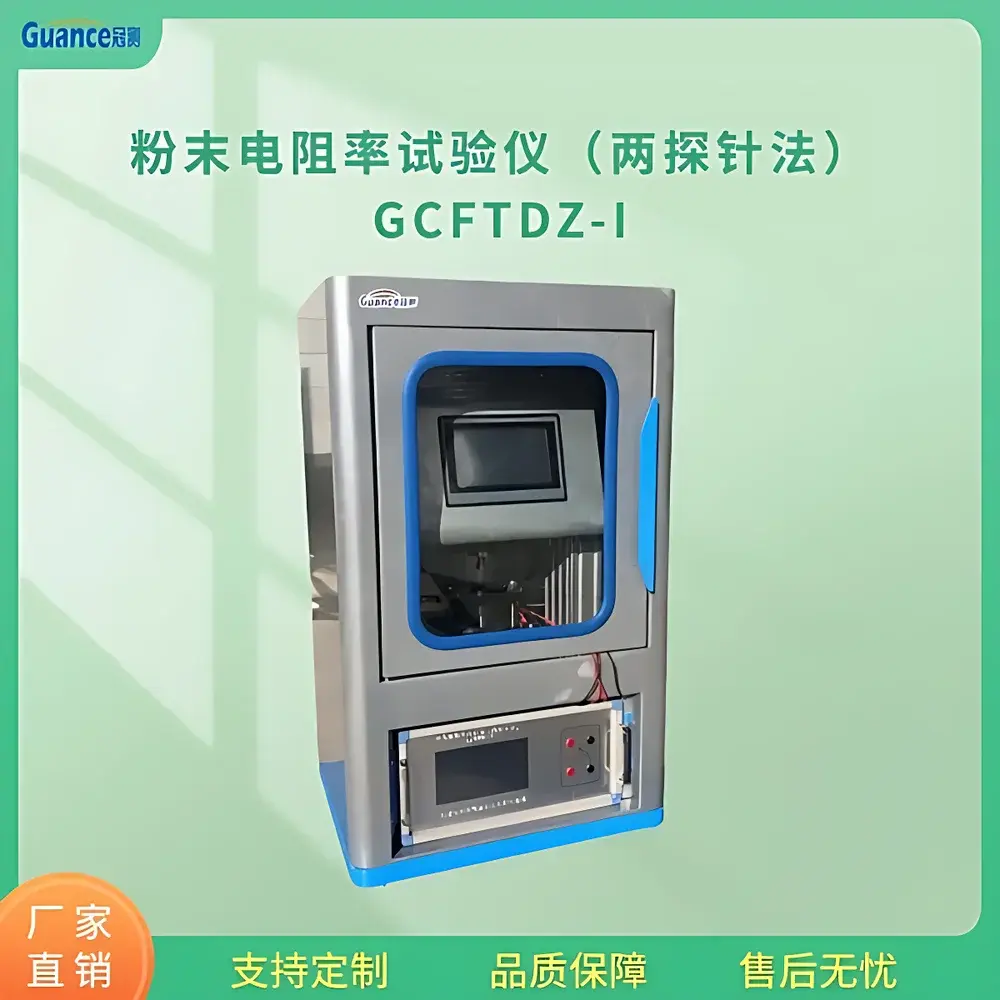
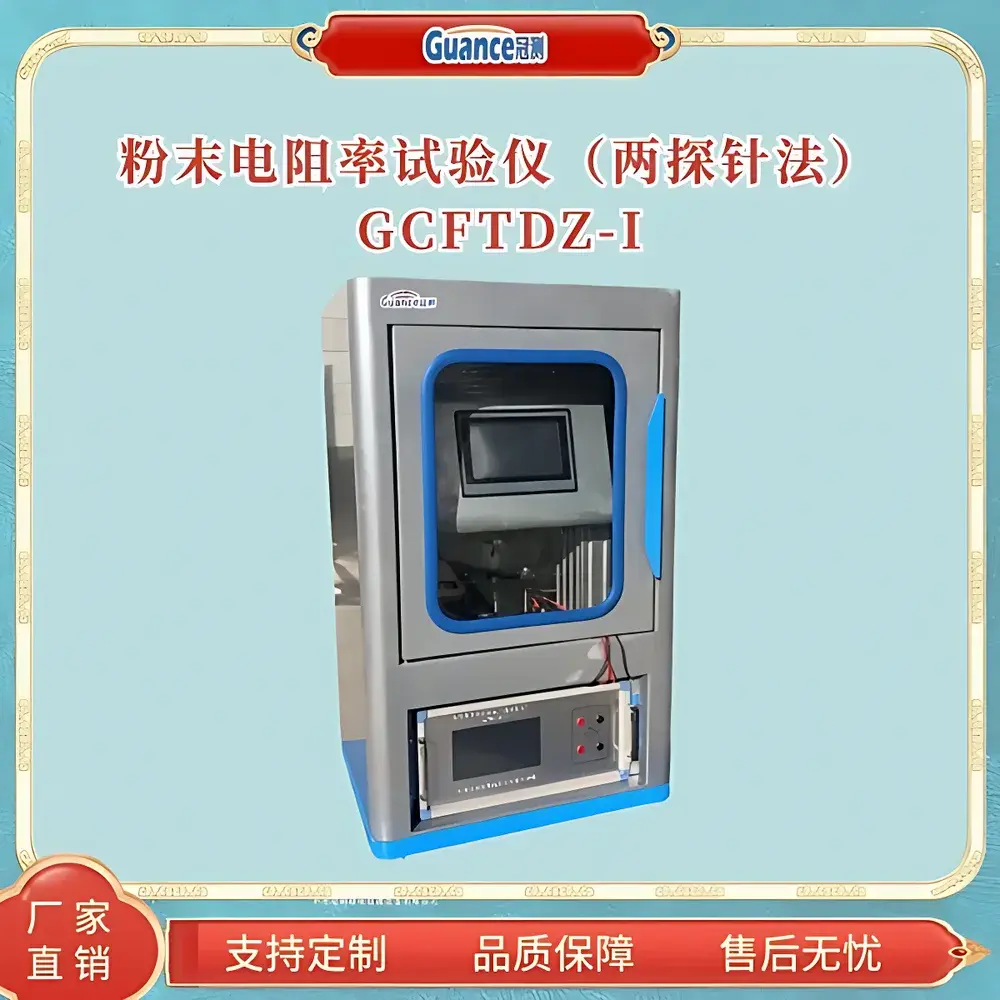
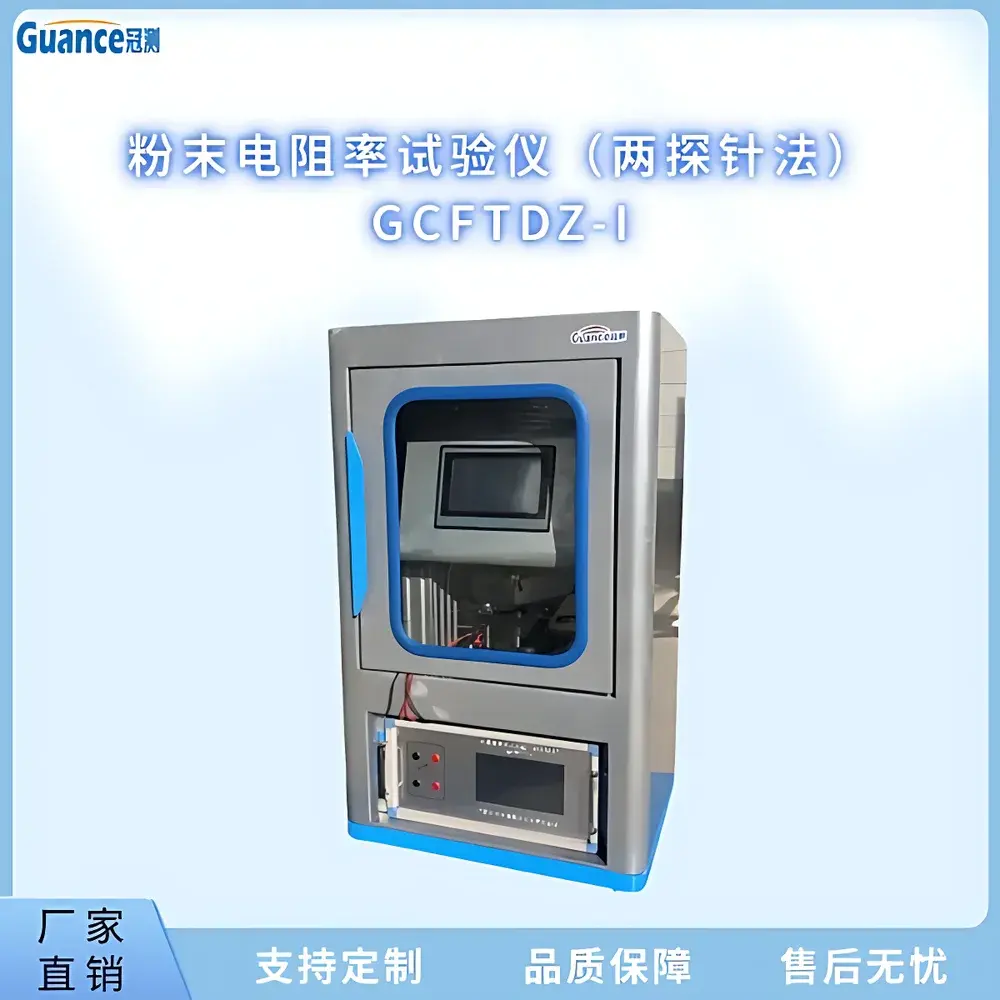
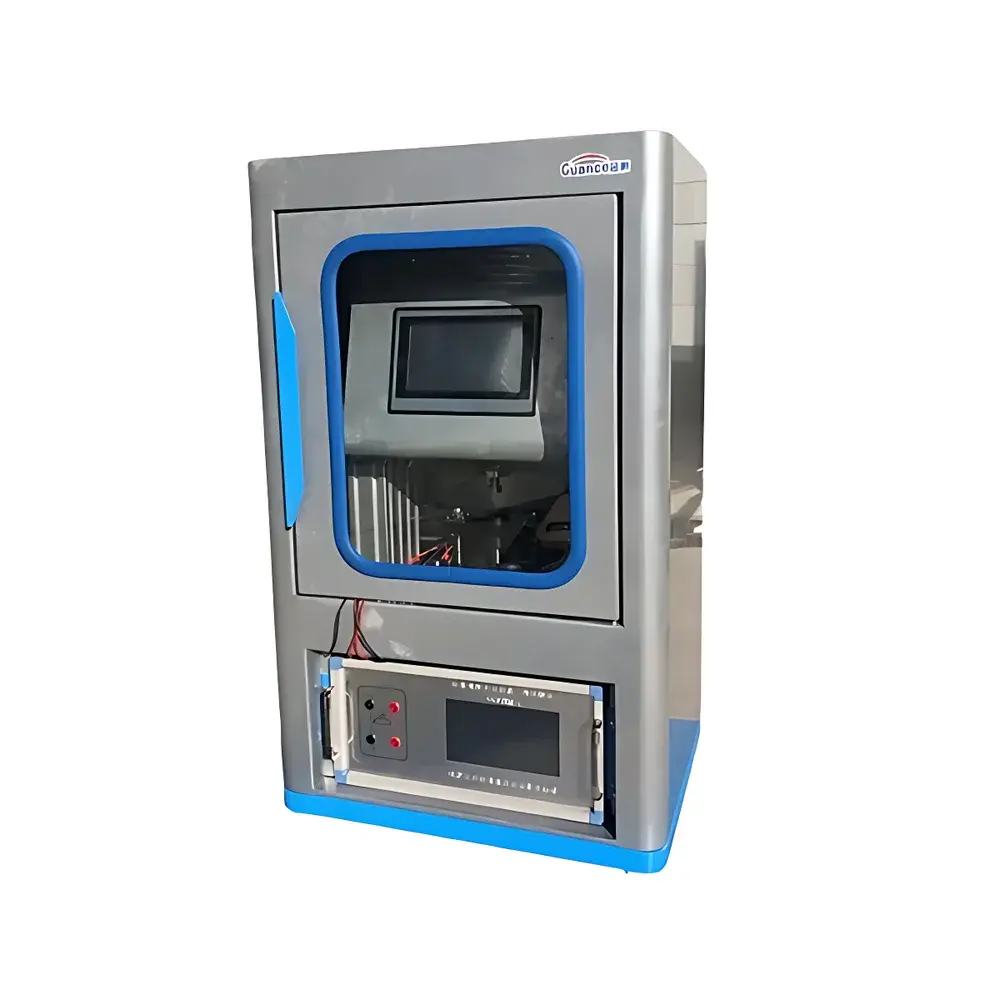
GuanCe GCFTDZ-I Carbon Black Powder Resistivity Tester (Two-Point Probe Method)
| Brand | GuanCe Instruments |
|---|---|
| Origin | Beijing, China |
| Model | GCFTDZ-I |
| Force Range | 0–5 kN (max. 3.9 MPa) |
| Pressure Control Accuracy | ±0.5% FS |
| Resistivity Measurement Range | 10⁻⁶ – 10⁵ Ω·m |
| Resistance Resolution | 10⁻⁸ Ω |
| Voltage Range | 2 mV – 2 V (±0.1% accuracy) |
| Current Sources | 10 μA to 10 A (7 ranges, ±0.5% accuracy) |
| Electrode Diameters | φ16.0 mm & φ30.0 mm |
| Sample Height Resolution | ±1 μm |
| Power Supply | 220 V / 50 Hz / 1 kW |
| Dimensions (L×W×H) | 550 × 450 × 960 mm |
| Weight | ~75 kg |
Overview
The GuanCe GCFTDZ-I Carbon Black Powder Resistivity Tester is an automated, PLC-controlled instrumentation system engineered for precise and repeatable measurement of electrical resistivity in carbonaceous powders—including carbon black, calcined anthracite, petroleum coke, graphite, needle coke, and baked carbon fragments—according to GB/T 24521–2018, the Chinese national standard for resistivity determination of carbon raw materials and coke. The instrument implements the two-point probe (collinear electrode) method under controlled uniaxial compression: a defined mass of dried, sieved powder is loaded into a cylindrical die cavity and subjected to programmable mechanical pressure (up to 3.9 MPa) via a servo-driven loading system. Once pressure stabilizes, a calibrated constant current is applied across the compacted sample, and the resulting voltage drop across the electrodes is measured. Resistivity (ρ) is calculated using ρ = R × A / L, where R is measured resistance, A is electrode cross-sectional area, and L is the compressed thickness—automatically determined by high-resolution displacement sensing (±1 μm). This principle ensures traceability to SI units and alignment with fundamental definitions of bulk electrical transport properties in granular media.
Key Features
- Fully automated test sequence: auto-loading, pressure ramping/holding, current application, voltage acquisition, data calculation, and return-to-origin—all executed without manual intervention
- Dual-electrode compatibility: interchangeable φ16.0 mm and φ30.0 mm stainless-steel electrodes optimized for distinct particle size fractions (0.315–0.5 mm and 0.5–1.0 mm, respectively), ensuring representative contact area and minimized edge effects
- Seven programmable measurement modes: constant force, constant pressure, stepped-force, stepped-pressure, and compression-ratio-based displacement control—enabling compliance with both routine QC and advanced R&D protocols
- Real-time multi-parameter display on a 10-inch industrial touch HMI: simultaneous visualization of applied force, pressure, compacted height, bulk density, current, voltage, resistance, resistivity, and conductivity—with selectable unit systems (e.g., Ω·m, S/m, mΩ·cm)
- High-fidelity electrical metrology: eight-step constant-current sourcing (10 μA to 10 A), 4-range voltage measurement (2 mV–2 V), ±0.5% resistance accuracy, and 10⁻⁸ Ω resolution—validated per IEC 60584 and ASTM D257 practices
- Integrated thermal-stable mechanical architecture: low-noise servo actuation, zero-drift auto-calibration, and repeatable sub-micron height repeatability—critical for minimizing inter-test variability in compressible carbon powders
Sample Compatibility & Compliance
The GCFTDZ-I is specifically validated for use with industrially relevant carbonaceous powders conforming to GB/T 24521–2018, including but not limited to furnace black, acetylene black, thermal black, calcined petcoke, graphitized coke, and green anode fines. Its dual-electrode design accommodates standardized sieve fractions, while the 3.9 MPa maximum pressure aligns with typical compaction conditions used in electrode manufacturing and battery material qualification. The system supports GLP-compliant operation through timestamped audit trails, user-access-controlled parameter locking, and non-volatile storage of raw measurement data—including force–displacement curves and I–V sweeps. While not FDA 21 CFR Part 11-certified out-of-the-box, its data export functionality (CSV/Excel) enables integration into validated LIMS or ELN platforms meeting ISO/IEC 17025 and GMP documentation requirements.
Software & Data Management
Control and data handling are managed via an embedded Siemens S7-1200 PLC interfaced with a ruggedized 10-inch capacitive touch HMI. All test parameters—including target pressure, hold duration, current level, and mode selection—are configured via intuitive graphical menus. Real-time plots update at 10 Hz during compression and measurement phases. Post-test, results are displayed numerically and stored internally with full metadata (date/time, operator ID, sample ID, environmental temperature/humidity if externally logged). Built-in thermal mini-printer supports immediate hardcopy output of single-point reports; USB-host interface permits export of batched test logs—including gradient-mode comparative statistics (e.g., Δρ between pressure steps, % change in conductivity)—for offline statistical process control (SPC) analysis.
Applications
This instrument serves quality assurance laboratories in carbon black production, anode material manufacturing for lithium-ion batteries, refractory carbon component development, and metallurgical coke evaluation. It enables correlation of resistivity with microstructural variables such as particle morphology, surface oxidation, graphitization degree, and binder content. In R&D settings, the stepped-pressure mode facilitates construction of pressure–resistivity isotherms—informing die design for cold isostatic pressing (CIP) and predicting sintering behavior. For regulatory submissions, its adherence to GB/T 24521–2018 provides technical defensibility in domestic and export markets requiring conformance to nationally recognized test methods.
FAQ
What standards does the GCFTDZ-I comply with?
It is designed and verified per GB/T 24521–2018 for carbon raw materials and coke. Its electrical and mechanical subsystems meet IEC 61000-4 immunity requirements and ISO 17025 metrological traceability guidelines.
Can the instrument measure anisotropic resistivity?
No—it implements isotropic two-probe geometry. For directional conductivity assessment (e.g., in extruded graphite), four-point probe or van der Pauw configurations are required.
Is calibration certification included?
Yes—a factory calibration report with uncertainty budget (k=2) for force, displacement, voltage, and current channels is supplied. Annual recalibration using NIST-traceable standards is recommended.
How is sample conditioning handled?
The instrument does not include environmental control. Users must pre-condition samples per GB/T 24521–2018 (e.g., drying at 105 °C ± 2 °C for 2 h, desiccator cooling) prior to loading.
What maintenance is required?
Monthly cleaning of electrode surfaces with isopropyl alcohol; annual verification of load cell linearity and displacement encoder drift; biannual lubrication of the servo lead screw per manufacturer’s technical bulletin.



