
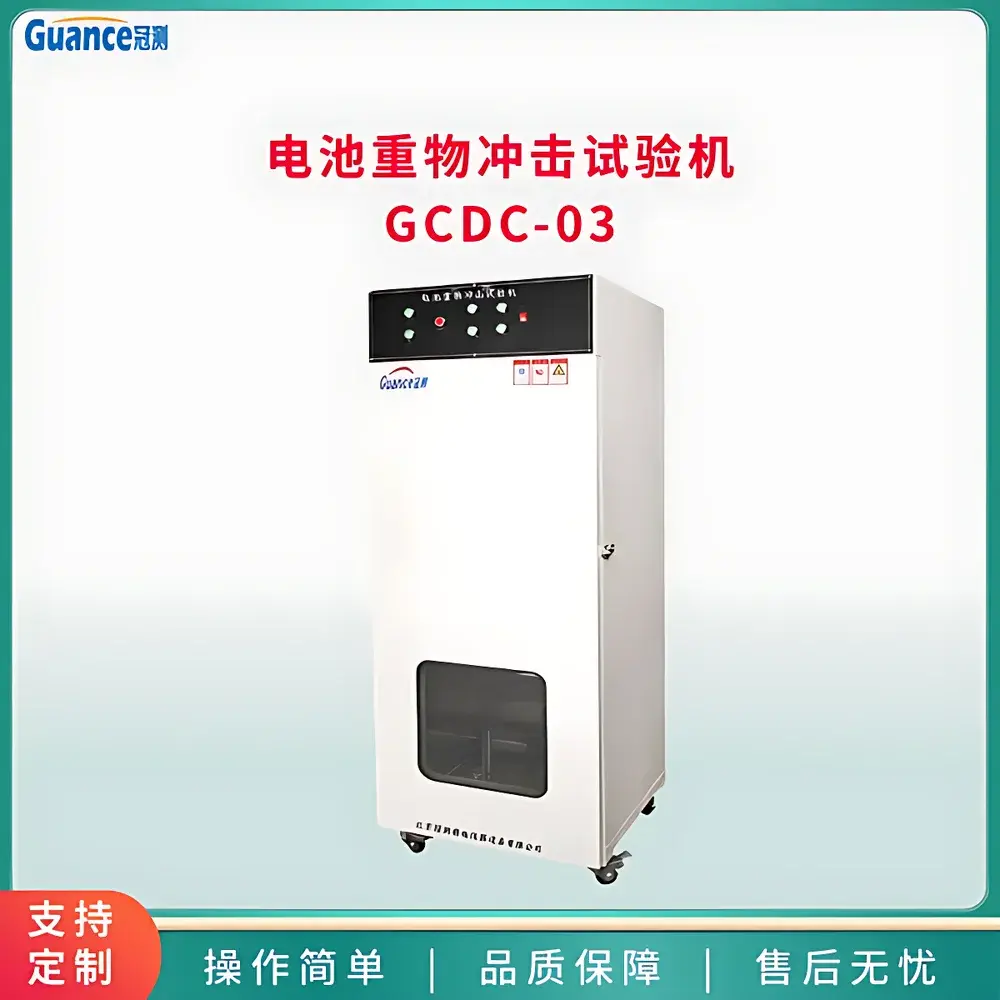
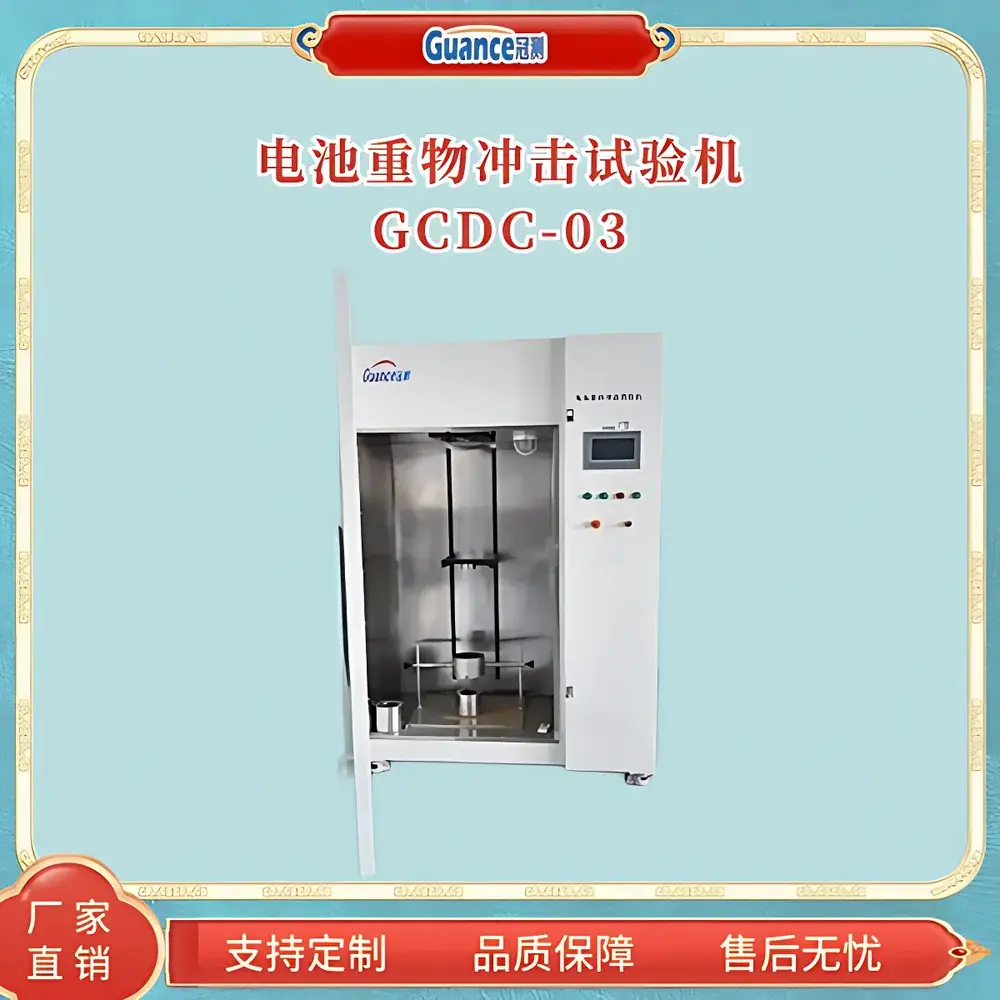
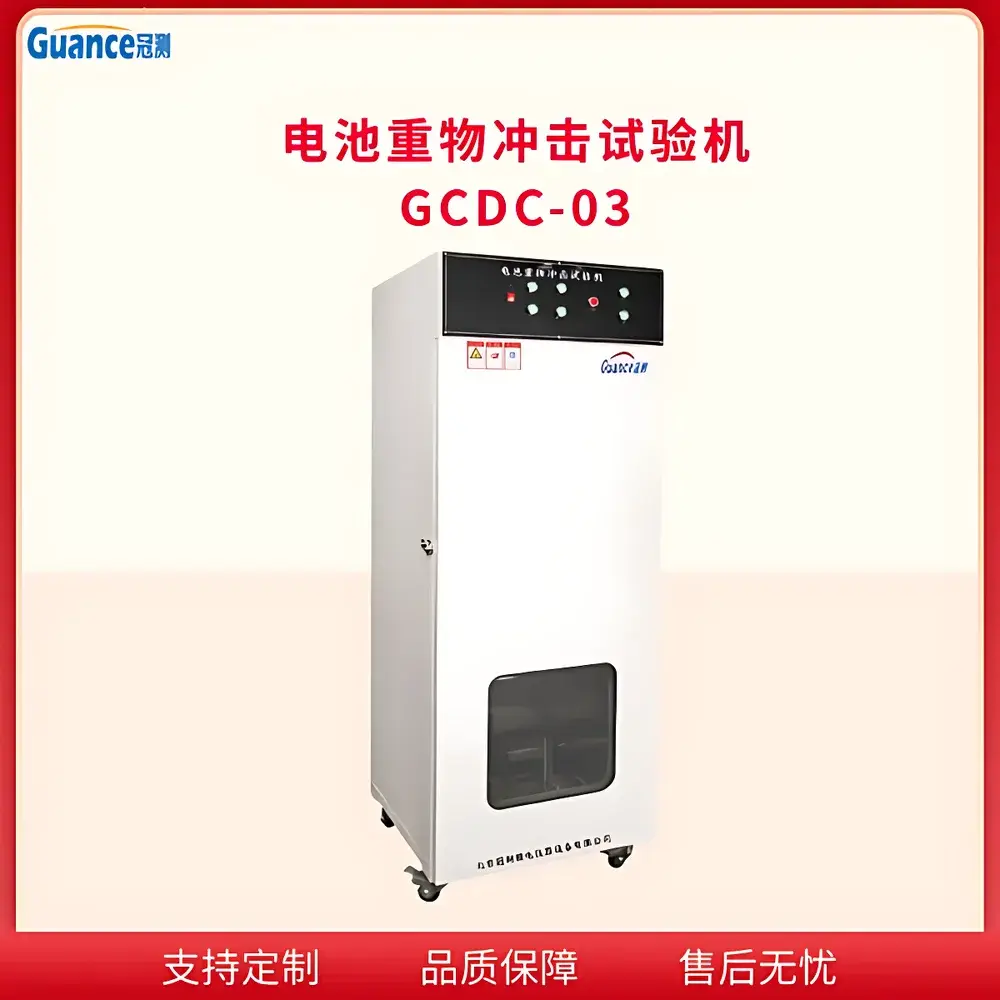
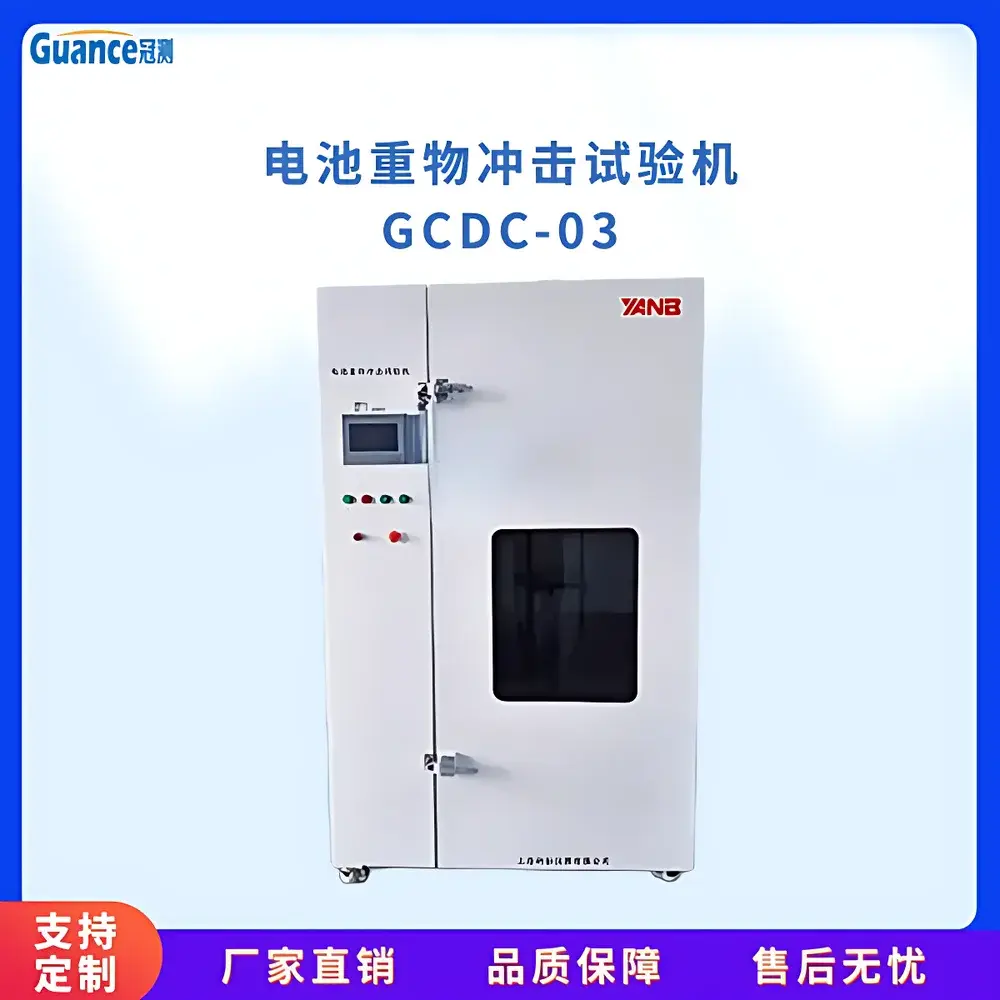
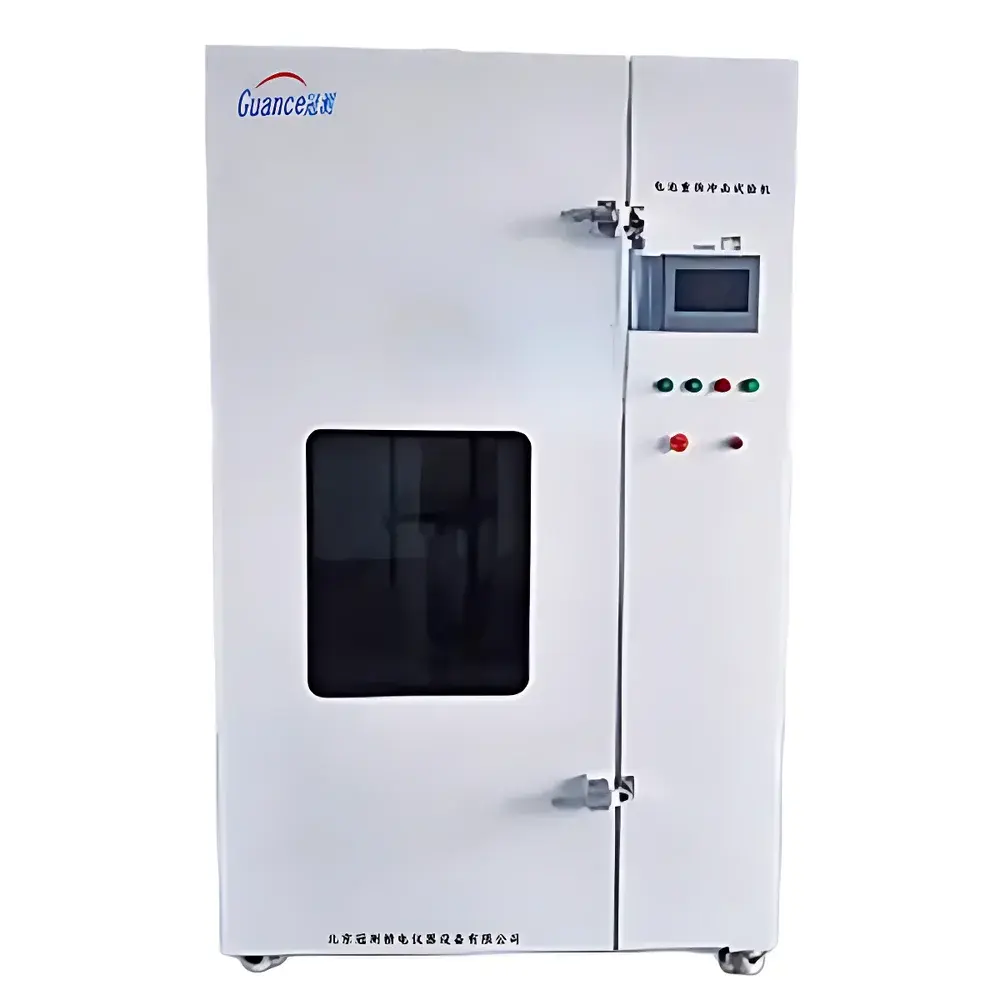
GuanCe Instruments GCDC-03 Coin-Cell Heavy Mass Impact Tester
| Brand | GuanCe Instruments |
|---|---|
| Origin | Beijing, China |
| Manufacturer Type | Authorized Distributor |
| Country of Origin | China |
| Model | GCDC-03 |
| Impact Mass | 9.1 kg or 10 kg stainless steel impact hammer |
| Impact Height Range | 300–1200 mm (adjustable, digital height indicator, ±2 mm accuracy) |
| Height Adjustment | Motorized |
| Crossbar Diameter | 15.8 mm (5/8 in) stainless steel rod |
| Load Cell Range | 0–200 N |
| Maximum Lifting Height | 200 mm |
| Power Supply | 220 V, 50/60 Hz, 3 A |
| Net Weight | ~145 kg |
| Chamber Construction | Inner chamber – 304 stainless steel |
| Viewing Window | Dual-layer tempered explosion-proof glass with integrated LED lighting |
| Exhaust Port | 120 mm diameter, rear-mounted |
Overview
The GuanCe Instruments GCDC-03 Coin-Cell Heavy Mass Impact Tester is a precision-engineered safety evaluation system designed specifically for mechanical abuse testing of primary and rechargeable coin-type (button) lithium batteries. It operates on the principle of controlled gravitational impact—dropping a calibrated mass from a defined height onto a battery sample constrained by a standardized cylindrical anvil (15.8 mm diameter stainless steel rod), simulating real-world mechanical stress events such as accidental drops or crushing during transport and handling. The instrument complies with internationally recognized safety standards for portable electrochemical cells, including IEC 62133, UN Manual of Tests and Criteria Part III, Subsection 38.3, UL 1642, UL 2054, SJ/T 11169–1998, SJ/T 11170–1998, QC/T 742–2006, QC/T 743–2006, QC/T 744–2006, GB/T 18287–2000, and GB 8897.4–2002 (equivalent to IEC 60086-4:2000). Its modular architecture ensures repeatable positioning, traceable height control, and operator-safe containment—critical requirements for laboratory-based safety qualification under GLP-compliant workflows.
Key Features
- Motorized height adjustment mechanism enabling precise, reproducible impact heights between 300 mm and 1200 mm, displayed via high-resolution digital height indicator (±2 mm tolerance)
- Dual-mass configuration: Interchangeable 9.1 kg and 10.0 kg stainless steel impact hammers, each certified to ASTM E23 and ISO 148-1 dimensional and mass tolerances
- Standardized 15.8 mm (5/8 inch) diameter stainless steel crossbar, rigidly mounted and orthogonal to the test surface, ensuring consistent contact geometry per IEC 62133 Clause 7.1.2
- Integrated load cell (0–200 N range) for optional real-time force profiling during impact event—compatible with third-party data acquisition systems
- Explosion-resistant test chamber with dual-layer tempered glass viewport, internal LED illumination, and rear-mounted 120 mm exhaust port for fume management
- Stainless steel inner chamber (304 grade) and powder-coated A3 steel outer enclosure ensure corrosion resistance and long-term structural integrity
- Compliance-ready design: All mechanical interfaces, calibration points, and operational sequences align with audit requirements for ISO/IEC 17025-accredited laboratories
Sample Compatibility & Compliance
The GCDC-03 is validated for use with all commercially available coin-cell and button-cell formats—including Li-MnO₂, Li-CFx, Li-SOCl₂, and Li-ion variants—with diameters ranging from 5 mm to 30 mm. Sample placement follows strict orientation protocols: the cell’s flat face must be parallel to the horizontal base plate, and the 15.8 mm anvil is positioned centrally across its surface. For regulatory conformance, the system supports two primary test configurations: (i) 9.1 ± 0.16 kg mass dropped from 610 ± 25 mm (per UL 1642:2008 and IEC 62133 Ed. 2.0), and (ii) 10.0 ± 0.46 kg mass dropped from 1000 ± 25 mm (per UN 38.3 Rev. 6 and QC/T 743–2006). Each test uses a single-use specimen; no retesting is permitted per standard mandates. The apparatus meets mechanical safety requirements outlined in IEC 61000-4-2 (ESD immunity) and IEC 61000-4-3 (radiated RF immunity), and is CE-marked for laboratory equipment (2014/30/EU EMC Directive).
Software & Data Management
While the GCDC-03 operates as a stand-alone electromechanical tester, its analog load cell output (0–5 V) and digital height encoder signals are compatible with industry-standard DAQ platforms (e.g., National Instruments CompactDAQ, Keysight 34972A). Users may integrate timestamped impact force profiles, drop height logs, and pass/fail annotations into LIMS or ELN environments using CSV or XML export protocols. Audit trails—including operator ID, test date/time, sample ID, impact parameters, and chamber status—are maintainable via external logging software compliant with FDA 21 CFR Part 11 requirements when paired with appropriate electronic signature modules.
Applications
- Pre-market safety validation of coin-cell batteries for consumer electronics (wearables, hearing aids, RFID tags)
- Quality assurance testing in battery manufacturing facilities under ISO 9001 and IATF 16949 frameworks
- Root cause analysis of thermal runaway initiation under mechanical abuse conditions
- Comparative evaluation of separator robustness, can integrity, and venting behavior across cell chemistries
- Supporting UN 38.3 Section 38.3.2.2 certification documentation for air transport compliance
- Research-grade investigation of impact-induced internal short-circuit mechanisms in solid-state microbatteries
FAQ
What standards does the GCDC-03 explicitly support?
IEC 62133, UN 38.3, UL 1642:2008, UL 2054:2008, SJ/T 11169–1998, SJ/T 11170–1998, QC/T 742–2006, QC/T 743–2006, QC/T 744–2006, GB/T 18287–2000, and GB 8897.4–2002.
Is the 15.8 mm crossbar included with the system?
Yes—the instrument ships with one certified 15.8 mm (5/8 inch) stainless steel rod, pre-installed and aligned per IEC 62133 Annex D specifications.
Can the GCDC-03 be used for cylindrical or prismatic cells?
No—the GCDC-03 is purpose-built for coin/button cells only. Cylindrical and prismatic formats require dedicated fixtures and alternate anvil geometries not supported by this model.
Does the system provide automatic pass/fail determination?
No—pass/fail assessment is based on visual observation (no fire, no explosion) per standard clauses; however, the digital height readout and load cell interface support objective parameter recording for report generation.
What maintenance is required for long-term calibration stability?
Annual verification of height encoder linearity, impact mass certification (via accredited metrology lab), and mechanical alignment check of the crossbar axis relative to the drop path are recommended per ISO/IEC 17025 Clause 6.4.1.



