
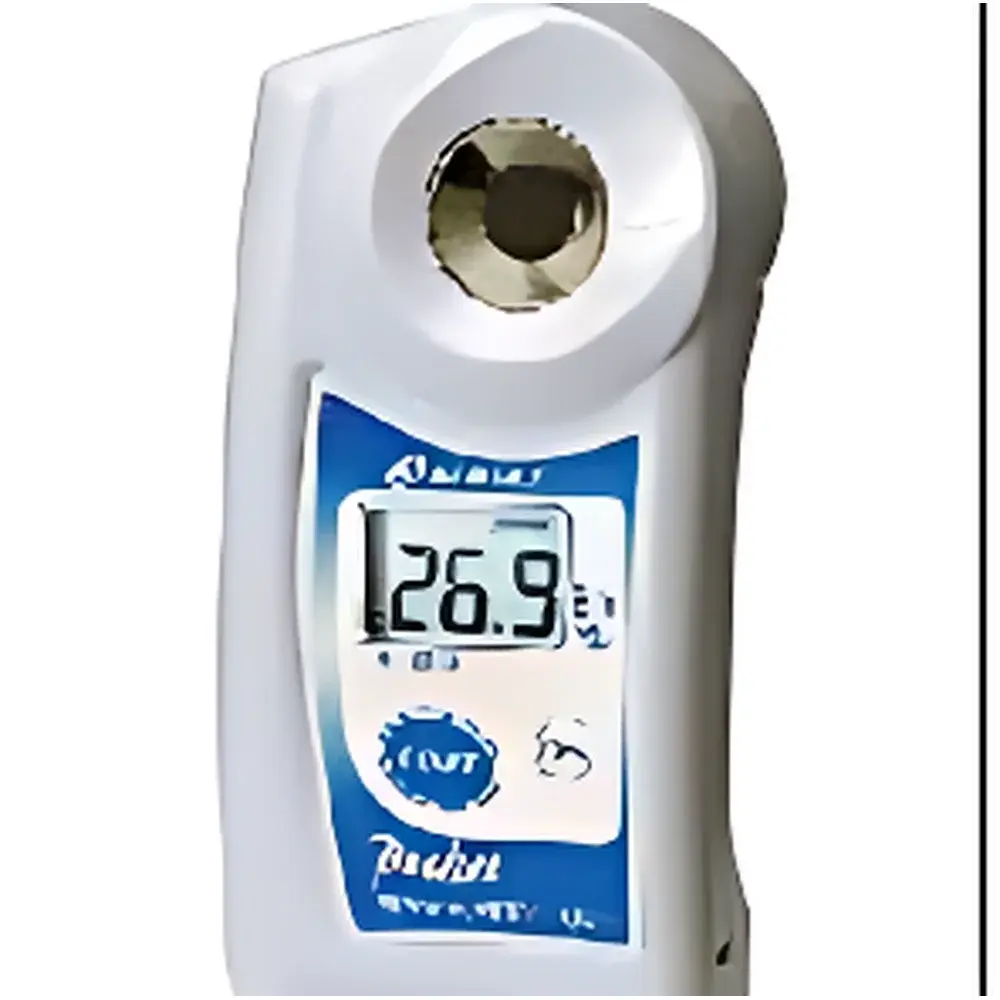
ATAGO PAL-1 Digital Pocket Refractometer
| Origin | Japan |
|---|---|
| Manufacturer Type | Authorized Distributor |
| Origin Category | Imported |
| Model | PAL-1 |
| Price | Upon Request |
| Brix Range | 0.0–53.0% |
| Temperature Range | 9.0–99.9°C |
| Brix Resolution | 0.1% |
| Temperature Resolution | 0.1°C |
| Brix Accuracy | ±0.2% |
| Temperature Accuracy | ±1.0°C |
| Ambient Operating Temperature | 10–40°C |
| Sample Temperature Range | 10–100°C (with Automatic Temperature Compensation, ATC) |
| Sample Volume | 0.3 mL |
| Measurement Time | 3 seconds |
| Power Supply | 2 × AAA batteries |
| Ingress Protection Rating | IP65 |
| Dimensions | 55(W) × 31(D) × 109(H) mm |
| Weight | 100 g (without accessories) |
Overview
The ATAGO PAL-1 Digital Pocket Refractometer is a compact, field-deployable optical instrument engineered for rapid, reliable measurement of refractive index–derived Brix concentration in aqueous solutions. Based on the principle of total internal reflection at the prism–sample interface, the PAL-1 converts measured critical angle displacement into a digital Brix reading (% w/w sucrose equivalent), calibrated per international sugar standards (ICUMSA, AOAC). Its integrated thermistor enables real-time Automatic Temperature Compensation (ATC) across 10–100°C, ensuring metrological consistency without manual correction. Designed for frontline quality control in food processing, beverage production, and agricultural post-harvest evaluation, the PAL-1 delivers laboratory-grade repeatability in a handheld form factor compliant with ISO 2173:2003 (fruit and vegetable products — determination of soluble solids content — refractometric method).
Key Features
- High-precision Abbe-type optical system with sapphire-coated measuring prism for abrasion resistance and long-term calibration stability
- Automatic Temperature Compensation (ATC) algorithm compliant with ISO 2173 and AOAC Official Method 932.12, eliminating manual temperature correction
- IP65-rated enclosure—dust-tight and protected against low-pressure water jets—enabling operation in humid, washdown-intensive environments (e.g., juice extraction lines, sauce kettles)
- 3-second measurement cycle with auto-hold function; optimized for high-throughput screening of viscous or particulate-laden samples (e.g., tomato paste, fruit pulps with skin fragments)
- Low sample volume requirement (0.3 mL) minimizes waste and supports analysis of precious or limited-volume batches
- Energy-efficient design powered by two standard AAA alkaline batteries (typical life: >5,000 measurements)
- Ergonomic, one-handed operation with large LCD display featuring backlight for low-light conditions
Sample Compatibility & Compliance
The PAL-1 accommodates a broad spectrum of food-grade liquids and semi-solids, including clarified juices, syrups, brines, dairy-based sauces, fermented beverages, and homogenized fruit preparations. Its 0.0–53.0% Brix range covers applications from dilute vegetable broths (45% Brix). The device meets key regulatory and industry requirements: it supports GLP-compliant recordkeeping when used with traceable calibration standards (e.g., RE-110010–RE-110060 certified sucrose reference solutions); its measurement uncertainty profile aligns with ISO/IEC 17025:2017 clause 7.6.3 for in-house verification; and its ATC performance satisfies ASTM D115–22 Annex A1 for refractometric temperature correction in industrial settings.
Software & Data Management
While the PAL-1 operates as a standalone, battery-powered instrument without onboard data logging, it is fully compatible with ATAGO’s optional PC interface kits (e.g., RS-232 or USB adapters) and proprietary software suite (Refractometer Manager v3.x). This enables export of timestamped Brix and temperature readings to CSV or Excel formats for statistical process control (SPC), trend analysis, and audit-ready documentation. All calibration records—including date, operator ID, and reference solution lot number—can be archived to satisfy FDA 21 CFR Part 11 requirements when paired with validated electronic signature workflows. Firmware updates are available via ATAGO’s authorized service centers to maintain alignment with evolving metrological guidelines.
Applications
- Routine Brix verification during fruit harvesting and sorting to determine optimal picking windows
- In-line QC of juice concentration pre-evaporation and post-dilution in beverage manufacturing
- Monitoring sugar content in fermentation substrates (e.g., must, wort) prior to yeast inoculation
- Verification of syrup consistency in confectionery and bakery ingredient preparation
- Field assessment of honey adulteration risk via deviation from expected floral-source Brix–moisture correlations
- Teaching tool in food science laboratories for demonstrating colligative property relationships
FAQ
Does the PAL-1 require periodic recalibration?
Yes—ATAGO recommends calibration before each shift using certified sucrose reference solutions (e.g., RE-110020 for mid-range verification). Calibration frequency should be validated per internal SOPs aligned with ISO/IEC 17025.
Can the PAL-1 measure non-sugar solutes accurately?
It reports Brix as % sucrose equivalence; results for invert sugar, glucose, or acids require empirical correlation curves or conversion factors per AOAC 985.27.
Is the prism surface resistant to acidic or high-salt samples?
The sapphire-coated prism exhibits excellent chemical resistance to pH 2–12 solutions and saline matrices up to 25% NaCl; rinse with deionized water after use.
What environmental conditions affect measurement stability?
Operation outside 10–40°C ambient range may impact battery voltage regulation and LCD response time; condensation on the prism must be removed prior to measurement.
How is traceability maintained for audit purposes?
Each unit ships with a factory calibration certificate (NIST-traceable references); users must retain logs of all field calibrations, including solution lot numbers and environmental conditions.





