
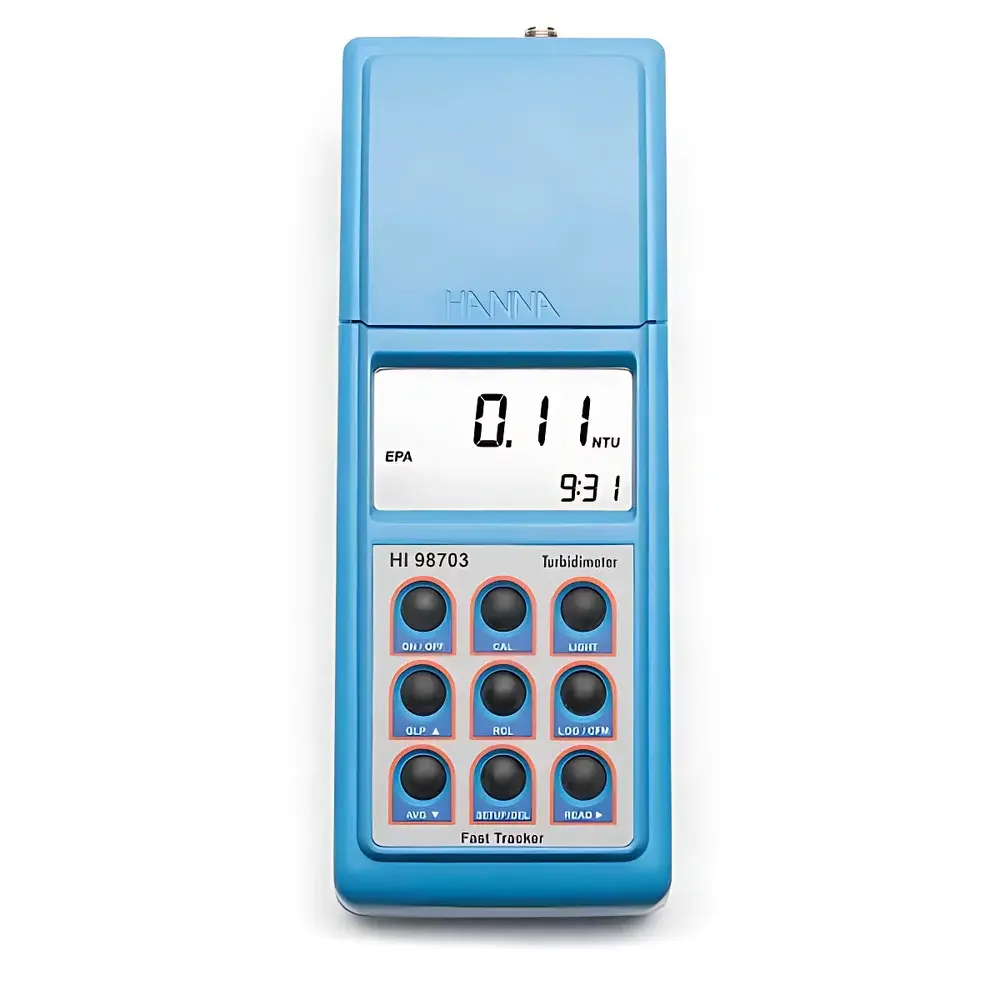
Hanna HI98703 Portable Multi-Range Turbidimeter
| Brand | Hanna Instruments |
|---|---|
| Origin | Italy |
| Model | HI98703 |
| Instrument Type | Portable |
| Parameter Type | Single-Parameter (Turbidity) |
| Measurement Range | 0.00–9.99 NTU, 10.0–99.9 NTU, 100–1000 NTU |
| Resolution | 0.01 NTU / 0.1 NTU / 1 NTU |
| Accuracy | ±2% of reading or ±0.02 NTU @ 25°C |
| Optical Method | Nephelometric (90° scatter) and Ratio (90° & 180° backscatter), compliant with USEPA Method 108.1 and Standard Method 2130B |
| Calibration Points | Four-point manual calibration (<0.1, 15, 100, 750 NTU |
| Detection Limit | <0.02 NTU |
| Repeatability | ±1% of reading + 0.02 NTU (whichever is greater) |
| Data Storage | 200 measurement records |
| Interface | USB and RS232 |
| GLP Compliance | Timestamped calibration logs, user ID, setup history |
| Power | 4 × 1.5 V AA batteries (auto-off after 15 min idle) |
| Operating Environment | 0–50°C, ≤95% RH non-condensing |
| Dimensions | 224 × 87 × 77 mm |
| Weight | 512 g |
Overview
The Hanna HI98703 Portable Multi-Range Turbidimeter is an ISO/IEC 17025-aligned field-deployable instrument engineered for precise, traceable turbidity quantification across three dynamically switched ranges (0.00–9.99 NTU, 10.0–99.9 NTU, and 100–1000 NTU). It operates on the nephelometric principle—measuring light scattered at 90° relative to the incident beam—as specified in USEPA Method 108.1 and Standard Method 2130B. For enhanced robustness in variable sample matrices—including colored or highly absorbing waters—the instrument also supports ratio-mode measurement (simultaneous 90° and 180° detection), minimizing interference from absorbance and particle size distribution effects. Designed for regulatory compliance in drinking water, wastewater effluent, surface water, and seawater monitoring, the HI98703 delivers metrological integrity through its custom-engineered optical path, thermally stabilized LED light source (850 nm), and precision photodetector array. Its low-range sensitivity (<0.02 NTU detection limit) makes it particularly suited for verification of filtration efficiency and disinfection barrier performance in potable water treatment.
Key Features
- Triple-range auto-ranging architecture ensures optimal signal-to-noise ratio across all turbidity levels without manual range selection.
- Four-point manual calibration using NIST-traceable standards (<0.1, 15, 100, and 750 NTU); optional 2000 NTU calibration kit (HI98703-11) extends upper validation scope.
- CAL CHECK™ Performance Verification System enables periodic validation of internal optical calibration curves—critical for maintaining long-term accuracy under field conditions where LED intensity drift or detector aging may occur.
- GLP-compliant data management: each stored measurement includes timestamp, operator ID (configurable), calibration status, and environmental temperature.
- Dual communication interface (USB + RS232) supports direct export to LIMS or laboratory informatics platforms; firmware upgradable via USB.
- Backlit 64 × 128 pixel LCD display with 40 × 70 mm viewing area ensures legibility in low-light or outdoor environments.
Sample Compatibility & Compliance
The HI98703 is validated for use with aqueous samples including raw and treated drinking water, groundwater, surface runoff, municipal and industrial wastewater effluents, and marine samples. Its optical design accommodates samples with moderate coloration or dissolved organic content when operated in ratio mode. The instrument conforms to key regulatory frameworks: USEPA-approved methodology for drinking water compliance (40 CFR Part 141), ASTM D6508-22 for turbidity in process water, and ISO 7027-1:2016 for instrument performance specification. All calibrations are documented per ISO/IEC 17025 requirements, supporting audit readiness for laboratories operating under GLP or GMP environments. CAL CHECK™ verification intervals align with ISO/IEC 17025 clause 6.4.10—requiring periodic confirmation of measurement system stability between formal calibrations.
Software & Data Management
Internal memory retains 200 fully timestamped measurements with metadata (calibration date, standard used, ambient temperature). Data export is compatible with CSV and Excel formats via Hanna’s free HI98703 Data Transfer Software (Windows/macOS). The instrument supports FDA 21 CFR Part 11-compliant workflows when paired with validated third-party LIMS—enabling electronic signatures, audit trails, and role-based access control for calibration and data review functions. GLP reports include full calibration history, instrument ID, operator ID, and deviation flags for out-of-tolerance results.
Applications
- Drinking water utilities: verification of filter performance, coagulation/flocculation optimization, and final disinfection barrier validation.
- Wastewater treatment plants: effluent compliance monitoring against NPDES permit limits (e.g., ≤2 NTU for discharge).
- Environmental monitoring: tracking sediment transport in rivers, reservoir clarity assessment, and eutrophication studies.
- Food & beverage processing: rinse water quality control, CIP cycle verification, and bottled water clarity certification.
- Pharmaceutical water systems: USP purified water and WFI turbidity screening (where applicable).
FAQ
What turbidity methods does the HI98703 support?
It supports both single-angle nephelometry (90° scatter) per USEPA Method 108.1 and dual-angle ratio turbidimetry (90° + 180°) per Standard Method 2130B.
Is CAL CHECK™ required—and how often should it be performed?
CAL CHECK™ is recommended every 1–3 months for high-frequency field use, or semiannually under routine lab conditions, to correct for optical drift and maintain measurement traceability.
Can non-Hanna turbidity standards be used for calibration?
No. Only Hanna-certified, NIST-traceable standards (e.g., HI93703 series) are chemically and spectrally matched to the instrument’s optical response function; third-party standards risk curve misalignment or permanent calibration corruption.
Does the HI98703 meet GLP documentation requirements?
Yes—it stores full calibration logs with timestamps, operator IDs, standard lot numbers, and pass/fail status, satisfying ISO/IEC 17025 clause 7.7 and FDA 21 CFR Part 11 audit trail prerequisites.
What is the minimum detectable turbidity level?
The instrument achieves a practical detection limit of <0.02 NTU in the lowest range, validated per ISO 7027-1:2016 Annex B.



