
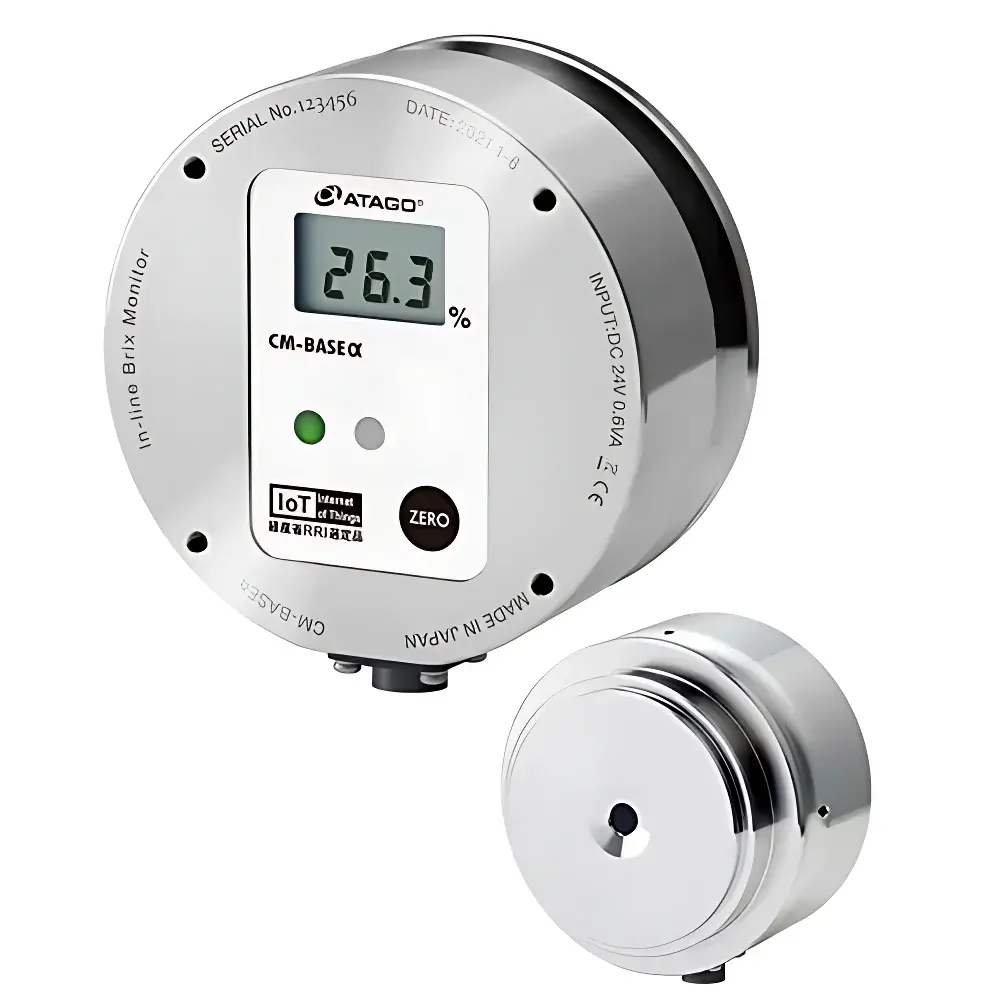
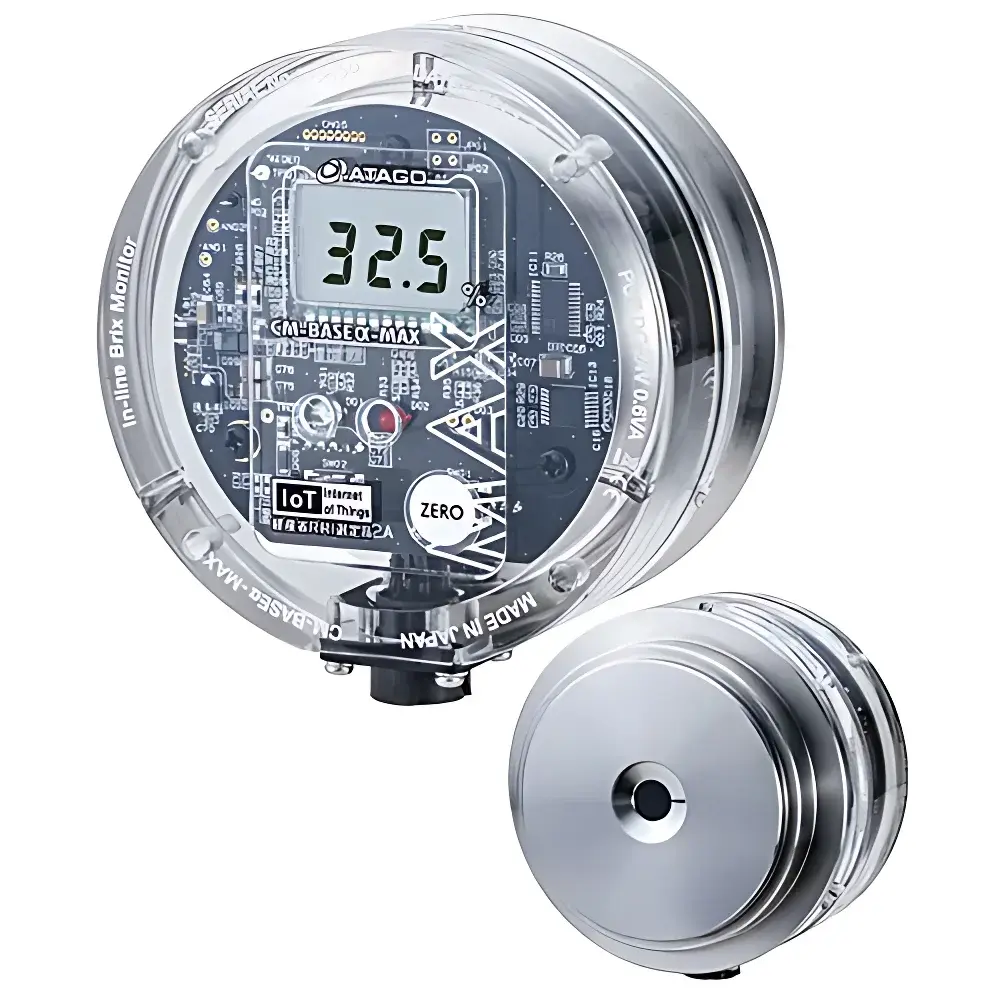
ATAGO CM-BASEα Series Online Refractometer for Liquid Concentration Monitoring
| Brand | ATAGO |
|---|---|
| Origin | Japan |
| Model | CM-BASEα Series |
| Measurement Principle | Digital Refractometry (Critical Angle Method) |
| Temperature Compensation | Automatic (ATC) |
| Output Interface | 4–20 mA, RS-485 (Modbus RTU), Optional Analog Voltage |
| Process Connection | Clamp-type or Flanged Flow Cell (DIN/ISO Standard) |
| Operating Temperature Range | −15 to +160 °C |
| IP Rating | IP65 (Sensor Head), IP67 (Electronics Enclosure) |
| Compliance | CE, RoHS, ISO 9001 Certified |
Overview
The ATAGO CM-BASEα Series Online Refractometer is an industrial-grade inline process analyzer engineered for continuous, real-time measurement of liquid concentration in dynamic production environments. Based on the principle of critical-angle digital refractometry, the instrument determines refractive index (nD) with high optical stability and minimal drift—enabling precise derivation of concentration units including °Brix, °Oe (GER), Plato, T.A.1990, alcohol by volume (v/v) or weight (w/w), and specific gravity-related scales. Unlike benchtop refractometers, the CM-BASEα integrates a flow-through prism sensor directly into piping systems, eliminating manual sampling and ensuring representative, temperature-compensated readings under flowing conditions. Its core architecture features sapphire prism optics, thermally stabilized photodiode array detection, and embedded ATC algorithms compliant with ISO 21542 and ASTM D1218 standards for refractive index correction across defined temperature ranges (e.g., 10–40 °C for wine applications; 10–75 °C for wort monitoring). Designed for integration into PLC-controlled lines, it supports uninterrupted operation in food & beverage, pharmaceutical, chemical, and bioethanol manufacturing.
Key Features
- Real-time, non-invasive concentration monitoring without sample extraction or reagent consumption
- Automatic Temperature Compensation (ATC) with dual-sensor thermal referencing for ±1 °C accuracy across operational range (−15 to +160 °C)
- Modular configuration: interchangeable application-specific firmware modules (e.g., CM-800α-Wine, CM-800α-Ethanol, CM-800α-Plato) pre-calibrated per industry-standard reference tables (OIV, ASBC, EBC)
- Ruggedized stainless steel (SUS316L) wetted parts and sapphire prism resistant to abrasion, corrosion, and CIP/SIP cleaning cycles
- Configurable analog output (4–20 mA) with HART-compatible protocol and digital communication via RS-485 Modbus RTU for SCADA/MES integration
- Local display with backlight LCD and intuitive menu navigation; optional remote configuration via USB or Ethernet gateway
Sample Compatibility & Compliance
The CM-BASEα Series is validated for homogeneous aqueous solutions with low turbidity (< 0.5 NTU) and suspended solids < 0.1 wt%. It is routinely deployed in grape must, fermented wine, beer wort, ethanol distillate, fruit juice concentrates, and pharmaceutical syrup streams. All models comply with EU Machinery Directive 2006/42/EC and Electromagnetic Compatibility Directive 2014/30/EU. While not intrinsically safe or ATEX-certified (non-explosion-proof), the unit meets IEC 61000-6-2 (immunity) and IEC 61000-6-4 (emissions) requirements. Data integrity aligns with ALCOA+ principles; audit trail logging and user access control are available when integrated with ATAGO’s optional CM-Link software platform supporting FDA 21 CFR Part 11 compliance.
Software & Data Management
CM-BASEα instruments operate autonomously but interface seamlessly with ATAGO’s CM-Link PC software for calibration validation, trend analysis, and report generation (PDF/CSV). The software enables multi-point verification using NIST-traceable sucrose or ethanol reference standards, stores up to 10,000 timestamped records locally, and supports configurable alarm thresholds (e.g., deviation > ±0.3°Brix triggers PLC interlock). For enterprise-level deployment, RESTful API integration allows ingestion into LIMS or cloud-based IIoT platforms such as Siemens MindSphere or PTC ThingWorx. All firmware updates are delivered via signed binary packages to ensure cryptographic integrity and version traceability.
Applications
- Continuous Brix monitoring during grape juice clarification and fermentation control in wineries (OIV-compliant °Brix and Oe/GER reporting)
- Real-time alcohol content tracking in stillage and rectification columns of fuel ethanol plants (v/v and w/w modes with expanded range up to 60% w/w)
- In-line Plato and extract concentration measurement in brewhouse hot wort and fermenter runoff (ASBC Method Beer-1)
- Titratable acidity (T.A.1990) estimation in white wine production via correlated refractive index–acid titration models
- Concentration control of sugar syrups, glycerol solutions, and organic solvent blends in pharmaceutical oral liquid manufacturing
FAQ
Is the CM-BASEα suitable for viscous or particulate-laden fluids?
No. It requires optically clear, low-turbidity liquids. Suspended solids > 0.1 wt% or viscosity > 500 cP may cause prism fouling or signal attenuation; inline filtration or bypass loop conditioning is recommended.
Can multiple concentration units be displayed simultaneously?
Yes—via CM-Link software or custom Modbus register mapping—but the primary display shows only one active unit per firmware module (e.g., Plato in wort mode, % v/v in ethanol mode).
What is the recalibration interval under continuous operation?
ATAGO recommends quarterly verification against certified reference standards; field recalibration is performed via two-point sucrose/ethanol solution adjustment with full traceability documentation.
Does the system support GMP/GLP audit requirements?
When paired with CM-Link and configured with electronic signatures, audit trails, and change control logs, it satisfies core elements of GLP (OECD 1998) and GMP Annex 11 (EU) for concentration-critical processes.
Is installation limited to horizontal pipe orientation?
No—vertical, angled, or U-bend configurations are supported with proper flow velocity (> 0.3 m/s) and air elimination; mounting brackets accommodate DIN 11850, ISO 2852, and SMS 1145 sanitary flanges.



