
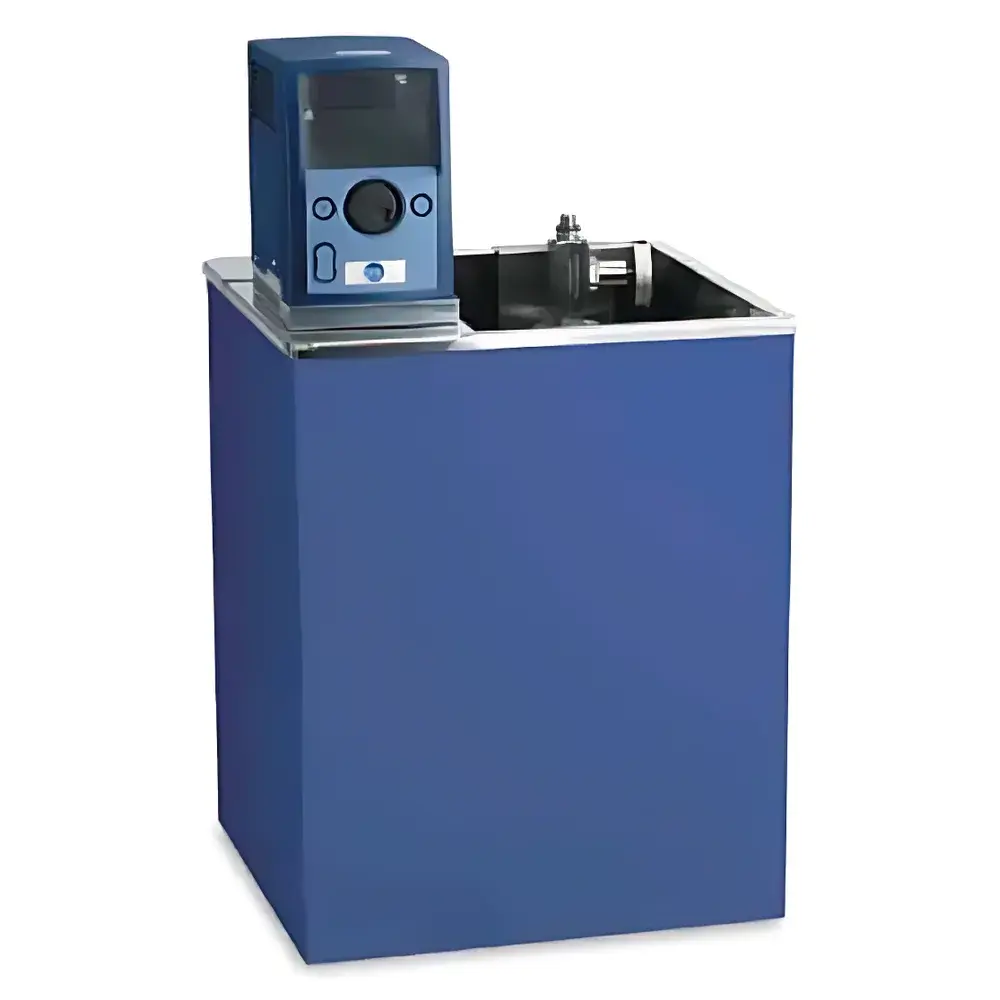
SETA Model 22220-4 Liquefied Petroleum Gas (LPG) Copper Strip Corrosion Test Bath
| Brand | SETA |
|---|---|
| Origin | United Kingdom |
| Model | 22220-4 |
| Temperature Range | Ambient to 100 °C |
| Temperature Stability | ±0.2 °C |
| Bath Volume | 38 L |
| Voltage | 110–120 V / 220–240 V, 50/60 Hz |
| Power Rating | 1.4 kW |
| Dimensions (W×D×H) | 60 × 35 × 33 cm |
| Weight | 9 kg |
| Test Positions | 3 |
| Control System | Digital PID temperature controller with LED display |
| Internal Agitation | Integrated mechanical stirrer |
Overview
The SETA Model 22220-4 Liquefied Petroleum Gas (LPG) Copper Strip Corrosion Test Bath is a precision-engineered thermal immersion system designed specifically for conducting standardized copper strip corrosion tests on liquefied petroleum gas samples. It operates in strict accordance with internationally recognized test methods—including ASTM D1838, ISO 6251, EN 26251 (obsolete), IP 411, SH/T 0232, BS 2000 Part 411, BS 6924, and NF M41-007—ensuring regulatory alignment across global refining, trading, and quality assurance laboratories. The instrument utilizes a thermostatically controlled liquid bath (typically filled with silicone oil or high-stability heat-transfer fluid) to maintain LPG sample containers at precisely defined temperatures during the prescribed exposure period. Copper strip specimens are immersed in the pressurized LPG phase within sealed test cells, while the bath provides stable thermal conditions essential for reproducible corrosion assessment. This configuration replicates real-world storage and handling conditions where sulfur-containing compounds (e.g., mercaptans, sulfides, elemental sulfur) react with copper surfaces—a critical indicator of product corrosivity and pipeline compatibility.
Key Features
- Triple-position test configuration enables concurrent evaluation of up to three copper strip specimens under identical thermal conditions, improving throughput without compromising inter-test consistency.
- Digital PID temperature controller with high-resolution LED display ensures setpoint accuracy within ±0.2 °C across the full operating range (ambient to 100 °C), minimizing thermal drift during extended 1–4 hour exposure periods.
- Integrated mechanical stirrer maintains uniform temperature distribution throughout the 38 L bath volume, eliminating localized hot/cold zones that could introduce measurement bias.
- Universal dual-voltage power supply (110–120 V and 220–240 V, 50/60 Hz) supports deployment in diverse laboratory environments without external transformers or voltage conversion hardware.
- Compact footprint (60 × 35 × 33 cm) and lightweight construction (9 kg) facilitate benchtop integration in QC labs with space constraints, while robust stainless-steel housing resists chemical exposure and mechanical wear.
- No internal pressure generation: the unit serves solely as a temperature-controlled immersion medium; all pressurized LPG handling occurs externally in certified test cells compliant with ASTM D1838 Annex A requirements.
Sample Compatibility & Compliance
The SETA 22220-4 is intended exclusively for use with standardized copper strip specimens (ASTM B152-compliant, 12.5 × 19 × 1.5 mm) housed in approved LPG test cells (e.g., glass or metal vessels rated for ≥1.4 MPa). It does not process raw LPG directly but provides the thermally stable environment required for the corrosion reaction to proceed under method-defined conditions. Its design adheres to the physical and operational specifications outlined in ASTM D1838 Section 6.2 (Bath Requirements) and ISO 6251 Clause 5.2. Laboratories implementing this instrument for regulatory reporting must validate bath temperature uniformity and stability per ASTM E2251 or ISO/IEC 17025 calibration protocols. Traceable NIST-traceable thermometer calibration and documented temperature mapping are recommended prior to GLP or ISO 9001 audits.
Software & Data Management
This instrument operates as a standalone analog-digital hybrid system with no embedded firmware or proprietary software. Temperature setpoints and real-time readings are managed via front-panel controls and LED display only—ensuring operational simplicity, long-term reliability, and immunity to cybersecurity vulnerabilities. For laboratories requiring electronic data capture, optional external USB or RS-232 data loggers (e.g., Omega OM-DAQPRO-5300 series) may be interfaced using standard PT100 probe inputs. All recorded temperature profiles must be archived with metadata (operator ID, test date, sample ID, method reference) to satisfy FDA 21 CFR Part 11 requirements for audit trails when used in regulated petroleum product release testing.
Applications
- Quality control of commercial LPG blends prior to distribution, verifying compliance with maximum allowable corrosion ratings (e.g., ASTM D1838 Class 1 or ISO 6251 “1b” rating).
- Refinery process optimization by correlating feedstock sulfur content with copper strip discoloration patterns observed under standardized bath conditions.
- Contractual arbitration between suppliers and end-users where corrosion test results serve as contractual acceptance criteria per EN 589 or GPA 2140 specifications.
- Research into inhibitor efficacy—evaluating how corrosion inhibitors affect copper reactivity in simulated LPG matrices under controlled thermal exposure.
- Training and method verification in petroleum testing laboratories seeking ISO/IEC 17025 accreditation for copper strip corrosion testing capability.
FAQ
Does the SETA 22220-4 generate pressure or handle LPG directly?
No. It is a temperature-controlled immersion bath only. LPG samples must be contained in externally pressurized, method-compliant test cells placed inside the bath.
What calibration standards are recommended for routine verification?
A NIST-traceable calibrated digital thermometer (±0.1 °C accuracy) inserted at three radial positions and two depths within the bath, per ASTM E2251 temperature mapping guidelines.
Can the bath accommodate alternative test methods beyond LPG corrosion?
While physically capable of maintaining temperature for other ASTM/IP/ISO immersion tests, its 3-position geometry and thermal profile are optimized for D1838/ISO 6251; validation per each new method is required.
Is the stirrer speed adjustable?
No. The integrated stirrer operates at a fixed, method-validated rotational speed to ensure consistent heat transfer without inducing cavitation or specimen movement.
What maintenance is required to sustain ±0.2 °C stability over time?
Annual verification of PID controller response, inspection of heater element resistance, and replacement of thermal fluid every 24 months or after 500 operational hours—whichever occurs first.






