
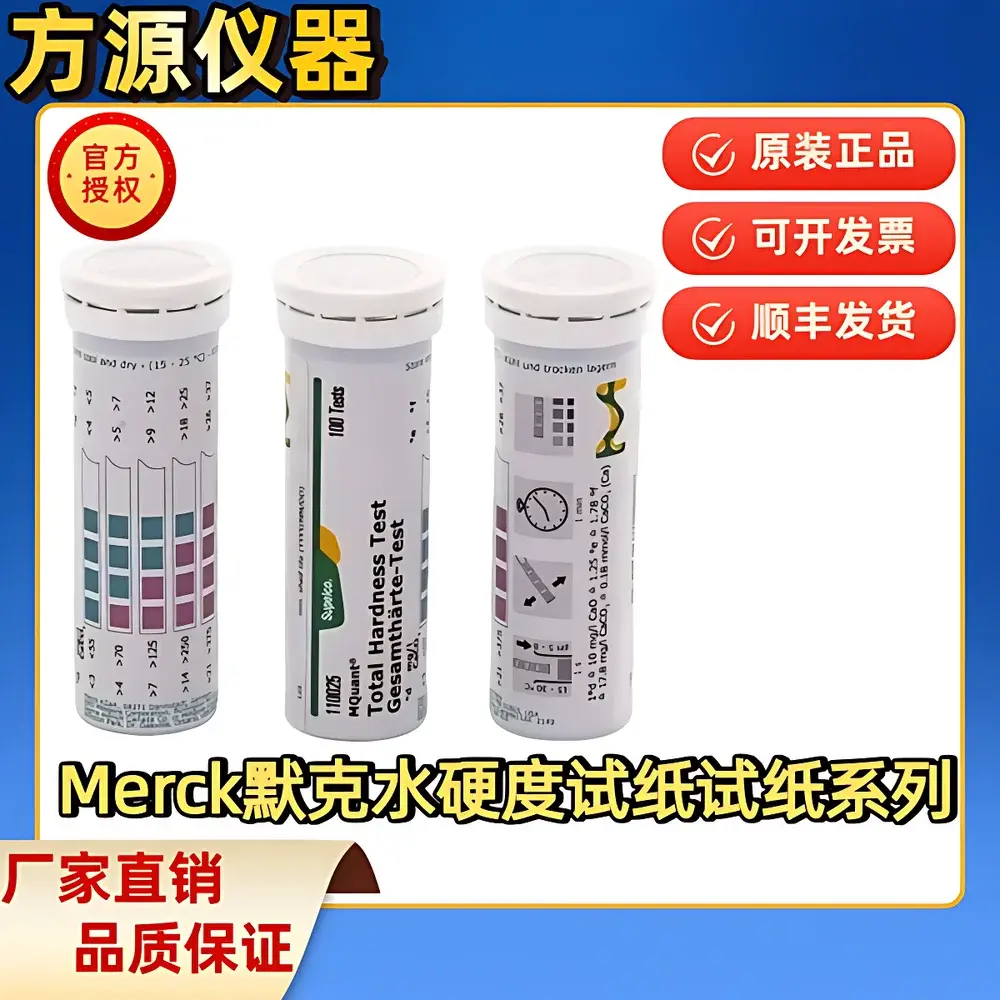
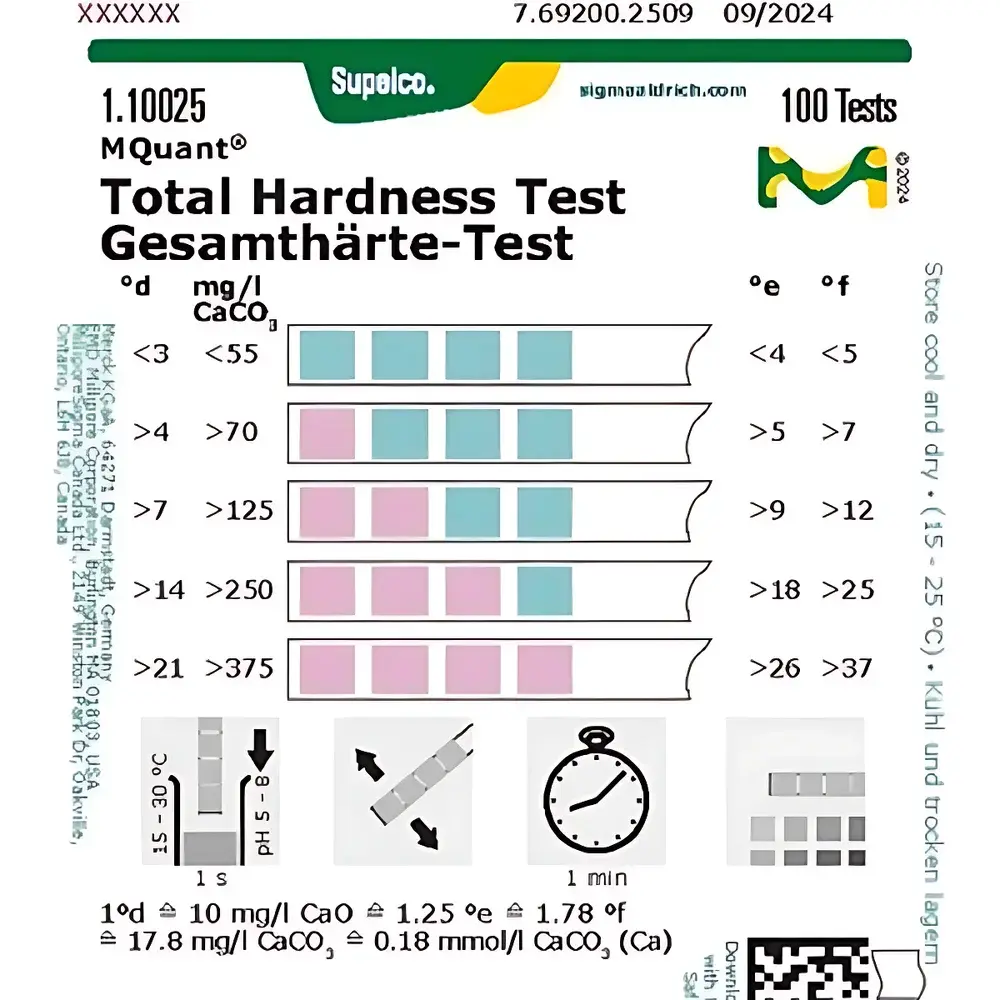
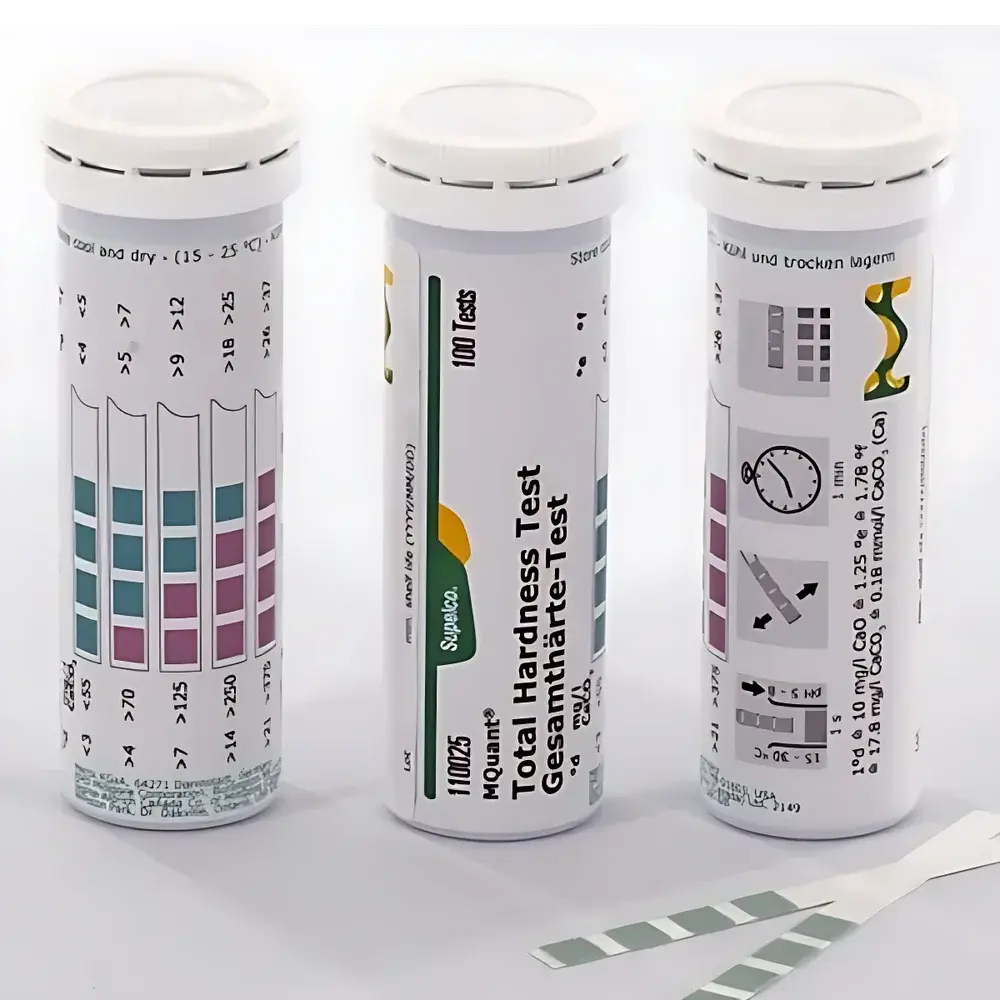
Merck MQuant® Total Hardness Test Strips
| Brand | Merck |
|---|---|
| Origin | USA |
| Manufacturer Type | Authorized Distributor |
| Product Category | Imported |
| Model Series | MQuant® Total Hardness Test Strips |
| Pricing | Available Upon Request |
Overview
The Merck MQuant® Total Hardness Test Strips are rapid, field-deployable colorimetric assay tools designed for the semi-quantitative determination of total water hardness—expressed as calcium carbonate (CaCO₃) equivalents—in drinking water, industrial process water, boiler feedwater, swimming pools, and environmental surface waters. Based on standardized complexometric chemistry, these test strips utilize a dual-indicator system (Eriochrome Black T and Calmagite) immobilized on inert polyester support, enabling visual detection of Ca²⁺ and Mg²⁺ ions across defined concentration ranges. The assay operates under buffered conditions (pH 10.0 ± 0.2), ensuring selective metal ion chelation and minimizing interference from transition metals or high alkalinity. Each strip is individually foil-wrapped to preserve reagent stability and calibrated against traceable NIST-traceable reference standards, supporting routine compliance screening in accordance with ISO 6059 and ASTM D1126 guidelines.
Key Features
- Pre-calibrated, single-use dip-and-read format requiring no instrumentation, power supply, or reagent preparation
- Two distinct measurement ranges: 0–200 mg/L and 0–500 mg/L CaCO₃, optimized for low- and medium-hardness applications
- Stable shelf life of ≥24 months when stored at 2–30 °C in original sealed packaging; no refrigeration required
- Color chart included with each vial, printed using ISO 12233-compliant grayscale and spectral-matched pigments for consistent visual interpretation under standard daylight (D65 illuminant)
- Batch-specific calibration certificates available upon request, documenting lot traceability and verification against certified reference materials (CRMs)
- CE-marked and compliant with EU Regulation (EC) No 765/2008 for conformity assessment of in vitro diagnostic-related environmental testing devices
Sample Compatibility & Compliance
The MQuant® Total Hardness Test Strips are validated for use with clear, non-turbid aqueous samples having turbidity <5 NTU and free chlorine 5 mg/L ClO₂), or high concentrations of iron (>0.3 mg/L Fe³⁺) or manganese (>0.1 mg/L Mn²⁺) may require pre-filtration or masking with potassium cyanide (as per ISO 6059 Annex B). The method meets the performance criteria for screening-level hardness assessment under EPA Method 130.1 (for drinking water) and ISO 6059:2022 (Water quality — Determination of total hardness — EDTA titrimetric method), serving as a validated alternative for rapid on-site verification where full titrimetric analysis is impractical. All lots undergo GLP-aligned manufacturing controls and are subject to internal QC release testing per Merck’s Quality Management System (ISO 9001:2015 certified).
Software & Data Management
As a manual, non-instrumented test system, the MQuant® Total Hardness Test Strips do not interface with digital software platforms or LIMS environments. However, Merck provides optional digital support tools including the free Merck Water Analysis Mobile App (iOS/Android), which enables users to capture strip images, auto-match color gradients against embedded reference libraries, log timestamps and location metadata (via GPS), and export PDF reports compliant with basic audit trail requirements. For regulated laboratories operating under 21 CFR Part 11, the app supports user authentication and electronic signature workflows when paired with Merck’s LabX® Lite data management module—though full Part 11 compliance requires integration with validated enterprise systems and documented validation protocols.
Applications
- Routine monitoring of municipal drinking water distribution points and point-of-use filters
- Pre-treatment verification for reverse osmosis and ion exchange systems in pharmaceutical water loops (PW/WFI)
- Boiler and cooling tower water management to prevent scale formation per ASME PTC 19.11 and VGB-R 450-L guidelines
- Environmental field surveys of rivers, lakes, and groundwater wells under national water framework directives
- Educational laboratory exercises demonstrating water chemistry principles and titration fundamentals
- Swimming pool and spa facility maintenance in alignment with WHO Guidelines for Safe Recreational Water Environments
FAQ
What is the detection principle behind the MQuant® Total Hardness Test Strips?
The strips rely on competitive complexation between Ca²⁺/Mg²⁺ ions and immobilized Eriochrome Black T dye under alkaline buffer conditions, inducing a violet-to-blue color shift proportional to total hardness.
Can these strips be used for seawater or brackish water analysis?
No—high ionic strength and Na⁺/K⁺ interference above 5,000 mg/L TDS invalidate the colorimetric response; use ICP-OES or titrimetric methods instead.
How should expired strips be disposed of?
Dispose as non-hazardous solid waste per local regulations; reagents contain <0.1% heavy metal indicators and pose no acute toxicity per GHS classification.
Is there a quantitative correlation between strip readings and EDTA titration results?
Yes—inter-method comparison studies show R² ≥ 0.98 within the 0–200 mg/L range when performed by trained personnel following ISO 6059 procedural controls.
Do Merck provide training or method validation documentation?
Yes—Merck offers downloadable application notes (AN-112, AN-147), SOP templates aligned with ISO/IEC 17025, and on-demand virtual technical workshops for laboratory staff certification.
Related Products







