Fangyuan YG815A Vertical Flame Resistance Tester for Textiles
| Brand | Fangyuan |
|---|---|
| Model | YG815A |
| Origin | Zhejiang, China |
| Compliance | GB/T 5455–1997, CPAI-84 (custom configuration) |
| Afterflame Timer Range | 0–999.9 s (0.1 s resolution) |
| Smolder Timer Range | 0–999.9 s (0.1 s resolution) |
| Ignition Time | 12 s (adjustable) |
| Flame Duration Stability | 30 s (adjustable) |
| Flame Height | 40 ± 2 mm |
| Igniter Tip Internal Diameter | 11 mm |
| Distance from Igniter Tip to Specimen | 17 mm at 25° tilt |
| Specimen Holder Dimensions | Outer 400 × 80 mm, Inner Aperture 360 × 50 mm |
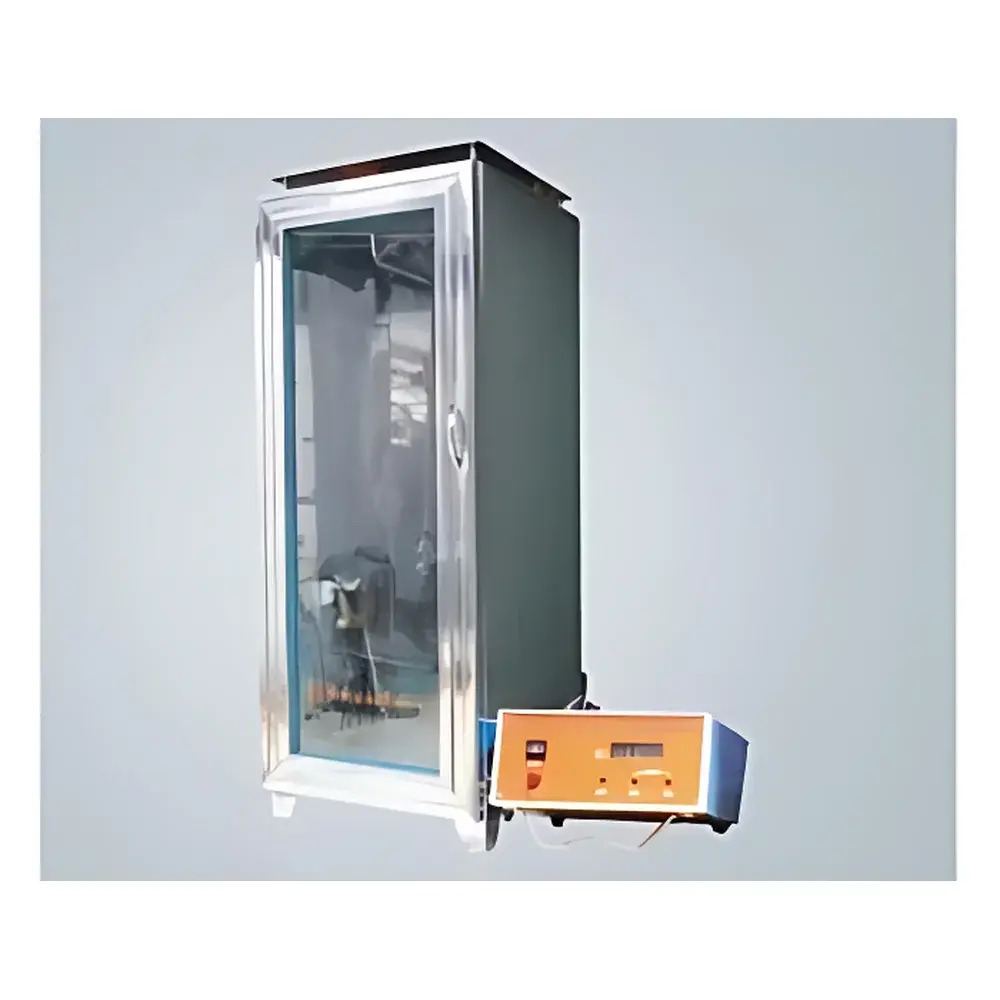
| Chamber Dimensions | 329 × 329 × 767 mm (L×W×H) |
| Overall Dimensions | 350 × 450 × 885 mm (L×W×H) |
| Control Box | 230 × 190 × 110 mm (L×W×H) |
| Power Supply | AC 220 V, 50 Hz |
Overview
The Fangyuan YG815A Vertical Flame Resistance Tester is a precision-engineered instrument designed specifically for evaluating the flame propagation behavior of textile materials under standardized vertical orientation conditions. It operates on the principle of controlled open-flame exposure, where a defined propane or butane flame is applied to the bottom edge of a vertically clamped fabric specimen for a fixed duration. The instrument quantifies three critical fire-response parameters: afterflame time (duration of flaming combustion after flame removal), smolder time (duration of glowing combustion without flame), and char length (extent of thermal degradation along the specimen axis). These metrics directly inform compliance with regulatory benchmarks for flame retardancy in apparel, protective workwear, upholstery, tents, and technical textiles—particularly where vertical orientation simulates real-world garment or curtain configurations.
Key Features
- Robust stainless-steel combustion chamber engineered for long-term thermal stability and corrosion resistance during repeated flame exposure cycles.
- Integrated flame-height calibration scale enables precise adjustment and verification of flame height at 40 ± 2 mm, ensuring strict adherence to GB/T 5455–1997 and CPAI-84 requirements.
- Electrically heated wire ignition system eliminates pilot flames and enhances operational safety, repeatability, and maintenance efficiency.
- Automated igniter positioning mechanism ensures consistent 17 mm tip-to-specimen distance at a fixed 25° tilt angle—critical for reproducible heat flux distribution across the test surface.
- Dual independent digital timers (LED display) with 0.1-second resolution for both afterflame and smolder measurements, supporting full traceability and GLP-aligned documentation.
- Optically clear front viewing window fabricated from high-transmittance tempered glass permits unobstructed visual monitoring of flame dynamics, char formation, and specimen deformation throughout testing.
- Top-mounted ventilation ducting and aerodynamically optimized chamber geometry minimize external airflow interference, thereby improving measurement fidelity under ambient laboratory conditions.
- Modular control box (230 × 190 × 110 mm) houses isolated power regulation and timing circuitry, facilitating serviceability and electromagnetic compatibility in shared lab environments.
Sample Compatibility & Compliance
The YG815A accommodates a broad spectrum of textile architectures including woven fabrics, knits, nonwovens, coated substrates, laminates, and multi-layer composites—provided specimens conform to standard dimensions (360 × 50 mm exposed area). Its mechanical design and procedural logic align with the fundamental test methodology outlined in GB/T 5455–1997, which remains widely referenced in Chinese textile quality assurance systems. For export-oriented applications, optional configuration supports CPAI-84 (Canvas Products Association International) requirements for flame resistance in recreational tent canopies and awnings. While not certified to ISO 6941 or ASTM D6413 by default, the instrument’s dimensional tolerances, flame geometry control, and timing accuracy meet foundational metrological prerequisites for method transfer and internal validation against those standards.
Software & Data Management
The YG815A operates as a standalone electromechanical tester without embedded microprocessor control or proprietary software. All timing functions are hardware-based, ensuring deterministic response and immunity to firmware anomalies. Test records—including ignition timestamp, flame-off timestamp, afterflame termination, smolder cessation, and operator annotations—are manually logged into standardized test sheets compliant with GLP documentation practices. Laboratories integrating the YG815A into regulated workflows (e.g., ISO/IEC 17025-accredited textile testing labs) commonly pair it with LIMS platforms via structured manual entry or barcode-assisted data capture. No electronic audit trail or 21 CFR Part 11 compliance is natively provided; however, its deterministic analog-digital hybrid architecture simplifies IQ/OQ validation protocols and supports retrospective review of physical test logs during regulatory audits.
Applications
- Quality control screening of flame-retardant finishes on military uniforms and industrial workwear per national procurement specifications.
- Pre-compliance assessment of tent fabrics prior to formal CPAI-84 certification testing.
- R&D evaluation of novel halogen-free flame retardants in polyester-cotton blends.
- Comparative analysis of char barrier performance between intumescent coatings and phosphorus-based back-coatings.
- Failure mode investigation of flame spread acceleration in seam-joined textile assemblies.
- Training and demonstration of vertical flame test principles in textile engineering curricula.
FAQ
What flame gas is recommended for use with the YG815A?
Propane or commercial-grade butane is specified in GB/T 5455–1997; cylinder pressure regulators must maintain stable flow to sustain 40 ± 2 mm flame height.
Can the YG815A be used for testing non-textile materials such as foams or films?
No—the specimen holder geometry, clamping force, and flame impingement angle are optimized exclusively for flexible planar textiles; deviations compromise result validity.
Is third-party calibration available for the timing circuits?
Yes—NIST-traceable stopwatch calibration services can be applied to the dual LED timers; calibration certificates are issued per ISO/IEC 17025 requirements.
Does the instrument include exhaust gas treatment?
No—it requires connection to an externally ducted fume hood meeting ≥150 fpm face velocity at the chamber opening to ensure safe venting of combustion byproducts.
How frequently should the igniter tube be cleaned or replaced?
Inspection and light brushing with stainless-steel bristles are recommended after every 20 test cycles; replacement is advised if internal bore diameter deviates beyond ±0.3 mm due to carbon buildup.