
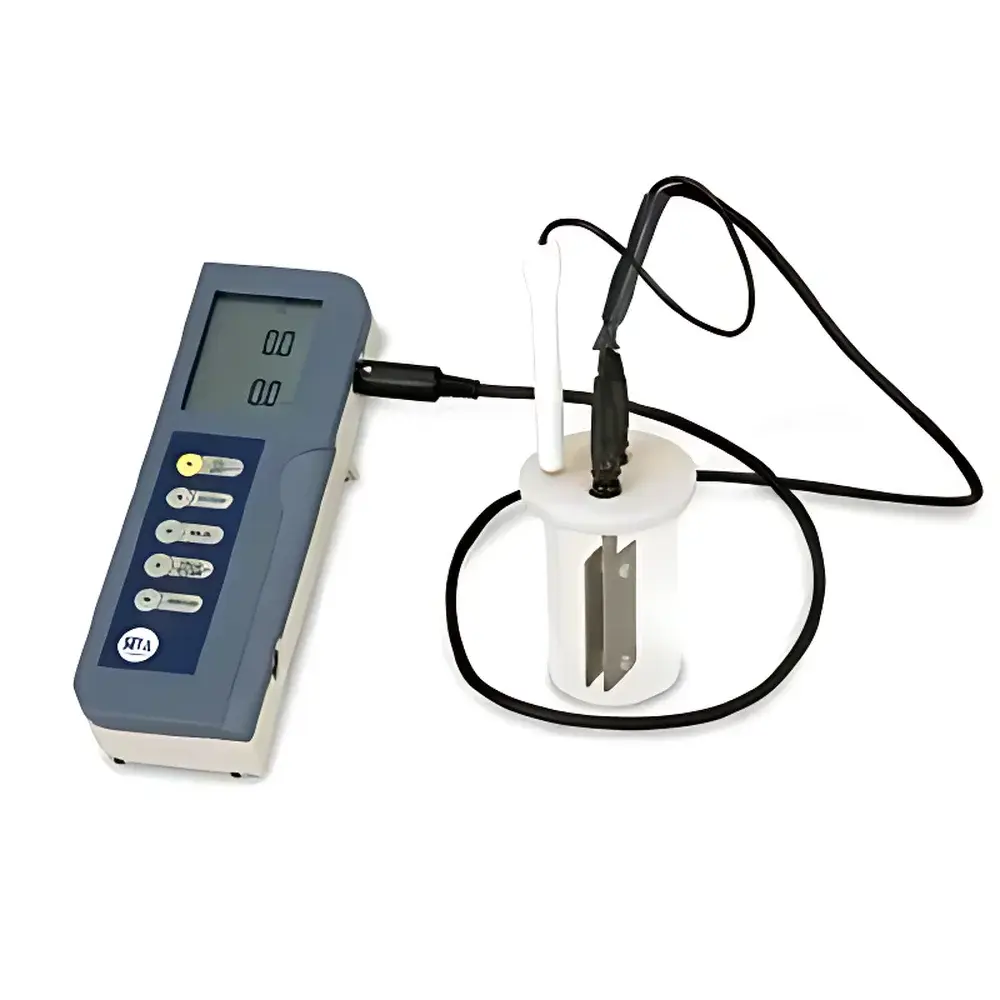
SETA Model 99700-4 Portable Salt Content Analyzer for Crude Oil and Distillates
| Brand | SETA |
|---|---|
| Origin | United Kingdom |
| Model | 99700-4 |
| Conductivity Range | 0.0 to 430.0 g/m³ (as NaCl) |
| Temperature Range | −20 °C to +150 °C |
| Power Supply | 9 V alkaline battery or universal AC adapter (110–240 V, 50/60 Hz) |
| Dimensions | 200 × 70 × 35 mm |
| Weight | 1.6 kg |
| Compliance | ASTM D3230, IP 265 |
| Interface | RS232 serial output |
Overview
The SETA Model 99700-4 Portable Salt Content Analyzer is an engineered field-deployable instrument designed for rapid, on-site quantification of inorganic salt concentration—primarily sodium chloride—in crude oil, refined petroleum distillates, and hydrocarbon process streams. It operates on the principle of electrical conductivity measurement of the aqueous phase extracted from the sample using a standardized solvent extraction procedure (per ASTM D3230 and IP 265). The analyzer measures the conductance of the extracted brine solution, which correlates directly with total dissolved salt content. This correlation is calibrated against certified reference standards traceable to NIST and UKAS-accredited laboratories. Unlike laboratory-based coulometric or potentiometric methods, the 99700-4 delivers field-ready reproducibility without requiring reagent handling, titration, or high-voltage excitation—making it suitable for routine QC checks at wellheads, terminals, refineries, and marine loading facilities where real-time salt monitoring informs desalting efficiency, corrosion risk assessment, and custody transfer compliance.
Key Features
- True portable architecture: Compact form factor (200 × 70 × 35 mm) and lightweight design (1.6 kg) enable handheld operation in confined spaces or mobile lab environments.
- Dual-standard method selection: Dedicated firmware switch between ASTM D3230 and IP 265 protocols ensures regulatory alignment across international operations and third-party inspection regimes.
- Integrated temperature compensation: Built-in Pt100 RTD sensor continuously monitors extraction solution temperature (−20 °C to +150 °C), applying real-time correction to conductivity readings per standard-defined algorithms.
- Pre-calibrated conductivity cell: Factory-trimmed electrode system eliminates user calibration drift; verified linearity across full 0.0–430.0 g/m³ range with ±2% full-scale accuracy under controlled reference conditions.
- Ruggedized enclosure: IP65-rated housing with chemical-resistant polycarbonate body and sealed membrane keypad provides resistance to hydrocarbon vapors, rain, dust, and incidental splash exposure.
- Flexible power options: Operates continuously for >8 hours on standard 9 V alkaline battery or indefinitely via universal AC adapter (110–240 V, 50/60 Hz), supporting both remote field use and fixed station deployment.
Sample Compatibility & Compliance
The 99700-4 is validated for use with crude oils (including heavy and sour grades), naphthas, kerosenes, gas oils, and light fuel oils meeting ISO 8217 specifications. Sample preparation follows strict adherence to ASTM D3230 Section 7 (solvent extraction using isopropanol/water mixture) and IP 265 Clause 6 (methanol/water extraction). The instrument’s measurement uncertainty budget accounts for interferences from organic acids, hydrogen sulfide, and residual emulsifiers when present within typical refinery stream limits. All firmware logic and data handling comply with GLP documentation requirements—including timestamped result logging, operator ID input, and method version tracking. While not FDA 21 CFR Part 11-certified (as it lacks electronic signature functionality), audit trails generated via RS232 export are compatible with LIMS integration for regulated environments requiring ALCOA+ data integrity principles.
Software & Data Management
Raw measurement data—including conductivity value (µS/cm), compensated salt concentration (g/m³), extraction temperature (°C), method identifier (ASTM/IP), date/time stamp, and operator code—is transmitted via RS232 serial interface at 9600 baud, 8N1 configuration. A dedicated Windows-compatible terminal application (provided on USB drive) enables batch download, CSV export, trend charting, and report generation compliant with internal QA templates. No proprietary drivers are required; the device appears as a standard COM port. Exported datasets retain native precision (0.1 g/m³ resolution) and include embedded metadata headers for traceability. Data files are structured to support automated ingestion into enterprise SCADA systems or cloud-based asset integrity platforms via middleware scripting.
Applications
- Crude assay pre-screening prior to desalter commissioning or optimization
- Monitoring salt breakthrough during electrostatic desalter operation
- Verification of post-treatment salt removal efficacy in fractionation units
- Field verification of custody transfer specifications per API RP 1172 and ISO 10438
- Corrosion management programs targeting chloride-induced stress cracking in downstream piping
- Training and competency assessment for refinery lab technicians and field operators
FAQ
Does the 99700-4 require daily recalibration?
No—its factory-preconditioned conductivity cell maintains stability for ≥6 months under normal field use. Verification against a single-point check standard (e.g., 100 g/m³ NaCl reference solution) is recommended before each shift.
Can it measure salts other than NaCl?
The instrument reports results “as NaCl” by default, based on the equivalent conductance of chloride ions. Non-chloride salts (e.g., CaCl₂, MgCl₂) contribute proportionally but require manual conversion factors per ASTM D3230 Annex A3.
Is the RS232 interface compatible with modern laptops?
Yes—when used with a USB-to-serial adapter (FTDI chipset recommended), the interface functions reliably on Windows 10/11, macOS, and Linux systems running standard terminal emulation software.
What maintenance is required beyond battery replacement?
Annual inspection of electrode surface cleanliness and O-ring integrity is advised. Cleaning protocol uses deionized water followed by isopropanol rinse—no abrasive agents or ultrasonic treatment permitted.
How is temperature measurement accuracy validated?
The integrated Pt100 sensor is calibrated at three points (0 °C, 25 °C, 100 °C) during final assembly and certified per ISO/IEC 17025; certificate included with unit shipment.





