
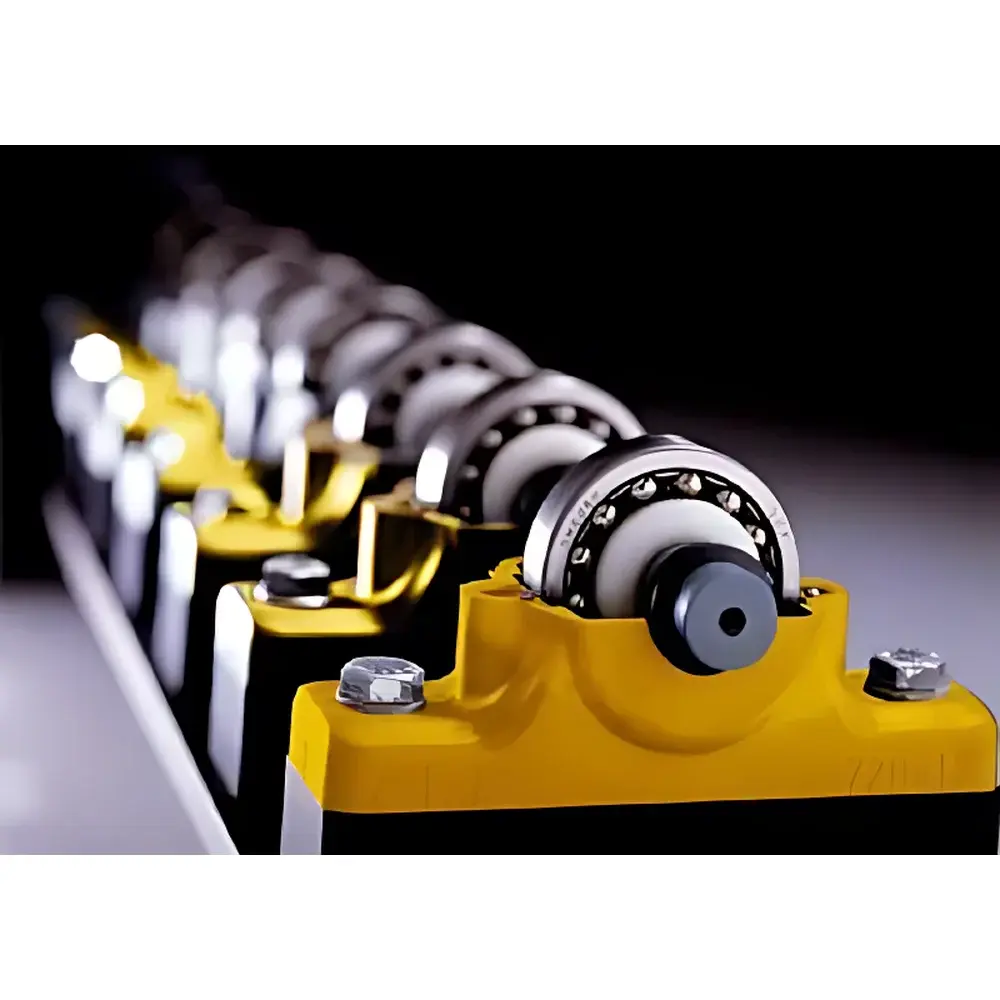
SKF EMCOR Dynamic Rust Inhibiting Test Apparatus
| Brand | SKF |
|---|---|
| Origin | Austria |
| Model | SKF EMCOR |
| Standard Compliance | ASTM D6138, ISO 11007 (equivalent to SH/T 0700), DIN 51802 |
| Rotational Speed | 80 rpm |
| Test Positions | 8 |
| Test Bearing | SKF 1306K / 236725 |
| Test Duration | 8 h per cycle × 3 cycles |
| Rust Evaluation | Visual inspection and quantitative assessment of outer raceway corrosion using calibrated dial gauge |
| Optional Accessory | Wash-out spray unit |
| Mounting | Precision-engineered test bench with standardized grease application fixture |
Overview
The SKF EMCOR Dynamic Rust Inhibiting Test Apparatus is an internationally recognized benchtop instrument engineered for the quantitative evaluation of rust-preventive performance of lubricating greases under controlled dynamic conditions. Based on the fundamental principle of simulating real-world bearing operation in humid, corrosive environments, the apparatus subjects pre-greased standardized bearings to continuous rotation at 80 rpm while maintaining defined temperature and humidity exposure over three consecutive 8-hour cycles. This replicates the electrochemical and mechanical stress conditions that initiate oxidation and surface degradation in rolling element contacts. Designed in strict accordance with ASTM D6138, ISO 11007 (identical to Chinese standard SH/T 0700), and DIN 51802, the system delivers reproducible, inter-laboratory comparable results essential for formulation validation, quality control, and regulatory submission in lubricant R&D and manufacturing.
Key Features
- Eight independent test stations enabling parallel evaluation of multiple grease samples or formulation variants under identical environmental conditions.
- Pre-calibrated SKF 1306K deep groove ball bearings (or equivalent 236725 metric variant) as standardized test substrates—ensuring geometric and metallurgical consistency across global laboratories.
- High-precision rotational drive system maintaining stable 80 rpm ± 0.5 rpm throughout the full 24-hour cumulative test duration (3 × 8 h).
- Dedicated test bench with integrated grease application fixture, guaranteeing uniform film thickness and distribution on the outer raceway prior to cycling.
- Optional Wash-out spray unit compliant with ASTM D1263 and ISO 11007 Annex B, enabling accelerated evaluation of water resistance and grease retention under simulated rain or condensation exposure.
- Robust stainless-steel construction and sealed electronics designed for long-term operation in controlled-humidity chambers or climate-controlled QC labs.
Sample Compatibility & Compliance
The SKF EMCOR system accommodates all NLGI-consistency-classified greases—including lithium, calcium-sulfonate, polyurea, and complex-soap-based formulations—without modification to hardware or procedure. Its design satisfies the physical and metrological requirements of major international standards: ASTM D6138 (Standard Test Method for Determining Rust-Preventive Characteristics of Lubricating Grease in the Presence of Water and Humidity), ISO 11007 (Petroleum products — Greases — Determination of rust-preventive properties), and DIN 51802 (Testing of lubricating greases — Rust protection test). The apparatus supports GLP-compliant workflows through traceable calibration records, documented maintenance logs, and operator-accessible parameter verification protocols. It is routinely deployed in third-party certification labs accredited to ISO/IEC 17025 and used in support of OEM technical specifications requiring rust-inhibition validation per SAE J1919 or OEM-specific grease qualification matrices.
Software & Data Management
While the core EMCOR apparatus operates as a hardware-controlled test platform without embedded software, its operational parameters are fully compatible with laboratory information management systems (LIMS) and electronic lab notebooks (ELN) via standardized RS-232 or optional USB interface. Test initiation, cycle timing, and environmental chamber synchronization can be logged externally using validated data acquisition modules compliant with FDA 21 CFR Part 11 requirements when integrated into regulated environments. All rust assessment data—including dial gauge readings (in 0.01 mm increments), photographic documentation of outer raceway surfaces, and pass/fail classification per ISO 11007 severity scale (0–5)—are structured for audit-ready reporting and statistical process control (SPC) analysis.
Applications
- Formulation development of anti-rust additives and base oil–thickener synergies in industrial and automotive greases.
- Batch-to-batch quality verification for grease manufacturers supplying to wind turbine, railway, and mining equipment OEMs.
- Comparative benchmarking against competitor products during technical tender submissions.
- Root-cause analysis of field failures linked to insufficient rust inhibition under high-humidity storage or intermittent operation.
- Supporting regulatory filings for lubricants intended for use in food-grade (ISO 21469) or marine (ISO 12922) applications where corrosion resistance is a critical performance criterion.
FAQ
What bearing types are required for ASTM D6138 compliance?
The standard mandates the use of SKF 1306K (or its dimensional and metallurgical equivalent, such as 236725), manufactured to ABEC-3 tolerance with uncoated 52100 bearing steel surfaces.
Can the EMCOR apparatus be used for oil-based rust inhibitors?
No—ASTM D6138 and ISO 11007 are explicitly limited to grease-phase materials; liquid lubricants require alternative methods such as ASTM D665 or D1748.
Is calibration of the dial gauge included in routine maintenance?
Yes—users must verify gauge linearity annually against NIST-traceable reference standards; calibration certificates are maintained per ISO/IEC 17025 requirements.
Does the Wash-out accessory meet any specific spray pattern specifications?
Yes—the optional unit delivers a defined 0.5 L/min flow rate at 2.5 bar pressure through a calibrated nozzle, producing a conical spray pattern meeting ISO 11007 Annex B geometry requirements.
How is rust severity quantified post-test?
Rust coverage on the outer raceway is assessed visually using the ISO 11007 five-point scale (0 = no rust, 5 = >50% surface coverage), supplemented by depth measurement using a calibrated dial indicator referenced to ISO 11007 Figure A.1.





