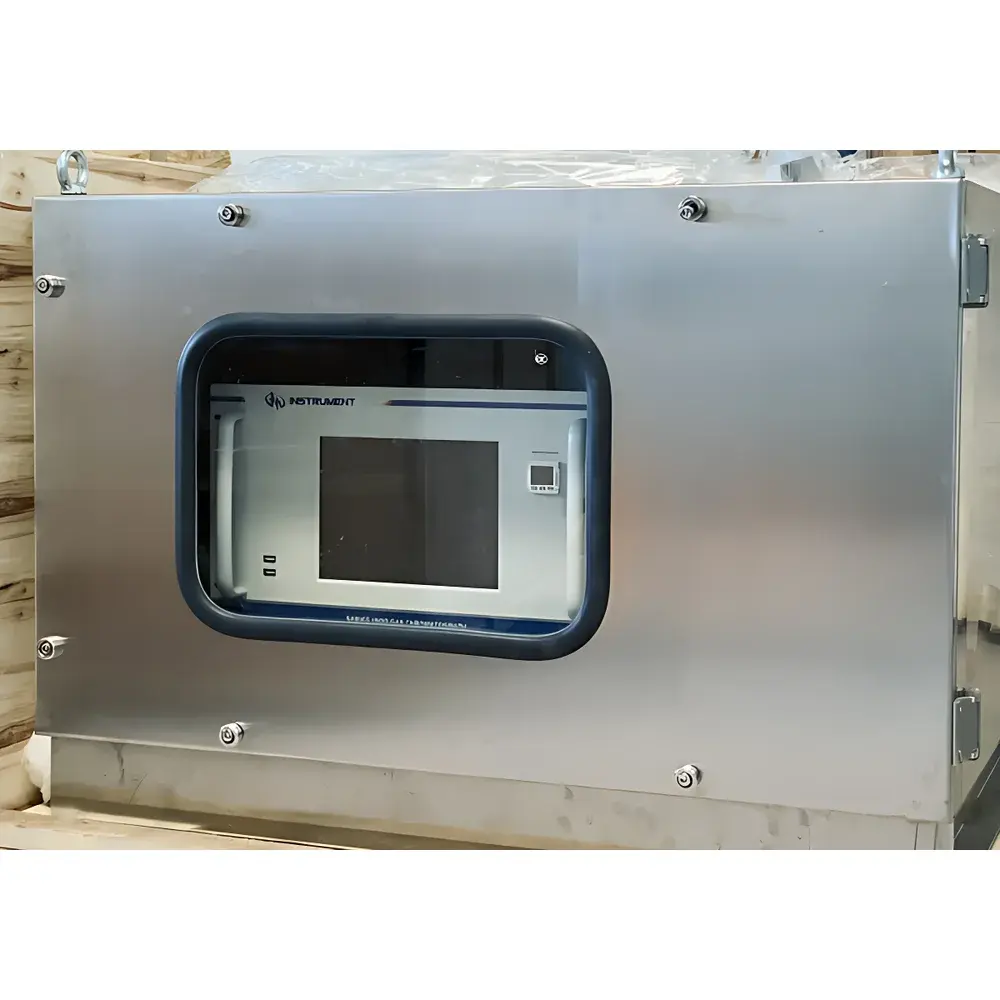
GM 1900 Explosion-Proof Series Online Gas Chromatograph
| Brand | GAOMAI |
|---|---|
| Origin | Beijing, China |
| Model | GM 1900 Explosion-Proof Series |
| Explosion Protection Mark | Ex de ib mb px IIC T4 Gb |
| IP Rating | ≥IP65 |
| Positive Pressure Range | 0–2069 Pa |
| Purge Time | 0–999 min (adjustable) |
| Alarm & Cut-off Pressure | 0–2069 Pa (adjustable) |
| Cabinet Dimensions | 90 cm × 75 cm × 50 cm |
| Gas Piping | EP-grade stainless steel tubing with orbital welding or VCR fittings |
| Pre-shipment Tests | Pressure hold, leak detection, moisture analysis, oxygen analysis, particle count |
| Compliance | Certified by National Supervisory Inspection Center for Explosion-Protected Instrumentation (Cert. No.: GYB21.3140X) |
Overview
The GM 1900 Explosion-Proof Series Online Gas Chromatograph is an industrial-grade, continuously operating gas analysis system engineered for real-time compositional monitoring in hazardous locations classified under Class II explosive gas atmospheres (Zones 1 and 2) and combustible dust environments (Zones 21 and 22). Built upon proven capillary column gas chromatography principles, the system separates volatile and semi-volatile gaseous components using temperature-programmed oven control, high-stability carrier gas flow regulation, and selective detection—typically via thermal conductivity (TCD) or flame ionization (FID) detectors, configurable per application requirements. Unlike laboratory GC systems, the GM 1900 integrates process interface hardware—including sample conditioning, pressure regulation, and automated valving—within a certified explosion-proof enclosure, enabling direct installation at the point of measurement without requiring remote sampling lines or secondary safety barriers.
Key Features
- UL/IEC-compliant explosion-proof cabinet (Ex de ib mb px IIC T4 Gb, GYB21.3140X certified) rated for continuous operation in Zone 1/2 and Dust Zone 21/22 environments
- Hermetically sealed positive-pressure enclosure with adjustable purge flow (0–999 min), real-time pressure monitoring (0–2069 Pa), and dual-stage alarm/cut-off thresholds
- EP-grade stainless steel gas plumbing throughout—orbital welded or VCR-connected—to ensure ultra-low permeability, oxygen/moisture retention <10 ppb, and particulate-free delivery
- Full pre-shipment validation: five-point verification protocol including pressure hold test, helium leak detection (<1×10⁻⁹ mbar·L/s), residual moisture (<0.1 ppmv), oxygen content (<10 ppb), and airborne particle count (<10 particles/ft³ @ 0.1 µm)
- Front-access explosion-resistant viewing window (2 J impact rating), rear service door, and slide-out instrument chassis for field maintenance without cabinet disassembly
- Integrated acoustic-optical alarm output, 4–20 mA analog outputs, and dry-contact relay signals compliant with SIL 2 functional safety requirements
- Robust mechanical design: fully welded stainless steel frame, anti-vibration mounting, ESD-safe grounding, and corrosion resistance validated for outdoor deployment in Pollution Degree 3 environments (IEC 60664-1)
Sample Compatibility & Compliance
The GM 1900 supports analysis of permanent gases (H₂, O₂, N₂, CH₄, CO, CO₂), light hydrocarbons (C₁–C₆), sulfur compounds (H₂S, COS), and specialty process gases (e.g., NH₃, Cl₂, HF) across concentration ranges from sub-ppm to 100% v/v. Sample introduction utilizes heated, chemically inert sample lines with integrated particulate filtration, coalescing separators, and pressure-regulated flow control. The system meets applicable portions of ISO 8573-1 (compressed air purity), ASTM D1945/D1946 (gas analysis by GC), and IEC 60079-0/-13/-14/-26 (explosion protection standards). It is designed for integration into plant-wide safety instrumented systems (SIS) and complies with electromagnetic compatibility (EMC) requirements per IEC 61326-1 and environmental stress testing per IEC 60068-2 series.
Software & Data Management
Data acquisition and instrument control are managed via embedded Linux-based firmware supporting Modbus TCP/RTU, OPC UA, and Ethernet/IP protocols for seamless integration into DCS, SCADA, or MES platforms. Chromatographic data—including retention time alignment, peak integration, calibration curve management, and diagnostic logs—is stored locally on industrial-grade SSD with optional redundant backup. Audit trails record all configuration changes, calibration events, and alarm activations with user ID and timestamp, satisfying FDA 21 CFR Part 11 and EU Annex 11 requirements for electronic records and signatures when deployed in regulated manufacturing environments. Remote diagnostics and firmware updates are supported over secure TLS-encrypted connections.
Applications
The GM 1900 serves critical online analytical roles in industries where process safety and compositional accuracy are non-negotiable: cryogenic air separation units (ASU) for O₂/N₂/Ar purity assurance; refinery fluid catalytic cracking (FCC) and hydroprocessing off-gas monitoring; hydrogen production and fuel cell feedstock qualification; blast furnace top gas analysis in integrated steelworks; high-purity electronic specialty gas certification (e.g., silane, phosphine); and propellant and energetic material synthesis in defense applications. Its ruggedized architecture enables long-term unattended operation with scheduled preventive maintenance intervals exceeding 12 months under typical industrial conditions.
FAQ
What hazardous area classifications does the GM 1900 support?
It is certified for use in Class II, Division 1 & 2 (NEC) / Zone 1 & 2 (IEC) explosive gas atmospheres and Zone 21 & 22 combustible dust environments.
Is the system compatible with existing plant automation infrastructure?
Yes—it provides native Modbus TCP, OPC UA, and 4–20 mA analog outputs for integration with DCS, PLC, and safety systems.
Can the cabinet be installed outdoors?
Yes—the IP65-rated enclosure, corrosion-resistant finish, and pollution degree 3 rating permit direct outdoor mounting without sheltering.
What pre-shipment validation tests are performed?
Five mandatory tests: pressure hold, helium leak detection, moisture analysis, oxygen analysis, and airborne particle counting—all documented in the factory acceptance test (FAT) report.
Does the system support regulatory compliance for pharmaceutical or food-grade gas applications?
When configured with appropriate detectors, columns, and validation documentation, it meets USP , ISO 8573-1 Class 1, and GMP-aligned data integrity requirements.
Related Products