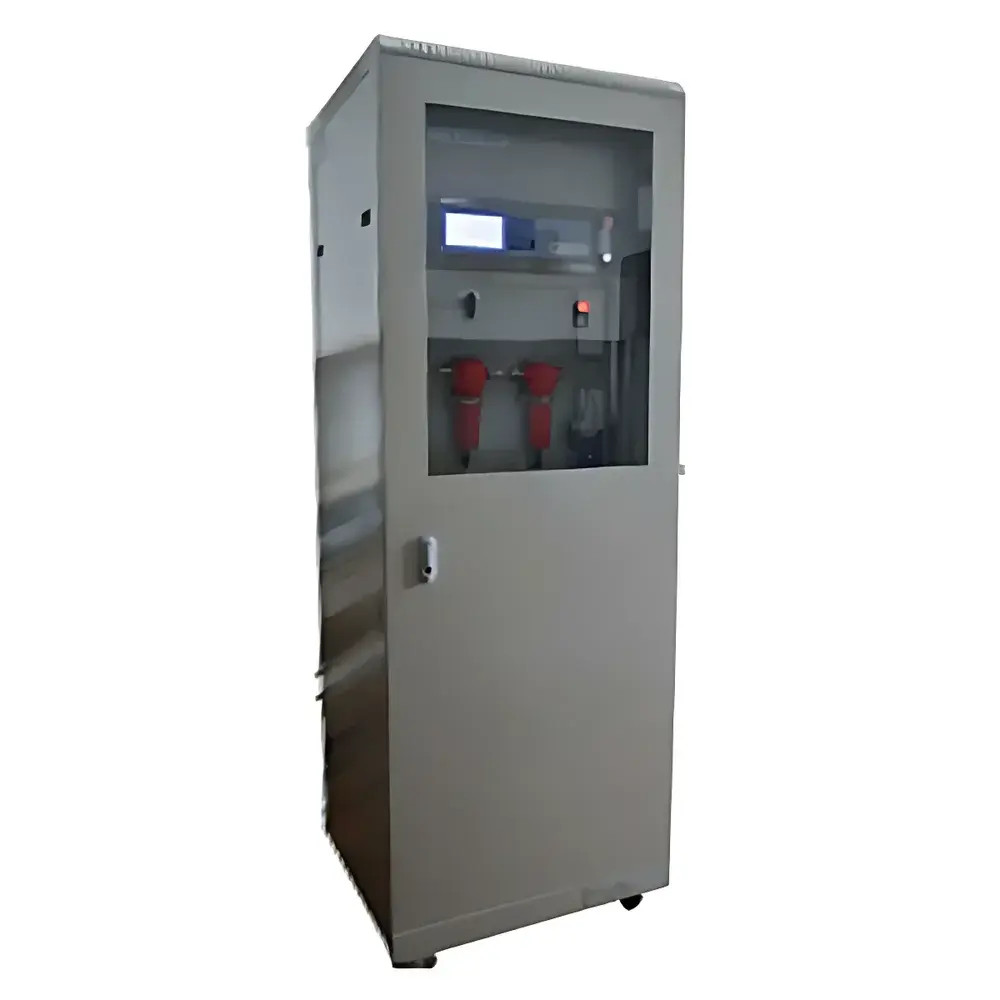
GAOMAI GM-800 Medical Oxygen Online Analyzer System
| Brand | GAOMAI |
|---|---|
| Origin | Beijing, China |
| Model | GM-800 |
| Price Range | USD 14,000 – 42,500 (FOB) |
| Linearity Error | ±2% FS |
| Repeatability | <0.5% FS |
| Drift | <1% FS/7 days |
| Response Time | ≤60 s |
| Explosion Protection | Not rated |
| Sensor Type | Imported Electrochemical Oxygen Sensor |
| Output Signal | 4–20 mA DC (isolated), RS-485 Modbus RTU |
| Power Supply | 220 VAC ±10%, 50/60 Hz |
| Operating Temperature | 0–45 °C |
| Enclosure Rating | IP65 |
| Calibration Interval | Recommended every 3–6 months |
Overview
The GAOMAI GM-800 Medical Oxygen Online Analyzer System is a dedicated, CE-compliant continuous gas monitoring solution engineered for real-time oxygen concentration measurement in medical-grade oxygen supply lines, central gas pipelines, and hospital bulk storage facilities. It operates on the principle of high-stability electrochemical sensing—utilizing a temperature-compensated, long-life galvanic cell sensor with diffusion-limited current response to O₂ partial pressure. Unlike paramagnetic or zirconia-based analyzers, this system prioritizes clinical safety, regulatory traceability, and low-maintenance operation under ambient indoor conditions typical of healthcare infrastructure. The GM-800 is not intended for hazardous area deployment (e.g., operating rooms with flammable anesthetics) due to its non-explosion-proof enclosure; instead, it is optimized for installation in equipment rooms, gas manifold cabinets, and sterilization support zones where ambient air quality, humidity control, and stable power are maintained per ISO 7396-1:2016 and HTM 02-01 (UK NHS) guidelines.
Key Features
- Imported electrochemical O₂ sensor with factory calibration certificate and documented shelf-life specification (typically ≥24 months)
- Integrated signal conditioning module delivering linearized 4–20 mA analog output with HART compatibility option (upon request)
- Real-time digital display (backlit LCD) showing %v/v O₂, status flags (e.g., “CAL”, “ALARM”, “SENSOR FAULT”), and elapsed time since last calibration
- Programmable dual-stage alarm outputs (relay contacts): low-O₂ threshold (e.g., 99.5% v/v), configurable via front-panel keypad or Modbus register write
- Auto-zero stabilization algorithm compensating for minor baseline drift during idle periods without requiring span gas
- Rugged IP65-rated stainless steel and polycarbonate enclosure suitable for cleanroom-adjacent environments and routine disinfection protocols
- No consumables beyond periodic sensor replacement (recommended every 18–24 months depending on cumulative exposure hours and ambient CO₂/SO₂ levels)
Sample Compatibility & Compliance
The GM-800 is validated for use with dry, particle-free medical oxygen streams meeting ISO 8573-1:2010 Class 2:2:2 (oil-free, ≤0.1 µm particulates, dew point ≤−40 °C). It is incompatible with humidified or aerosol-laden gas streams, oxidizing mixtures containing nitrous oxide or halogenated agents, or pipelines carrying liquid-phase cryogenic oxygen. System design complies with IEC 61000-6-2 (immunity) and IEC 61000-6-3 (emissions). While not certified to ATEX or IECEx, its electrical architecture conforms to IEC 61010-1 for laboratory and industrial measurement equipment. Documentation includes Factory Acceptance Test (FAT) report, sensor calibration record, and Declaration of Conformity aligned with EU Medical Device Regulation (MDR) Annex II requirements for ancillary monitoring devices supporting Class IIa medical systems.
Software & Data Management
Data logging is supported via optional RS-485 interface using Modbus RTU protocol (function codes 03h/04h for holding/input registers). Compatible with SCADA platforms including Siemens Desigo CC, Honeywell Experion PKS, and open-source solutions such as Node-RED or Ignition Edge. The system supports timestamped event logging (alarm triggers, power cycles, calibration actions) with local storage buffer (1,024 entries). Audit trail functionality meets GLP/GMP expectations when integrated with validated Historian software; however, native FDA 21 CFR Part 11 compliance requires external electronic signature and audit log management layers deployed at the supervisory system level.
Applications
- Continuous verification of USP ® Grade A oxygen purity (≥99.0% v/v) in hospital central supply networks
- Monitoring O₂ concentration downstream of pressure swing adsorption (PSA) generators and cryogenic vaporizers
- Alarm interlock integration with emergency venting valves in oxygen manifold rooms per NFPA 99 Chapter 5
- Periodic validation support for ISO 13485-certified medical gas manufacturers conducting process consistency audits
- Baseline trending for predictive maintenance of oxygen concentrators and compressor systems
FAQ
Is the GM-800 compliant with USP & EP monographs for medicinal oxygen?
Yes—the analyzer’s measurement range (0–100% v/v O₂), linearity (±2% FS), and repeatability (<0.5% FS) satisfy the instrumental performance criteria outlined in USP ® General Chapter <911> and Ph. Eur. 2.5.27.
Can it be installed directly in an operating theater gas outlet panel?
No—due to absence of explosion protection rating and lack of medical electrical safety certification (IEC 60601-1), installation must occur upstream of terminal outlets, typically in mechanical plant rooms or gas distribution cabinets.
What calibration gases are required for routine verification?
A single certified reference material (CRM) of 21.0% O₂ in N₂ (certified to ISO 6141) is sufficient for zero/span verification; full multi-point calibration is not required for medical O₂ applications within specification limits.
Does the system support remote diagnostics or firmware updates?
Firmware updates require physical USB connection and proprietary GAOMAI configuration tool; remote diagnostics are limited to Modbus register polling for operational status and error codes.
How often must the sensor be replaced?
Under typical hospital duty cycles (continuous operation, ambient temperature <35 °C, no exposure to hydrocarbons or chlorine compounds), sensor service life is 18–24 months—documented in the OEM’s Technical Service Bulletin TSB-GM800-03.