
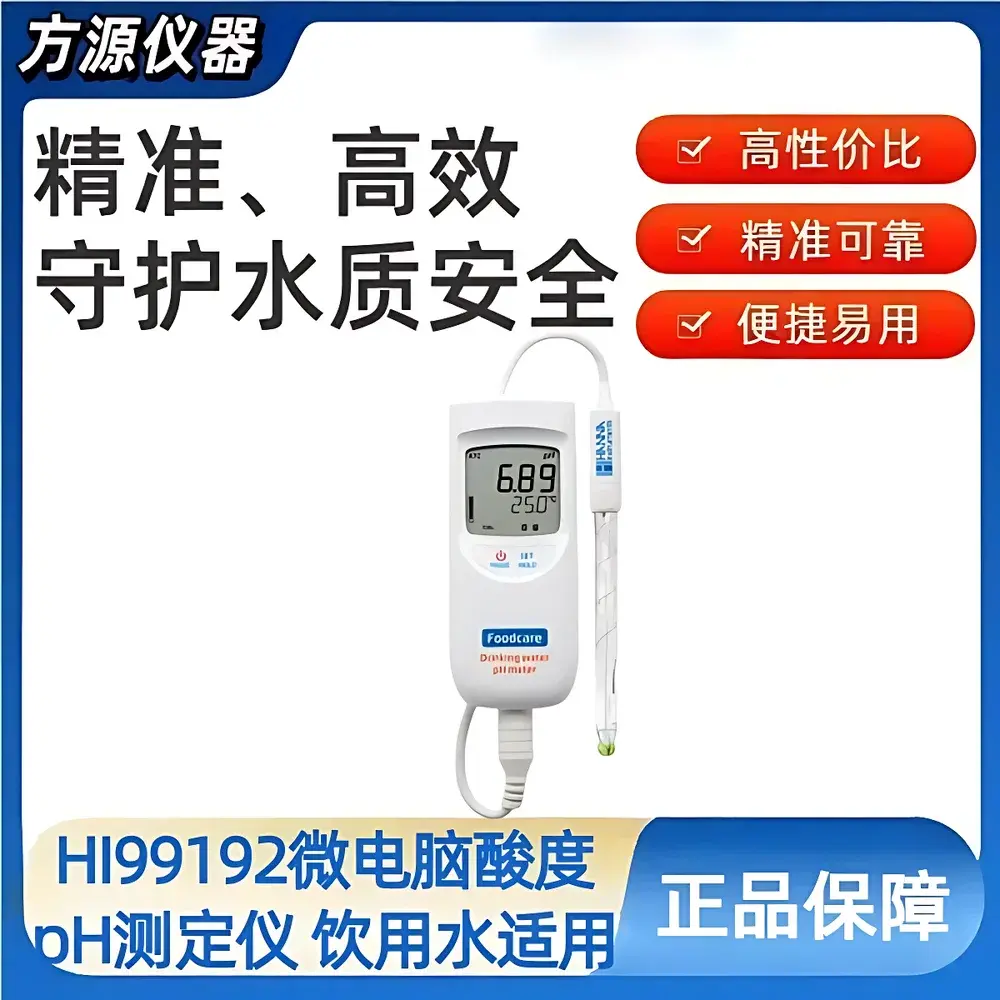
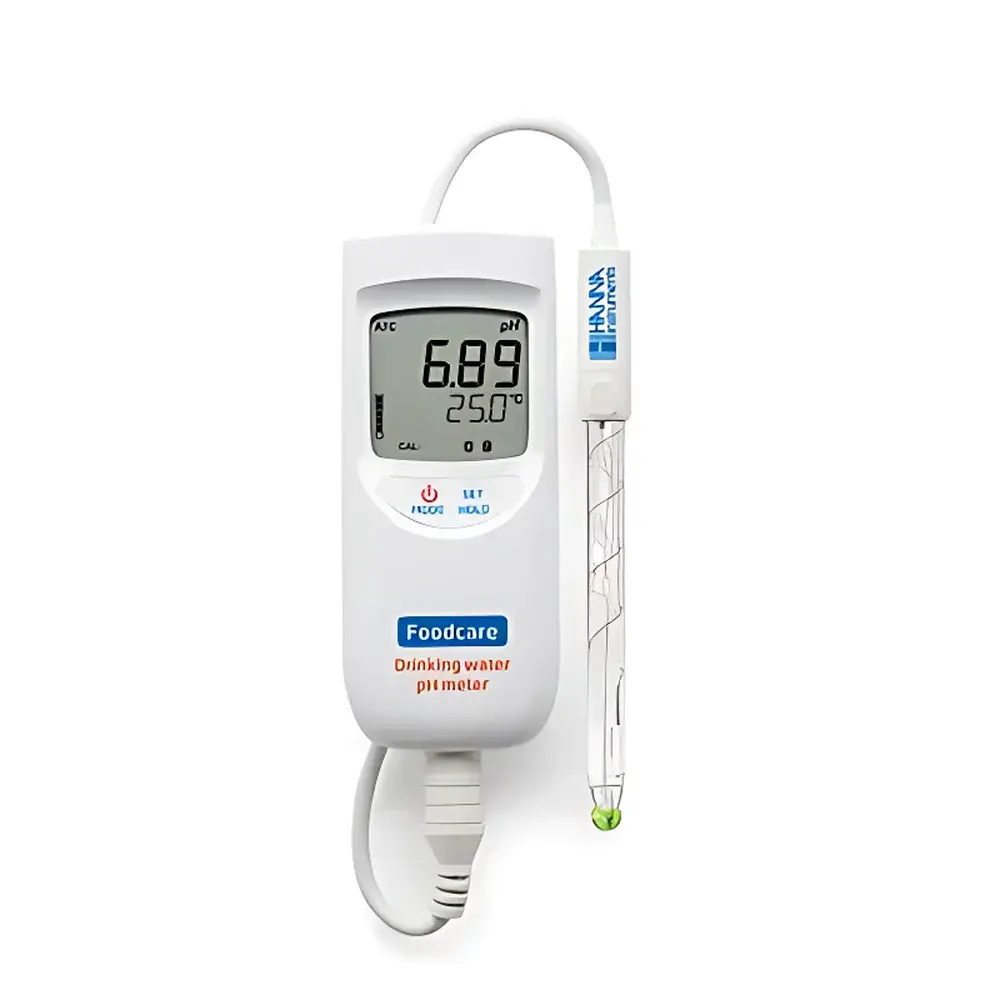
Hanna HI99192 Portable pH and Temperature Meter for Drinking Water and Low-Conductivity Applications
| Brand | Hanna Instruments |
|---|---|
| Origin | Italy |
| Model | HI99192 |
| Instrument Type | Portable |
| Parameter Type | Single-Parameter (pH + °C) |
| Measurement Range | -2.00 to 16.00 pH |
| Resolution | 0.01 pH / 0.1 °C |
| Accuracy | ±0.02 pH / ±0.5 °C (up to 60 °C) |
| Calibration | Automatic 1- or 2-point with built-in standards (4.01, 7.01, 10.01 pH or 4.01, 6.86, 9.18 pH) |
| Electrode | FC2153 refillable spherical glass pH electrode with integrated amplifier and NTC temperature sensor |
| Protection Rating | IP67 |
| Power | 3 × 1.5 V AAA batteries (auto-off after 8 min idle) |
| Dimensions | 154 × 63 × 30 mm |
| Weight | 196 g |
Overview
The Hanna HI99192 is a rugged, portable pH and temperature meter engineered for regulatory-compliant measurement in low-conductivity aqueous matrices—specifically designed for drinking water distribution systems, food processing rinse water, beverage production, and municipal water quality verification. It operates on the fundamental principle of potentiometric pH measurement: the voltage difference between a reference electrode and a pH-sensitive glass membrane is converted into a logarithmic pH value using the Nernst equation, with automatic temperature compensation (ATC) applied via an integrated NTC thermistor embedded in the FC2153 probe. Unlike general-purpose benchtop meters, the HI99192 incorporates electrical architecture optimized for high-impedance, low-ionic-strength samples—minimizing drift and polarization errors common in deionized water, distilled water, and post-RO or post-UV treatment streams. Its extended pH range (-2.00 to 16.00) supports both acidic disinfectant solutions (e.g., hypochlorous acid washes) and alkaline sanitizers (e.g., caustic soda rinses), while its ±825 mV mV mode enables direct redox potential (ORP) assessment where required for process validation.
Key Features
- IP67-rated enclosure ensures full protection against dust ingress and immersion in water up to 1 m for 30 minutes—validated for field use in humid, wet, or outdoor environments.
- Sensor Check™ diagnostic function provides real-time visual feedback on electrode slope and offset during calibration, enabling proactive maintenance and traceable electrode performance logging.
- Dual-resolution display (0.1 pH / 0.01 pH) with large LCD allows simultaneous viewing of pH, mV, temperature, stability indicator, battery status, and calibration prompts from multiple angles.
- FC2153 spherical-tip pH electrode features a low-resistance glass membrane, double-junction Ag/AgCl reference system, and refillable KCl electrolyte chamber—optimized for rapid response and stability in low-conductivity media (<50 µS/cm).
- Automatic temperature compensation across -5.0 to 105.0 °C eliminates manual correction and reduces thermal hysteresis error in dynamic thermal environments.
- HOLD function freezes displayed values for documentation; BEPS (Battery Error Prevention System) alerts users at ≤5% remaining charge to prevent data loss due to unexpected power failure.
- Compliant with FDA Food Safety Modernization Act (FSMA) requirements for environmental monitoring and sanitation verification in food-grade facilities.
Sample Compatibility & Compliance
The HI99192 is validated for use with potable water, purified water (PW), and water-for-injection (WFI)-adjacent matrices per USP and EP 2.2.3 guidelines. Its electrode design mitigates junction clogging and liquid junction potential errors typical in low-conductivity samples. The instrument meets IEC 60529 (IP67), CE marking requirements under the EU Electromagnetic Compatibility Directive 2014/30/EU, and RoHS 2011/65/EU. While not certified to ISO/IEC 17025 for accredited testing, it supports GLP-aligned workflows through documented calibration records, Sensor Check™ logs, and stable endpoint detection—enabling audit-ready traceability in QC labs operating under 21 CFR Part 11–compatible documentation practices.
Software & Data Management
As a standalone portable meter, the HI99192 does not interface directly with PC-based software or cloud platforms. However, its deterministic calibration logic, stable endpoint algorithm, and timestamp-independent HOLD functionality facilitate manual transcription into LIMS or electronic lab notebooks (ELNs). All calibration events—including date, standard used, measured mV, slope (%), and offset (mV)—are visually confirmed on-screen and can be recorded manually with full metrological traceability. The device supports dual-standard calibration protocols required by ASTM D1293 (Standard Test Method for pH of Water) and EPA Method 150.1, ensuring alignment with environmental compliance reporting frameworks.
Applications
- Drinking water quality verification at points-of-entry, storage tanks, and distribution endpoints per WHO Guidelines and EPA Safe Drinking Water Act (SDWA) criteria.
- Sanitation efficacy monitoring in food & beverage plants: pH verification of chlorine-based sanitizers (target 6.5–7.5), peracetic acid solutions, and caustic cleaning agents.
- Pharmaceutical water system surveillance: periodic checks of purified water loops during routine operational qualification (OQ).
- Field-based environmental sampling: groundwater, surface water, and wastewater effluent screening where portability and environmental resilience are critical.
- Educational laboratories requiring robust, entry-level instrumentation compliant with AP Chemistry and undergraduate analytical chemistry curricula.
FAQ
Does the HI99192 support GLP-compliant calibration documentation?
Yes—while no internal memory stores calibration history, its Sensor Check™ diagnostics, visible slope/offset values, and unambiguous pass/fail indicators during calibration enable manual GLP-compliant recordkeeping per 21 CFR Part 11 Annex 11 principles.
Can the FC2153 electrode be used for non-aqueous or high-protein samples?
No—the FC2153 is specifically engineered for aqueous, low-conductivity applications. For viscous, protein-rich, or organic solvent matrices, Hanna recommends the FC202D or FC232D electrodes with specialized junctions.
What is the recommended recalibration frequency for routine drinking water testing?
Per ASTM D1293 and EPA guidance, recalibration before each batch of measurements—and immediately after electrode cleaning or exposure to extreme pH—is required. Sensor Check™ should be performed daily in regulated environments.
Is the HI99192 suitable for continuous immersion in water?
It is IP67-rated for temporary submersion (≤1 m, ≤30 min), but continuous immersion is not supported. For permanent in-line monitoring, Hanna’s HI98190 series or industrial pH transmitters are recommended.
How does the HI99192 handle temperature compensation in rapidly changing thermal conditions?
The integrated NTC sensor updates temperature readings every 0.5 seconds, and the microprocessor applies real-time ATC using the standardized Nernst factor—ensuring accuracy even during dynamic thermal transitions typical in pipe-loop sampling.
Related Products




