
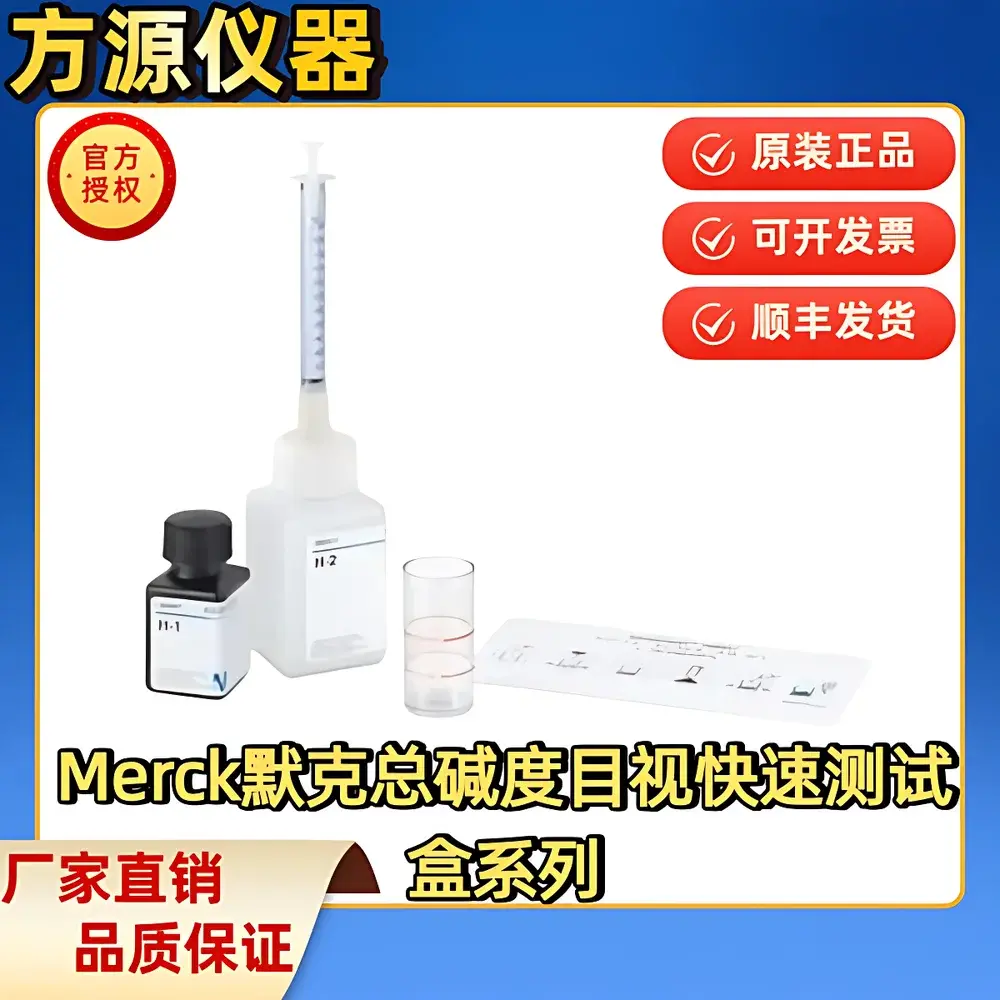
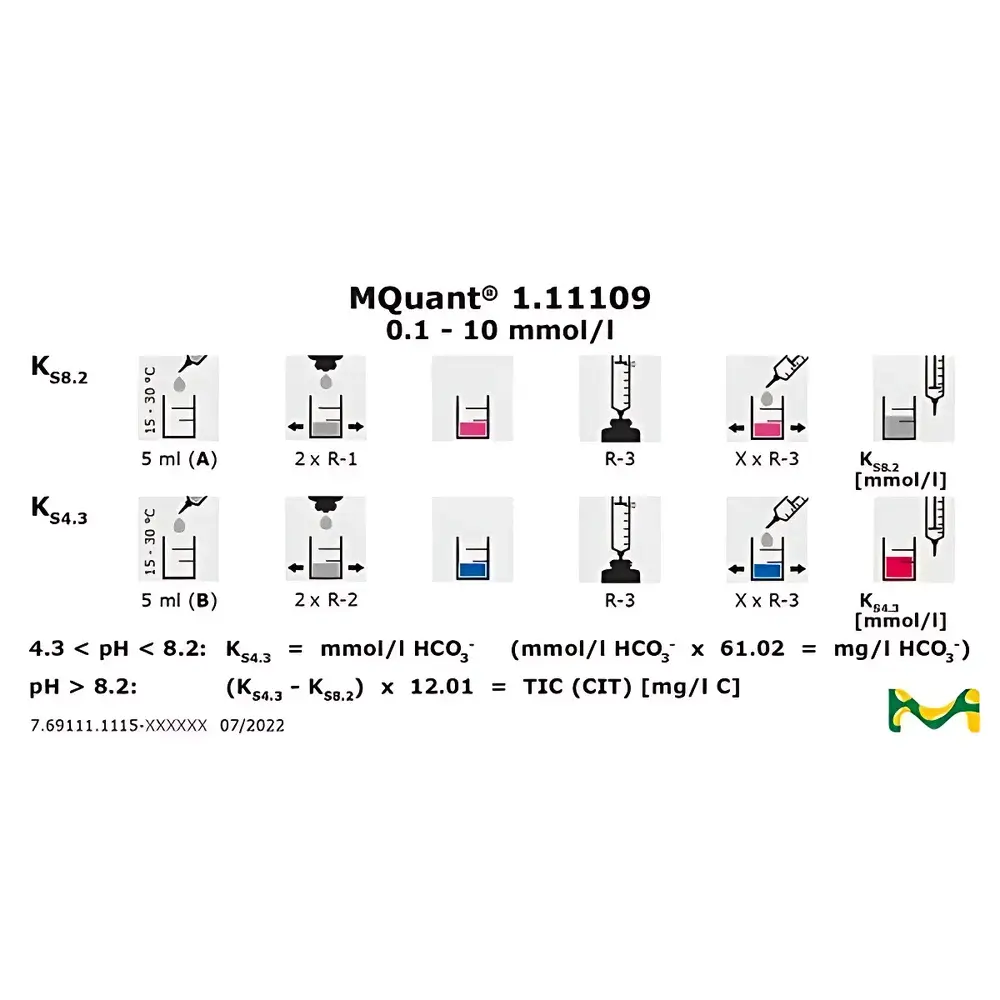
Merck Total Alkalinity Titration Test Kit
| Brand | Merck |
|---|---|
| Origin | USA |
| Manufacturer Type | Authorized Distributor |
| Product Origin | Imported |
| Model | Total Alkalinity Titration Test Kit |
| Pricing | Available Upon Request |
Overview
The Merck Total Alkalinity Titration Test Kit is a standardized, reagent-based analytical system designed for the precise determination of total alkalinity in water samples via acid–base titration. Total alkalinity—expressed as mg/L CaCO3—quantifies the buffering capacity of water against pH changes and reflects the combined concentration of bicarbonate (HCO3−), carbonate (CO32−), and hydroxide (OH−) ions. This kit implements the classical potentiometric or visual endpoint titration method using standardized sulfuric acid (0.02 N or 0.1 N, depending on expected alkalinity range) and a mixed bromocresol green–methyl red indicator. It complies with core principles outlined in ISO 9963-1:1994 and ASTM D1067–22 for alkalinity measurement in natural, drinking, and wastewater matrices.
Key Features
- Pre-measured, factory-calibrated reagents ensuring batch-to-batch consistency and minimizing user error during preparation
- Stable, light-protected indicator formulation enabling clear, unambiguous endpoint detection (color shift from blue-green to pink)
- Integrated titration syringe or burette-compatible design supporting both semi-micro (1–5 mL sample) and standard (50–100 mL sample) protocols
- Validated working range covering 10–1000 mg/L as CaCO3, with optional dilution protocols extending upper limit to 5000 mg/L
- CE-marked and compliant with EU REACH and CLP regulations for safe handling and transport of chemical reagents
- Shelf life of ≥24 months when stored at 15–25 °C in original sealed packaging
Sample Compatibility & Compliance
This test kit is validated for use with potable water, surface water, groundwater, effluent, cooling tower water, and boiler feedwater. It accommodates turbid or mildly colored samples without requiring pretreatment; however, strongly oxidizing agents (e.g., residual chlorine >0.5 mg/L) must be quenched with sodium thiosulfate prior to analysis. The methodology satisfies regulatory reporting requirements under US EPA Method 310.1 and aligns with quality control expectations in ISO/IEC 17025-accredited laboratories. All reagent lot numbers are traceable to Merck’s master reference standards, supporting full auditability in GLP and GMP environments.
Software & Data Management
While this is a manual wet-chemistry kit, Merck provides complementary digital support through its Photometer Pro and TitraLab® Suite platforms. Users may log results manually into Excel templates provided in the kit insert—or integrate measurements into LIMS via CSV export from Merck’s LabX® Lite companion app (available free download). Full electronic record retention, user access controls, and audit trail functionality are available when paired with LabX® Premium (sold separately), meeting FDA 21 CFR Part 11 requirements for electronic signatures and data integrity in regulated industries.
Applications
- Drinking water treatment plants monitoring corrosion control and lime-soda softening efficiency
- Wastewater treatment facilities assessing biological nutrient removal stability and anaerobic digester influent buffering capacity
- Power generation sites evaluating condensate and boiler water chemistry to prevent scale formation and acidic corrosion
- Environmental field laboratories conducting routine compliance sampling per national water quality directives (e.g., EU WFD Annex V, China GB 3838–2002)
- Academic teaching labs demonstrating fundamental acid–base stoichiometry and water chemistry principles
FAQ
What is the recommended storage temperature for the reagents?
Store unopened kits between 15–25 °C, away from direct sunlight and moisture. Do not refrigerate or freeze.
Can this kit be used for seawater analysis?
Yes—with appropriate dilution (typically 1:10) and correction for chloride interference using the blank titration protocol described in the instruction leaflet.
Is a calibration standard included?
Each kit includes a certified reference solution (100 mg/L as CaCO3) for daily verification of titrant normality and endpoint sensitivity.
How often should the titrant be standardized?
Standardize before first use, after every 24 hours of continuous operation, and following any temperature fluctuation exceeding ±5 °C.
Are safety data sheets (SDS) available?
Yes—electronic SDS documents (in English, German, French, and Spanish) are accessible via Merck’s official portal using the kit’s batch-specific QR code.
Related Products







