
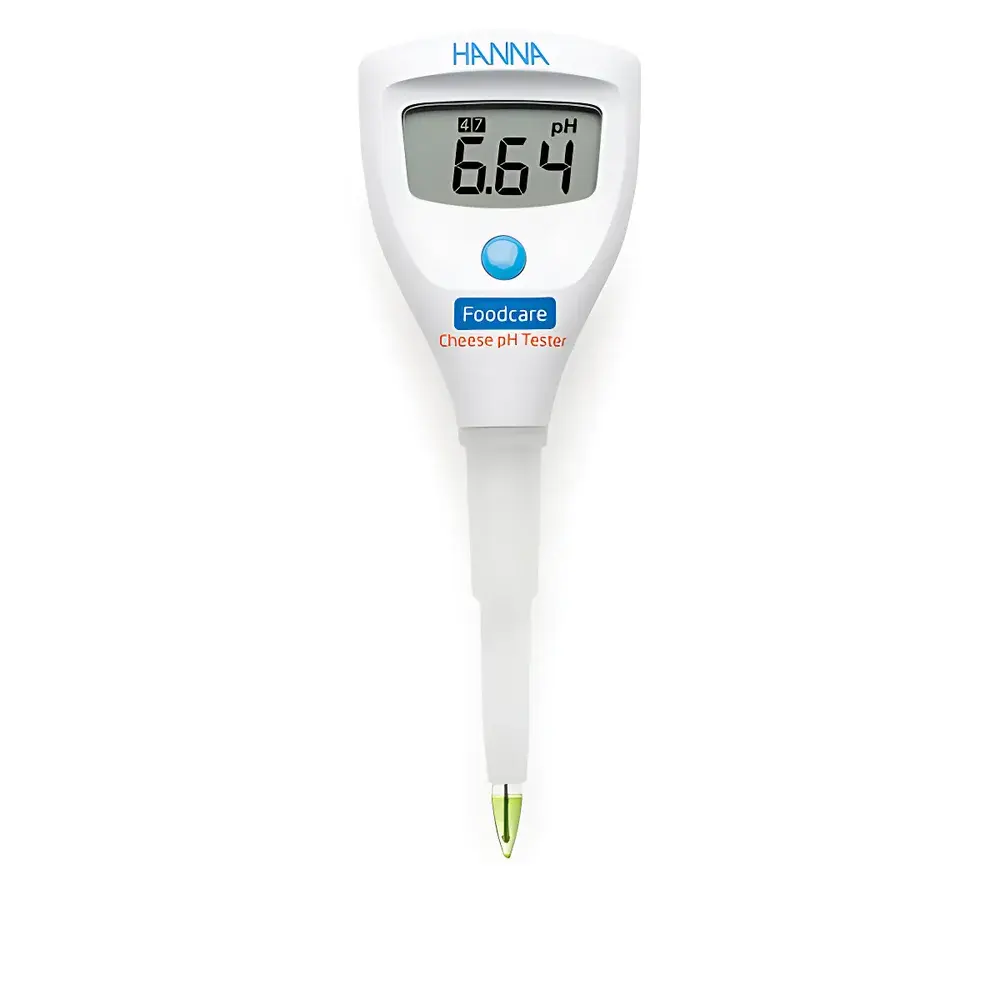
Hanna HI981032 Cheese-Specific Portable pH Meter
| Brand | Hanna Instruments |
|---|---|
| Origin | Italy |
| Model | HI981032 |
| Instrument Type | Portable pH Meter |
| Parameter Type | Single-Parameter (pH) |
| Measurement Range | 0.00 to 12.00 pH |
| Resolution | 0.01 pH |
| Accuracy | ±0.05 pH @ 25°C |
| Calibration | Auto-recognition, 1–2 point with built-in standards (4.01 pH, 7.01 pH @ 25°C) |
| Temperature Compensation | Automatic (0 to 50°C) |
| Power Source | CR2032 lithium coin cell |
| Dimensions | 51 × 151 × 21 mm |
| Weight | 44 g |
| IP Rating | Not specified |
| Compliance | Designed for food-grade pH measurement per ISO 2173, AOAC 975.02, and FDA guidance for dairy product acidification monitoring |
Overview
The Hanna HI981032 is a purpose-engineered portable pH meter designed specifically for direct acidification monitoring in semi-solid and viscous dairy matrices—particularly cheese curds, ripened cheeses, cream cheese, and other high-fat, protein-rich乳膏 (cream-based) products. Unlike general-purpose pH meters, the HI981032 integrates an electrochemical sensing architecture optimized for challenging food samples: its low-temperature (LT) glass pH electrode features a conical tip geometry and an open-junction reference system. This configuration minimizes clogging from suspended casein micelles, fat globules, and calcium phosphate precipitates commonly encountered during cheese aging and quality control. The device operates on potentiometric principles—measuring the potential difference between a hydrogen-ion-sensitive glass membrane and a stable reference electrode—converted into pH values via Nernst equation calibration. Its 0.00–12.00 pH range, ±0.05 pH accuracy at 25°C, and automatic temperature compensation (0–50°C) ensure traceable, repeatable results aligned with dairy processing requirements under ambient or chilled conditions.
Key Features
- Conical-tip LT (low-temperature) glass sensor enabling rapid equilibration and precise insertion into semi-solid cheese matrices without sample disruption
- Open-junction reference design reducing fouling from proteins and particulates—critical for extended operational stability in high-solids dairy applications
- Auto-recognition of two standard buffer points (4.01 and 7.01 pH @ 25°C), eliminating manual buffer selection errors and supporting GLP-compliant calibration logs when paired with Hanna’s optional data transfer accessories
- Stability indicator on large backlit LCD confirms measurement convergence before value lock—essential for non-homogeneous samples where drift may occur
- Three programmable auto-off settings (8 min, 60 min, or disabled) to balance battery conservation with workflow continuity in production environments
- PVDF (polyvinylidene fluoride) body construction providing chemical resistance to common dairy sanitation agents including chlorine-based disinfectants and peracetic acid solutions
Sample Compatibility & Compliance
The HI981032 is validated for direct immersion measurement in unprocessed curd, pressed cheeses (e.g., Cheddar, Gouda), soft ripened varieties (e.g., Brie, Camembert), and dairy spreads. Its conical probe geometry allows penetration through rinds and dense textures while maintaining electrical contact integrity. The instrument meets functional performance criteria referenced in ISO 2173:2003 (fruit and vegetable products—determination of pH), adapted for dairy by Codex Alimentarius CXS 206-1999 (Standard for Cheese), and supports internal QA/QC protocols aligned with HACCP Critical Control Point (CCP) monitoring for acidification steps. While not certified to IEC 61000-4 electromagnetic immunity standards, its analog signal path and isolated electrode interface minimize noise susceptibility in typical dairy plant environments. No regulatory certification (e.g., FDA 510(k), CE medical device classification) applies, as it is classified as a laboratory-grade food process instrument—not an in-vivo or clinical diagnostic tool.
Software & Data Management
The HI981032 operates as a standalone field instrument with no embedded Bluetooth or USB connectivity. However, when used with Hanna’s optional HI92000 Windows-based software (via HI920011 USB adapter), users can export time-stamped pH readings—including calibration history, temperature stamps, and stability flags—to CSV or PDF formats. This enables audit-ready documentation compliant with 21 CFR Part 11 requirements when configured with user authentication, electronic signatures, and audit trail activation. All calibration events are stored internally with date/time stamps and buffer IDs; memory retains up to 50 measurement records. For facilities operating under ISO/IEC 17025 or SQF Edition 9, the included HI70004P and HI70007P single-use buffer pouches support documented traceability to NIST-traceable pH standards.
Applications
- Monitoring lactic acid development during cheese vat fermentation and whey drainage
- Verifying target pH endpoints in stretched-curd processes (e.g., Mozzarella) to ensure proper protein denaturation
- Tracking pH evolution during brining and aging stages to predict texture development and microbial safety
- Quality assurance testing of cream cheese, mascarpone, and quark for consistency across batches
- On-site verification of acidification in artisanal or farmstead cheese production where lab access is limited
- Supporting R&D studies on starter culture performance under variable temperature and salt conditions
FAQ
Can the HI981032 be used for liquid milk or whey?
No—this model is optimized for semi-solid matrices. For liquid dairy streams, Hanna recommends the HI981034 Milk pH Meter, which uses a different junction design and flow-cell compatibility.
Is the electrode replaceable as a standalone component?
Yes—the HI1414D cheese-specific conical electrode is available separately (Hanna Part No. HI1414D) and features the same open-junction LT glass formulation.
How often should the electrode be cleaned between measurements?
After each sample, rinse with deionized water; for heavy residue, soak 15–20 minutes in HI700642 cheese electrode cleaning solution to dissolve protein/fat deposits.
Does the instrument comply with FDA 21 CFR Part 11 for electronic records?
The meter itself does not store audit trails; full Part 11 compliance requires use of HI92000 software with enabled security settings and external validation documentation.
What is the expected service life of the CR2032 battery under typical usage?
Approximately 1,000 hours of active measurement time, assuming 8-minute auto-off and average daily use of 20 measurements.





