
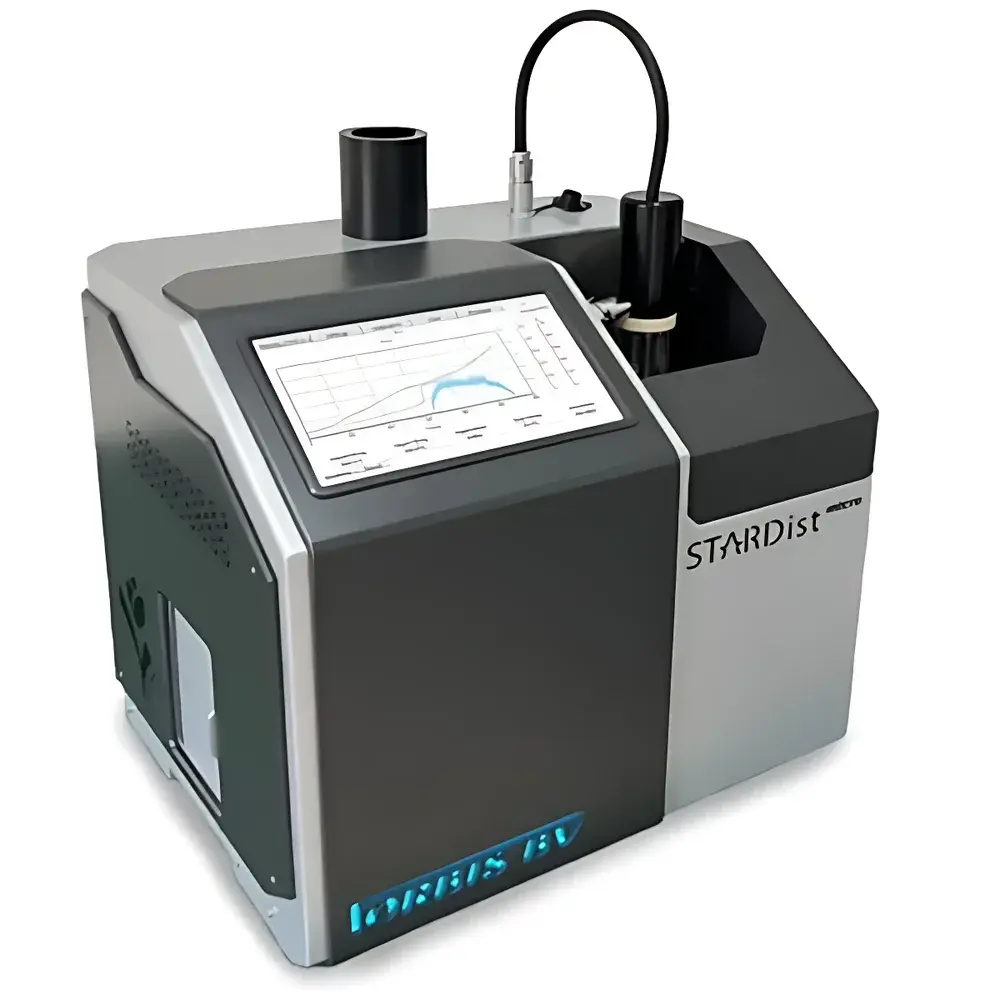
STARDist micro Automated Micro Distillation Analyzer by ORBIS BV
| Brand | ORBIS BV |
|---|---|
| Origin | Netherlands |
| Model | STARDist micro |
| Sample Volume | 10 mL ± 0.3 mL |
| Analysis Time | < 10 minutes |
| Temperature Range | 0–500 °C |
| Temperature Resolution | 0.1 °C |
| Heating Power | 140 W |
| Power Supply | AC 100–240 V, 50/60 Hz, 300 W |
| Flash Point Prediction | Closed-cup flash point estimation for diesel and kerosene |
| Compliance | ASTM D7345, EN 17306, IP 596 (directly correlated to ASTM D86, ISO 3405, IP 123) |
| Operating System | Windows-based with capacitive touchscreen and stylus support |
| Form Factor | Benchtop, space-optimized design for mobile or constrained laboratories |
Overview
The STARDist micro Automated Micro Distillation Analyzer is a precision-engineered benchtop instrument designed for rapid, reproducible distillation characterization of light to mid-range petroleum fractions. It operates on the principle of micro-scale, controlled-rate atmospheric distillation—employing a calibrated, programmable heating mantle, integrated vapor temperature sensing, and real-time condensate collection tracking—to deliver ASTM D7345-compliant distillation curves with minimal operator intervention. Unlike conventional D86 apparatuses requiring 100 mL samples and 30+ minute runtimes, the STARDist micro achieves full boiling point distribution (IBP, 10%, 50%, 90%, FBP) using only 10 mL of sample, significantly reducing reagent consumption, waste generation, and laboratory footprint. Its architecture integrates thermal mass optimization, PID-controlled heating kinetics, and high-fidelity Pt100 temperature measurement to ensure traceable accuracy across the 0–500 °C range—critical for regulatory reporting in fuel certification workflows.
Key Features
- Micro-volume operation: Validated 10 mL ± 0.3 mL sample requirement—reducing hazardous material handling and disposal costs while maintaining statistical equivalence to standard methods.
- Sub-10-minute analysis cycle: Achieved through dynamic heating ramp profiling and adaptive condensate detection, enabling high-throughput screening in refinery QC labs or field-deployed mobile units.
- Integrated closed-cup flash point prediction: Utilizes empirical correlations derived from distillation curve shape (e.g., initial boiling point, 10% recovery temperature, and volatility slope) to estimate ASTM D93-equivalent flash points for diesel and kerosene—eliminating need for separate flash point testing in preliminary screening.
- Windows-based touchscreen interface: Capacitive 10.1″ display with stylus support enables intuitive method setup, real-time curve visualization, and audit-ready electronic records without external PCs.
- Compact benchtop form factor: Dimensions of 320 × 380 × 310 mm (W × D × H) and weight under 25 kg facilitate deployment in ISO container labs, offshore platforms, or ISO/IEC 17025-accredited facilities with spatial constraints.
- Universal power input: Auto-ranging 100–240 V AC, 50/60 Hz operation ensures compatibility with global electrical infrastructure, including generator-backed mobile labs.
Sample Compatibility & Compliance
The STARDist micro is validated for gasoline (including ethanol-blended E10/E15), aviation turbine fuel (Jet A-1, JP-8), automotive diesel (EN 590, ASTM D975), kerosene (Jet B, lamp oil), and FAME-based biodiesel blends (B5–B20). It fully satisfies the procedural requirements of ASTM D7345 (Standard Test Method for Distillation of Petroleum Products at Atmospheric Pressure Using a Micro Distillation Apparatus), EN 17306 (Petroleum products — Determination of distillation characteristics — Micro distillation method), and IP 596 (Determination of distillation characteristics of petroleum products — Micro distillation method). Its results are directly correlated to legacy standards—including ASTM D86, ISO 3405, and IP 123—via certified conversion algorithms embedded in firmware, supporting cross-method data reconciliation for regulatory submissions. The system supports GLP-compliant operation with user-level access control, electronic signature capability, and 21 CFR Part 11–ready audit trails when paired with optional LIMS integration modules.
Software & Data Management
The embedded Windows 10 IoT Enterprise OS hosts the proprietary STARDist Control Suite, which provides method library management, customizable report templates (PDF/CSV/XLSX), and real-time overlay of multiple distillation curves for comparative analysis. All raw sensor data—including heater voltage, vapor temperature, condensate volume vs. time, and ambient pressure compensation values—are timestamped and stored locally with SHA-256 hash integrity verification. Data export supports secure SFTP, USB drive transfer, or OPC UA connectivity for enterprise SCADA or LIMS systems. Firmware updates are delivered via signed package files with rollback capability, ensuring continuous compliance during software lifecycle maintenance.
Applications
- Refinery process control: Rapid verification of fractionator overhead cuts and side-stream specifications prior to blending.
- Fuel quality surveillance: On-site testing at terminals, depots, and border inspection points to verify compliance with UK BS EN 228, EU EN 590, CAN/CGSB-3.523, Mexican NOM-002-CRE, and Indian IS 2796.
- Biodiesel R&D: Monitoring esterification completeness and glycerol removal efficiency via low-end volatility shifts in FAME distillation profiles.
- Contract laboratory accreditation: Meets ISO/IEC 17025 clause 7.7 requirements for method validation, uncertainty estimation, and result traceability in third-party testing reports.
- Educational training: Used in petroleum engineering curricula to demonstrate distillation thermodynamics with reduced safety overhead versus traditional glassware setups.
FAQ
Does the STARDist micro replace ASTM D86 testing for regulatory submission?
No—it complies with ASTM D7345, which is an approved alternative method for many fuel specifications; however, certain jurisdictions or contractual agreements may still require D86. Correlation data and conversion protocols are provided in the instrument’s validation dossier.
Can it analyze heavy fuel oils or residual fuels?
No—its 0–500 °C range and micro-distillation design are optimized for distillates up to ~370 °C TBP; residues, bitumens, or vacuum gas oils fall outside its validated scope.
Is method validation documentation included?
Yes—each unit ships with a Factory Acceptance Test (FAT) report, ASTM D7345 interlaboratory study summary, and a traceable calibration certificate for the integrated Pt100 sensor and volumetric collector.
What maintenance is required?
Annual verification of temperature sensor linearity and condensate volume accuracy using NIST-traceable reference standards; no consumables beyond standard lab-grade solvents for system cleaning.
Is remote diagnostics supported?
Yes—optional Ethernet-enabled remote support mode allows ORBIS-certified engineers to perform firmware health checks and parameter diagnostics with customer authorization and encrypted session logging.





