
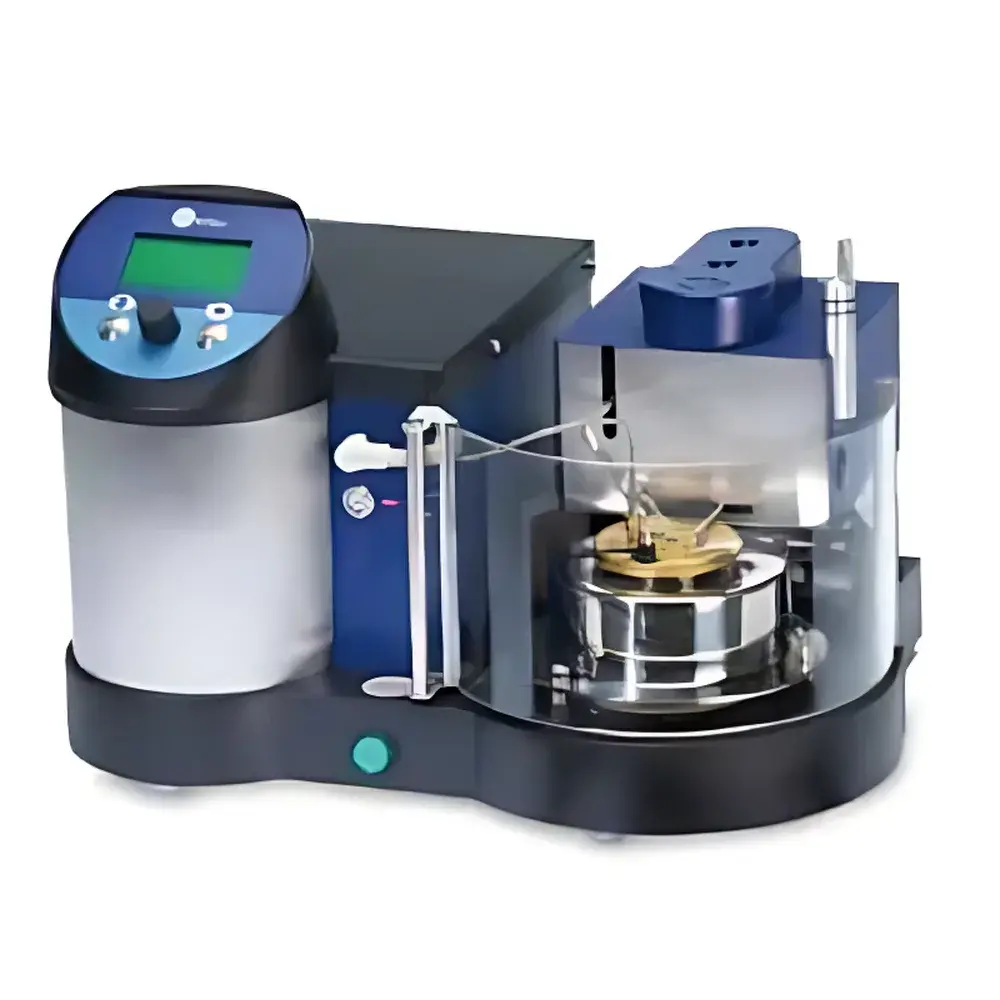
SETA 34700-0 MULTIFLASH Automated Micro Equilibrium Closed-Cup Flash Point Tester
| Brand | SETA |
|---|---|
| Origin | United Kingdom |
| Model | 34700-0 |
| Test Method | ASTM D3278, D3828, D7236, E502 |
| Temperature Range | Ambient to 300 °C (–10 °C to 300 °C with optional chiller) |
| Heating | Solid-block electric heater |
| Cooling | Fan-cooled (36 min) or optional compressed air / recirculating chiller (2 min) |
| Ignition | Selectable gas or electric spark ignition |
| Temperature Sensor | Platinum resistance thermometer (Pt100) |
| Flash Detection | Ionization ring |
| Stirring Speed | 30 rpm |
| Atmospheric Pressure Correction | Automatic |
| Power Supply | 110/120 V or 220/240 V, 50/60 Hz |
| Power Consumption | 1 kW |
| Dimensions | 34 × 47 × 42 cm |
| Weight | 20 kg |
Overview
The SETA 34700-0 MULTIFLASH Automated Micro Equilibrium Closed-Cup Flash Point Tester is a precision-engineered instrument designed for rapid, reproducible flash point determination of flammable and combustible liquids in accordance with globally recognized standard test methods. It implements the micro equilibrium closed-cup principle—where a small sample (typically 0.5–2 mL) is heated in a sealed cup under controlled atmospheric conditions until vapour concentration reaches the lower flammability limit, at which point an ignition source is applied to detect the lowest temperature yielding momentary flame propagation. This thermodynamic equilibrium-based approach minimizes thermal lag, reduces sample consumption, and accelerates cycle time without compromising method fidelity. The instrument is built upon SETA’s modular MULTIFLASH platform, enabling seamless integration of interchangeable test modules—including Pensky-Martens, Tag, Abel, Cleveland Open Cup, and Micro Equilibrium—within a single base unit. Its architecture supports routine operation in petroleum refineries, chemical manufacturing QA/QC labs, regulatory compliance testing facilities, and transportation safety certification environments.
Key Features
- Modular hardware design allows field-swappable test method modules without recalibration or firmware modification
- Automated temperature ramping, ignition timing, and ionization-based flash detection ensure high inter-laboratory reproducibility
- Integrated Pt100 platinum resistance thermometer with NIST-traceable calibration path for ±0.1 °C accuracy across full operating range
- Automatic barometric pressure compensation using onboard digital pressure sensor, compliant with ASTM D3278 Section 7.2 and ISO 3679 Annex B
- Dual ignition options: programmable electric spark (IEC 60079-11 compliant) or regulated gas flame (butane/propane), selectable per method requirement
- Robust solid-block heating system with PID-controlled thermal management ensures uniform cup wall temperature and minimal overshoot
- Comprehensive safety architecture including vapor containment lid interlock, automatic shutdown on flame persistence, and fail-safe gas flow cutoff (for gas ignition variant)
- Onboard data storage retains the last five test records with timestamp, ambient pressure, final flash temperature, and operator ID (if configured)
Sample Compatibility & Compliance
The 34700-0 accommodates liquid samples with viscosities up to 100 mm²/s at 40 °C and boiling points below 300 °C. It is validated for use with hydrocarbon solvents, base oils, biodiesel blends, lubricants, paint thinners, adhesives, and intermediate petrochemical streams. Regulatory alignment includes full conformance with ASTM, ISO, IP, BS, and EPA flash point methodologies listed in its specification. For GLP/GMP-regulated environments, the system supports audit-ready operation when paired with optional LIMS integration and 21 CFR Part 11-compliant software extensions (e.g., SETA LabLink Pro), enabling electronic signatures, user access controls, and immutable audit trails.
Software & Data Management
Instrument control and data acquisition are managed via the embedded touchscreen interface running real-time Linux OS. All test parameters—including heating rate, ignition interval, pass/fail thresholds, and atmospheric correction algorithm—are configurable and stored per method profile. Raw temperature vs. time datasets, ion current traces, and flash event markers are exportable in CSV format via USB or Ethernet. Optional LabLink Pro software provides extended functionality: automated report generation (PDF/Excel), statistical trend analysis across batches, deviation alerts against specification limits, and secure database archiving aligned with ISO/IEC 17025 documentation requirements.
Applications
- Flash point verification of crude oil fractions prior to distillation unit feed
- Quality release testing of finished gasoline, jet fuel (Jet A-1), and diesel blends per ASTM D93/D3828
- Classification of waste solvents under UN TDG and ADR/RID transport regulations
- Stability assessment of formulated coatings and inks during R&D
- Regulatory submission testing for EPA Tier II reporting and REACH SVHC screening
- Third-party certification for OSHA 29 CFR 1910.1200 (HazCom) labeling compliance
FAQ
What sample volume is required for the micro equilibrium method?
Typical volume is 0.5–2.0 mL, depending on volatility and expected flash point range. Lower volumes reduce thermal mass and improve response time without affecting method validity.
Is external cooling mandatory for sub-ambient testing?
Yes—operation below ambient requires the optional recirculating chiller or compressed air kit. Fan-only cooling maintains ≥20 °C above ambient.
How does the ionization ring detect flash events?
The ring senses transient current increase caused by conductive plasma formation during flame propagation—providing faster, more reliable detection than optical sensors in low-luminance scenarios.
Can the instrument be integrated into a centralized lab network?
Yes—Ethernet connectivity enables remote monitoring, firmware updates, and scheduled diagnostics via standard TCP/IP protocols.
Does the system meet explosion-proof requirements for Zone 1 hazardous areas?
No—the instrument is rated for general laboratory use (non-hazardous location). External vapor extraction and secondary containment are required when handling highly volatile Class I liquids.





