
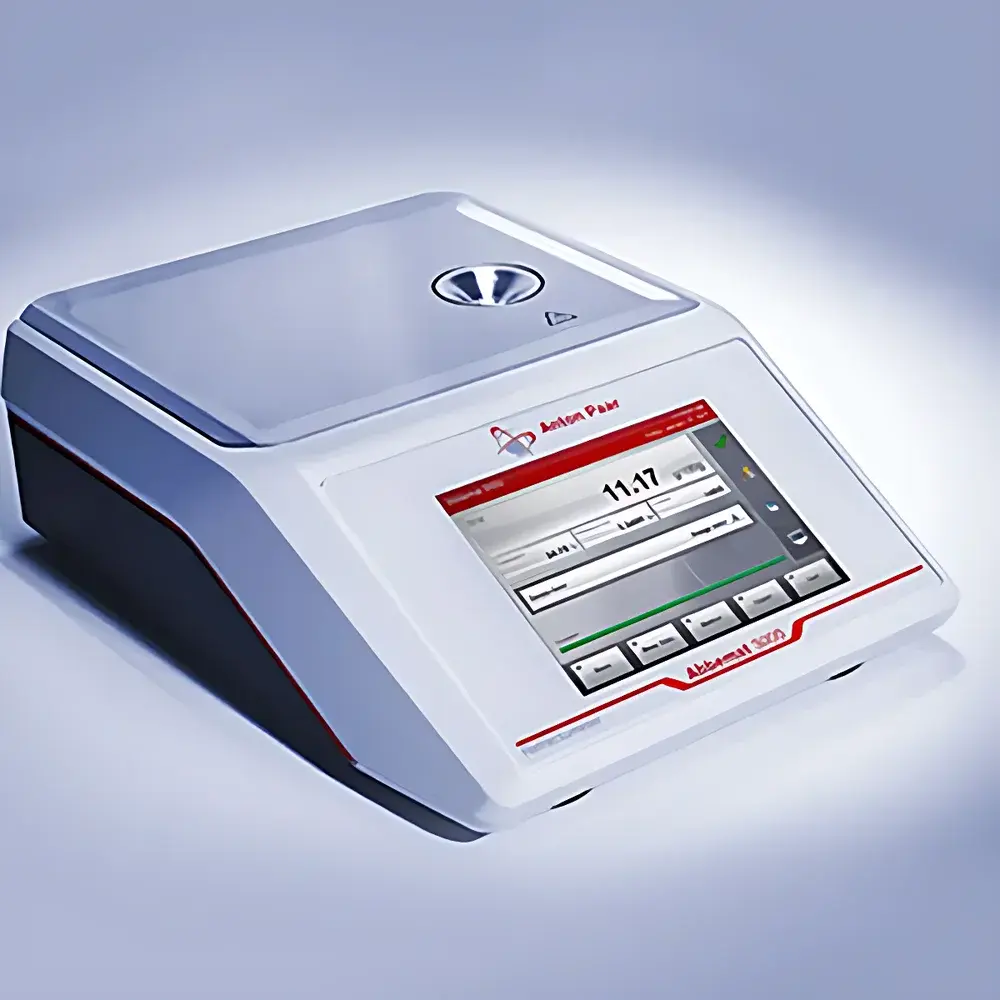
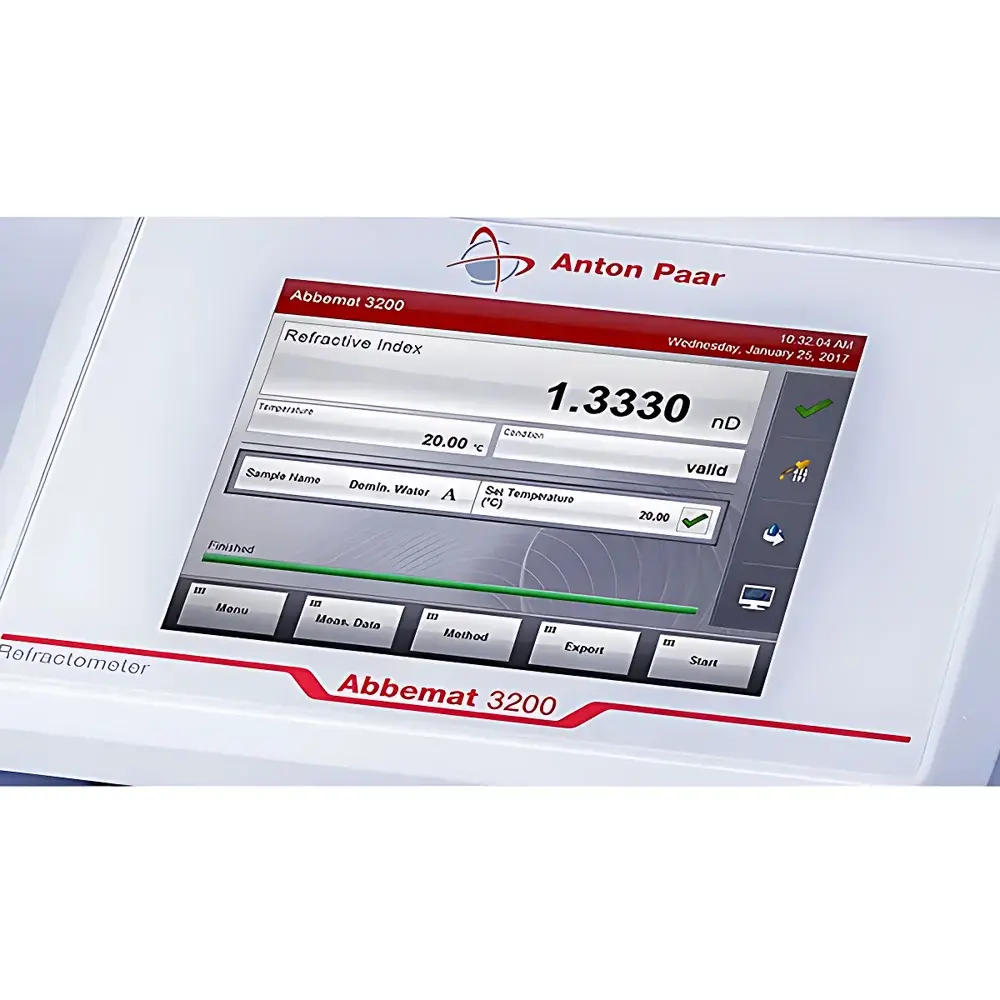
Anton Paar Abbemat 3200 Benchtop Refractometer
| Brand | Anton Paar |
|---|---|
| Origin | Austria |
| Model | Abbemat 3200 |
| Product Type | Benchtop Refractometer |
| Temperature Control | Yes |
| Digital Display | Yes |
| Refractive Index Range | 1.30 to 1.72 |
| Refractive Index Accuracy | ±0.0001 |
| Measurement Time | ~5 s (after thermal equilibration) |
| Sample Volume | ~0.2 mL |
| Light Source | LED at 589 nm |
| Interface | RS-232, 2× USB, Ethernet, LIMS-compatible |
| Display | 5.8-inch color touchscreen |
| Dimensions (W×H×D) | 228 × 94 × 300 mm |
| Weight | 4.6 kg |
| Prism Material | Sapphire |
| Wetted Materials | Sapphire, perfluoroelastomer, PP-GF30, stainless steel |
Overview
The Anton Paar Abbemat 3200 is a high-precision benchtop refractometer engineered for reliable, traceable, and compliant measurement of refractive index (nD) and derived concentration parameters—including Brix, glucose, fructose, sucrose, invert sugar, iodine value, and numerous industry-specific scales. Based on the fundamental principle of total internal reflection at the sample-prism interface, the instrument determines nD by precisely detecting the critical angle of refraction using a stabilized 589 nm LED light source—matching the sodium D-line wavelength specified in pharmacopoeial and international standards (e.g., USP , Ph. Eur. 2.2.6, JIS K 0061). Its integrated Peltier temperature control (15–60 °C, ±0.05 °C accuracy) ensures strict adherence to standardized test conditions, eliminating manual water-bath dependency and enabling repeatable measurements across variable ambient environments. Designed for routine QC laboratories in regulated industries, the Abbemat 3200 delivers metrological integrity without compromising operational efficiency.
Key Features
- High-resolution refractive index measurement with ±0.0001 accuracy and 1.30–1.72 nD range—optimized for challenging samples including turbid, colored, or opaque liquids and semi-solids (e.g., syrups, honey, emulsions)
- Integrated Peltier-based thermostating system with active temperature control and real-time monitoring—fully compliant with ISO 21147 and ASTM D1218 requirements for temperature-controlled refractometry
- Chemically inert optical path: sapphire measuring prism and wetted materials (sapphire, perfluoroelastomer, PP-GF30, stainless steel) ensure long-term stability and resistance to aggressive solvents, acids (e.g., H2SO4, NaOH), and organic media
- Intuitive 5.8-inch capacitive color touchscreen with glove-compatible operation and context-sensitive warnings (e.g., insufficient sample volume, prism contamination)
- Automated measurement cycle (~5 seconds post-thermal stabilization), requiring only ~0.2 mL sample volume and minimal prism cleaning between runs
- Pre-loaded library of over 200 validated calibration methods—including Ph. Eur./USP/JPN-compliant pharmaceutical assays, food & beverage Brix/sugar conversions, and chemical titration equivalents (e.g., acetic acid, Zeiss scale)
Sample Compatibility & Compliance
The Abbemat 3200 accommodates a broad spectrum of sample types without optical preconditioning: aqueous solutions, viscous liquids (e.g., glycerol, propylene glycol), suspensions, gels, and pastes. Its robust optical design mitigates interference from particulates or chromophores, enabling direct analysis of unfiltered fruit juices, crude oils, polymer melts, and biological fluids (serum, urine). The instrument supports full audit trail functionality and electronic signature readiness per FDA 21 CFR Part 11 when connected to Anton Paar’s mPMS software. It meets GLP/GMP documentation requirements through automatic timestamped result export, method versioning, and user-access logging. All factory calibrations are traceable to NIST- and PTB-certified refractive index standards.
Software & Data Management
Data handling is facilitated via native Ethernet and dual USB ports, supporting direct integration into LIMS, ELN, and SAP QM environments. The included mPMS (measurement Process Management Software) enables method creation, instrument remote control, batch reporting, and PDF/CSV export with embedded metadata (operator ID, timestamp, temperature, method name, uncertainty budget). Optional IQ/OQ/PQ documentation packages are available for validation in regulated manufacturing settings. All measurement data includes automatic temperature compensation, statistical process control (SPC) flags, and configurable pass/fail limits aligned with internal SOPs or pharmacopoeial acceptance criteria.
Applications
- Pharmaceuticals: Excipient concentration verification (e.g., glycerin, propylene glycol), API purity screening, solvent recovery monitoring per USP and Ph. Eur. 2.2.6
- Foods & Beverages: Brix quantification in fruit juices and soft drinks; sucrose/glucose/fructose differentiation in honey and syrups; iodine value estimation in edible oils per AOAC 920.114
- Chemicals: Concentration determination of NaOH, H2SO4, HCl, and acetic acid solutions; quality release testing of industrial solvents and surfactants
- Biotechnology: Osmolality proxy measurement in cell culture media and fermentation broths; protein solution concentration tracking
- Academic & R&D Labs: Polymer solution characterization, thermodynamic property studies (e.g., partial molar volume), and binary mixture phase behavior analysis
FAQ
Does the Abbemat 3200 require external calibration standards for daily use?
No—factory calibration is traceable to primary standards, and built-in verification routines (e.g., water and calibration oil checks) satisfy routine performance qualification per ISO/IEC 17025.
Can it measure samples below 15 °C or above 60 °C?
No—the Peltier system operates strictly within 15–60 °C; for non-ambient measurements, external thermostatted cells are required.
Is method development supported for custom concentration scales?
Yes—users can define new correlation functions (nD vs. concentration) using up to 20 reference points and export them as reusable method files.
How is data integrity ensured during network transmission?
All Ethernet and USB data transfers employ TLS 1.2 encryption and checksum-verified packet transmission; LIMS synchronization logs include hash-based integrity verification.
What maintenance is required beyond prism cleaning?
Annual verification of temperature sensor drift and optical alignment is recommended; no consumables or lamp replacements are needed due to solid-state LED illumination with >50,000-hour lifetime.



