
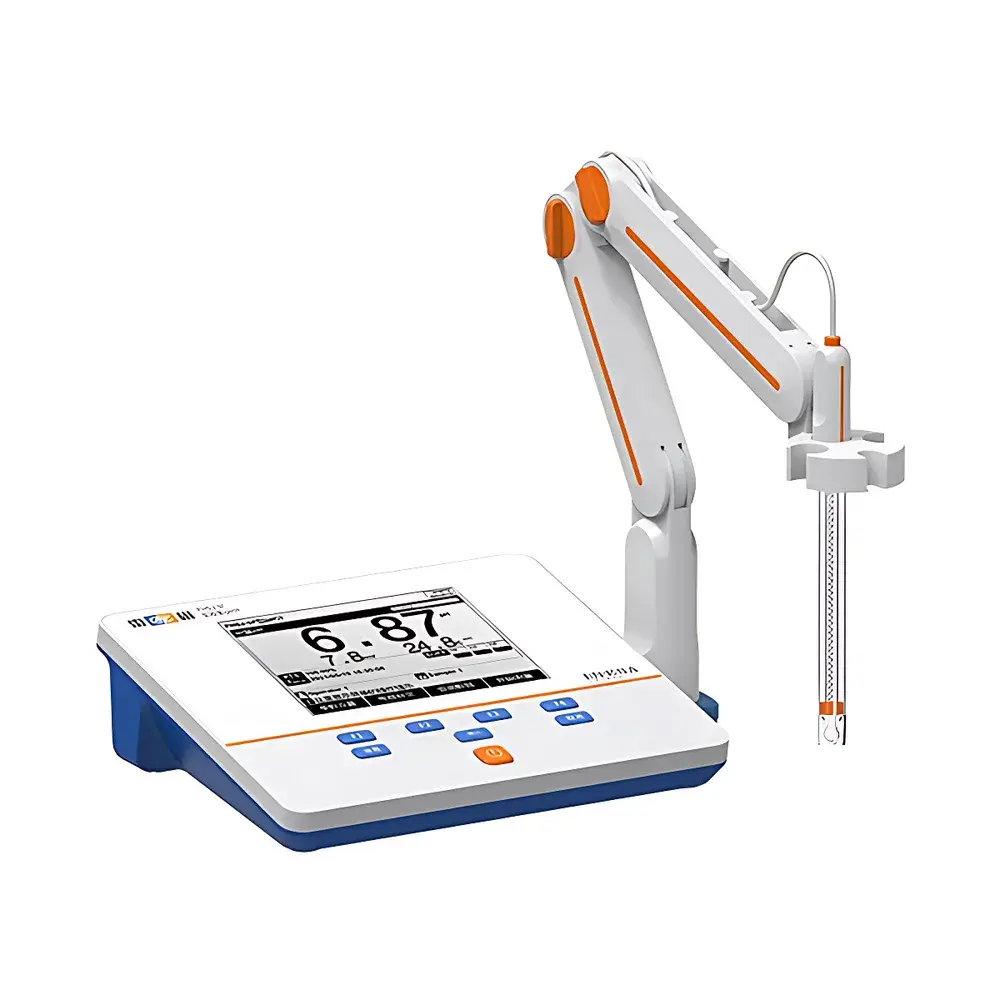
Leici PHSJ-3F Benchtop pH Meter
| Brand | Leici |
|---|---|
| Origin | Shanghai, China |
| Model | PHSJ-3F |
| Instrument Type | Benchtop |
| Parameter Type | Single-Parameter (pH/mV/T) |
| Measurement Range | –2.000 to 20.000 pH |
| Resolution | 0.01 pH |
| Accuracy | ±0.01 pH ±1 digit |
| Temperature Compensation | Automatic or Manual (–5.0 to 135.0 °C) |
| Buffer Recognition | Auto-detection of 5 standard Chinese calibration buffers |
| Calibration Points | Up to 3-point pH calibration |
| Isoelectric Point Options | 3 selectable (for ultrapure water, boiler water, and low-ionic-strength samples) |
| Data Storage | 500 GLP-compliant measurement records |
| Interface | USB port with dedicated PC communication software |
| Display | Dot-matrix LCD with simultaneous readout of pH, mV, temperature, electrode slope, isoelectric point, mode, date/time |
| Enclosure Material | Flame-retardant polycarbonate (PC) front panel |
| Power | AC adapter with battery backup (data protection during power loss) |
Overview
The Leici PHSJ-3F is a benchtop pH meter engineered for precision electrochemical measurement in quality control laboratories, environmental monitoring stations, and educational institutions across Asia and emerging markets. Based on potentiometric principle, it measures the hydrogen ion activity in aqueous solutions via a glass pH electrode and reference electrode pair, converting the resulting potential difference (in mV) into pH values using the Nernst equation. Designed for routine yet demanding applications—including ultrapure water analysis, boiler feedwater monitoring, and pharmaceutical process water testing—the instrument delivers high reproducibility within its certified range of –2.000 to 20.000 pH at 0.01 pH resolution and ±0.01 pH ±1 digit accuracy. Its robust architecture integrates automatic temperature compensation (ATC) over –5.0 to 135.0 °C, enabling reliable measurements across diverse sample thermal conditions without manual correction.
Key Features
- Smart-Read function: Automatically detects stable endpoint based on signal drift rate, eliminating subjective judgment in endpoint determination.
- Timed-Read mode: Configurable time-interval data logging (e.g., every 10 s or 1 min) for kinetic pH monitoring of titrations or slow-equilibrating samples.
- Cont-Read (Continuous Read) mode: Real-time display update at 0.5 Hz for observing dynamic pH shifts—ideal for reaction monitoring or buffer stability assessment.
- Electrode health diagnostics: Alerts users when electrode slope falls below 85% or asymmetry potential exceeds ±30 mV, supporting proactive maintenance.
- Firmware upgradability via USB: Ensures long-term compatibility with evolving regulatory requirements and measurement protocols.
- Three user-selectable isoelectric points (pH 4.01, 7.00, 10.01): Optimized for low-conductivity samples such as deionized water, nuclear-grade coolant, and steam condensate where conventional two-point calibration introduces significant error.
- GLP-compliant data integrity: Each stored record includes operator ID, timestamp, calibration history, electrode ID (if encoded), slope, offset, and ambient temperature—fully traceable for internal audits or regulatory review.
Sample Compatibility & Compliance
The PHSJ-3F supports measurement of aqueous solutions across wide ionic strength ranges—from high-salinity brines (≥1 M NaCl) to ultrapure water (<0.1 µS/cm). Its electrode interface accommodates standard BNC connectors for universal compatibility with Leici’s suite of pH electrodes (e.g., E-201-C, PHS-3C series) and third-party sensors meeting IEC 60746-1 specifications. The instrument complies with national metrological verification regulations JJG 119–2018 (China) and aligns with international best practices referenced in ISO 7888, ASTM D1293, and USP . All stored data meet minimum GLP documentation requirements per OECD Principles of Good Laboratory Practice, including audit trail capability (operator ID, calibration logs, and modification timestamps), though native 21 CFR Part 11 compliance requires external validation of the connected PC software environment.
Software & Data Management
Equipped with a full-featured USB interface, the PHSJ-3F communicates bidirectionally with Leici’s proprietary PC software (v3.2+), enabling export of measurement records in CSV and PDF formats. Data files include embedded metadata: instrument serial number, firmware version, calibration coefficients, and environmental conditions. The software supports batch printing of calibration reports and trend analysis graphs (pH vs. time). Internal memory retains up to 500 GLP-compliant datasets—even after power interruption—thanks to non-volatile flash storage and integrated battery-backed real-time clock. Users may delete individual entries or perform full memory reset with password protection to prevent accidental erasure.
Applications
- Pharmaceutical water systems: Monitoring purified water (PW) and water for injection (WFI) per EP/USP conductivity-pH correlation protocols.
- Power plant chemistry: Routine testing of boiler feedwater, condensate, and steam cycle samples where low-pH accuracy and isoelectric point correction are critical.
- Environmental labs: Field-deployable benchtop verification of surface water, wastewater effluent, and soil leachates under CNAS-accredited methods.
- Academic teaching: Demonstrating Nernstian behavior, buffer capacity, and electrode response kinetics in undergraduate analytical chemistry labs.
- Food & beverage QC: Verifying acidification endpoints in dairy fermentation, vinegar production, and juice blending processes.
FAQ
Does the PHSJ-3F support automatic recognition of international buffer standards (e.g., NIST or DIN)?
No—it auto-identifies only the five Chinese national standard buffers (pH 1.68, 4.01, 6.86, 9.18, 12.45 at 25 °C) as defined in GB/T 27503. Custom buffer entry is not supported.
Can the instrument store calibration data separately from measurement records?
Yes—calibration events are archived independently with full metadata (buffer IDs, measured mV, calculated slope/offset, date/time) and can be reviewed or printed without exporting measurement datasets.
Is the USB interface compatible with Windows 11 and macOS?
The official Leici software is validated for Windows 7–11 (64-bit); macOS support is limited to file transfer via mass-storage emulation—no native driver or application available.
What happens if power fails during measurement?
All active readings and the last 20 seconds of continuous data are preserved in RAM; full dataset integrity is maintained due to non-volatile memory and real-time clock backup.
How often should the pH electrode be recalibrated?
Recalibration is recommended before each analytical session, after electrode cleaning, or when slope deviation exceeds ±3% from initial value—consistent with ISO/IEC 17025 clause 7.7.1 for measurement traceability.




