
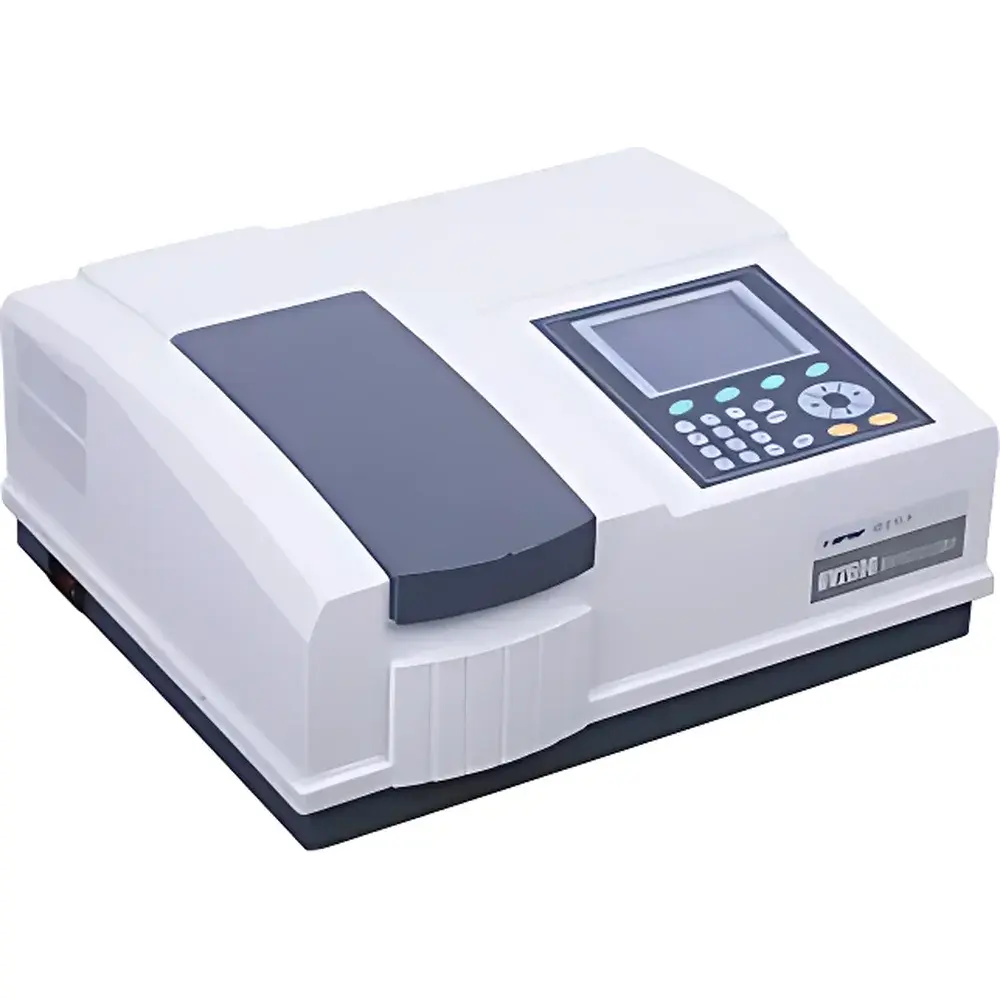
Shanghai SOPTOP UV2600PC UV-Vis Spectrophotometer
| Brand | SOPTOP |
|---|---|
| Origin | Shanghai, China |
| Model | UV2600PC |
| Optical System | Ratio-monitoring double-beam |
| Detector | Photomultiplier Tube (PMT) |
| Wavelength Range | 190–1100 nm |
| Wavelength Accuracy | ±0.3 nm |
| Spectral Bandwidth | 1.8 nm |
| Stray Light | ≤0.05% T (at 220 nm and 360 nm) |
| Wavelength Repeatability | ≤0.2 nm |
| Photometric Accuracy | ±0.3% T |
| Photometric Repeatability | ≤0.1% T |
| Baseline Flatness | ±0.002 A |
| Drift | ≤0.001 A/h (at 500 nm) |
| Display | 320 × 240 pixel 6-inch LCD |
Overview
The Shanghai SOPTOP UV2600PC is a ratio-monitoring double-beam ultraviolet-visible spectrophotometer engineered for precision quantitative and qualitative analysis across research laboratories, quality control environments, and educational institutions. Based on the fundamental principle of Beer-Lambert law absorption spectroscopy, the instrument measures sample absorbance, transmittance, and concentration by comparing light intensity between a reference and sample beam in real time. Its optical architecture employs a high-stability dual-lamp source system—featuring a deuterium lamp for the UV region (190–350 nm) and a tungsten-halogen lamp for the visible-NIR range (350–1100 nm)—ensuring continuous spectral coverage without manual lamp switching. The 1.8 nm fixed spectral bandwidth enables sufficient resolution for routine pharmaceutical assays, nucleic acid/protein quantification, and dye characterization, while maintaining robust signal-to-noise performance. Designed with long-term operational integrity in mind, the UV2600PC integrates thermally stable optical mounts, low-drift analog circuitry, and a sealed PMT detector to minimize baseline drift and photometric noise—critical for kinetic measurements and low-concentration analyses.
Key Features
- Ratio-monitoring double-beam optics for real-time compensation of source intensity fluctuations and detector drift, enhancing measurement reproducibility over extended acquisition periods.
- High-sensitivity photomultiplier tube (PMT) detector with optimized quantum efficiency across 190–1100 nm, delivering low dark current and high dynamic range for both trace-level and high-absorbance samples.
- Automated 8-position sample changer supporting up to seven standard cuvettes plus one reference position—enabling unattended sequential analysis and improving throughput in batch testing workflows.
- Automatic cuvette error correction algorithm that compensates for pathlength and refractive index variations among quartz or glass cells, improving accuracy especially at low absorbance (<0.1 A) where cell mismatch contributes significantly to uncertainty.
- Intuitive 6-inch monochrome LCD interface (320 × 240 pixels) enabling standalone operation: spectrum scanning, fixed-wavelength measurement, kinetic profiling, and multi-point calibration—all accessible without external PC connection.
- Tool-free deuterium lamp replacement via flanged socket design; eliminates post-replacement optical alignment procedures and reduces maintenance downtime in regulated environments.
Sample Compatibility & Compliance
The UV2600PC accommodates standard 10 mm square cuvettes (quartz, fused silica, or high-quality optical glass), as well as micro-volume adapters and flow cells compatible with optional accessories. It supports liquid, solution-based, and transparent solid film samples within optical density limits of 0–4.000 Abs (equivalent to 0–200.00% T). While not pre-certified for GMP/GLP environments out-of-the-box, its hardware architecture—including stable wavelength calibration, audit-ready photometric repeatability (≤0.1% T), and baseline flatness (±0.002 A)—provides foundational compliance readiness for laboratories implementing internal SOPs aligned with ISO/IEC 17025, USP , and ASTM E275. When operated with validated software modules, it supports data integrity requirements consistent with FDA 21 CFR Part 11 principles—including electronic signature capability, user access controls, and immutable audit trails—if deployed within a compliant IT infrastructure.
Software & Data Management
The UV2600PC is fully compatible with SOPTOP’s proprietary UVWin software suite (Windows OS), which extends instrument functionality to include spectral overlay, derivative spectroscopy, multi-component quantitation using simultaneous equation solving, and GLP-compliant report generation. Raw spectral data are saved in ASCII-compatible .txt format for third-party integration with LIMS or statistical analysis platforms (e.g., MATLAB, Python pandas). All measurement logs—including date/time stamps, operator ID, method parameters, and raw absorbance arrays—are stored locally and exportable. Software validation documentation (IQ/OQ protocols) is available upon request for regulated users requiring formal verification prior to deployment in QC/QA settings.
Applications
- Pharmaceutical analysis: Active pharmaceutical ingredient (API) assay, dissolution testing, excipient compatibility screening per USP chapters and .
- Biochemical quantification: DNA/RNA concentration (A260), protein determination (Bradford, BCA, Lowry), and enzyme kinetics (NADH/NADPH monitoring at 340 nm).
- Environmental testing: Nitrate/nitrite, phosphate, and heavy metal ion (e.g., Cr(VI), Fe(II)) analysis via colorimetric derivatization methods.
- Materials science: Thin-film transmittance/absorption profiling, semiconductor bandgap estimation, and nanoparticle surface plasmon resonance characterization.
- Educational use: Teaching core spectroscopic concepts including Lambert-Beer law validation, spectral deconvolution, and instrumental error analysis in undergraduate analytical chemistry labs.
FAQ
What is the wavelength accuracy specification, and how is it verified?
The UV2600PC guarantees wavelength accuracy of ±0.3 nm across its full 190–1100 nm range, verified using NIST-traceable holmium oxide and didymium oxide reference filters during factory calibration.
Can the instrument perform kinetic measurements?
Yes—the built-in timer function supports time-scan mode with user-defined intervals (100 ms to 60 s per point) and up to 10,000 data points per run, suitable for monitoring slow enzymatic reactions or photochemical processes.
Is GLP-compliant data archiving supported?
When used with UVWin software and configured with role-based user accounts and enabled audit trail logging, the system meets essential GLP data integrity criteria; however, site-specific validation remains the responsibility of the end-user laboratory.
What cuvette materials are recommended for UV-range measurements below 220 nm?
Fused silica or synthetic quartz cuvettes with UV-grade optical polishing are required for reliable transmission below 220 nm; standard optical glass exhibits significant absorption in this region.
Does the instrument support spectral smoothing or baseline correction algorithms?
Yes—UVWin software includes Savitzky-Golay smoothing, polynomial baseline fitting (1st–3rd order), and automatic peak detection with integrated area calculation for quantitative peak analysis.




