
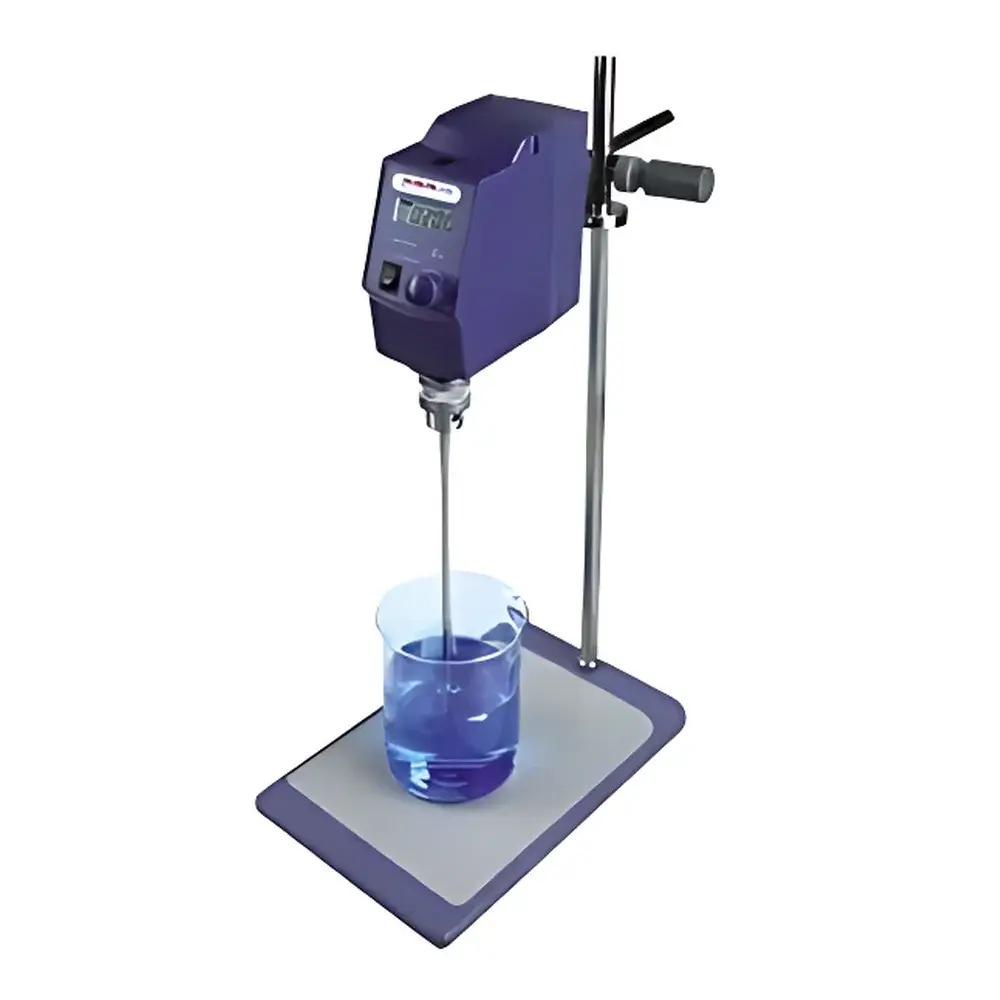
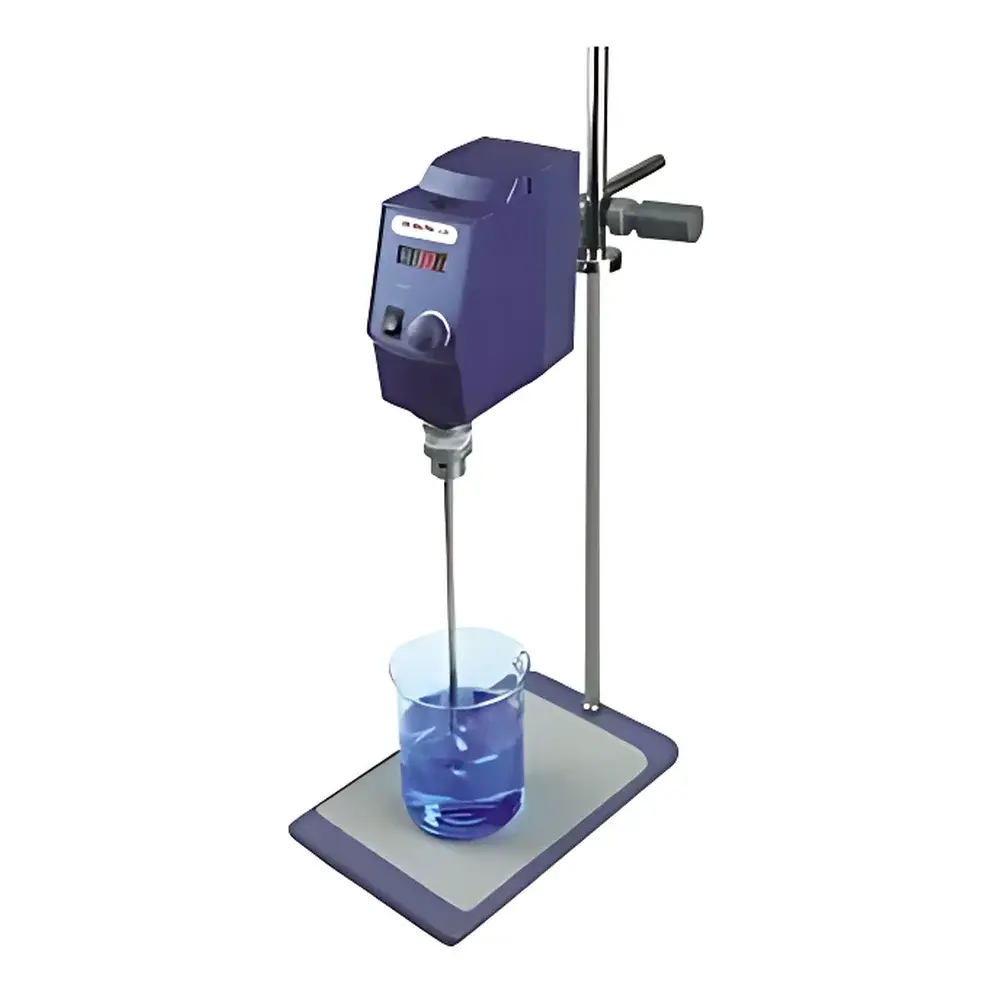
DLAB OS20-Pro Digital Overhead Stirrer
| Brand | DLAB |
|---|---|
| Origin | Beijing, China |
| Model | OS20-Pro |
| Instrument Type | Electric Overhead Stirrer |
| Max. Mixing Volume (H₂O) | 20 L |
| Speed Range | 50–2200 rpm |
| Speed Accuracy | ±3 rpm |
| Max. Torque | 40 N·cm |
| Max. Viscosity | 10,000 mPa·s |
| Chuck Capacity | 0.5–13 mm |
| Motor Input Power | 60 W |
| Motor Output Power | 50 W |
| Rated Power | 70 W |
| Voltage | 100–240 VAC, 50/60 Hz |
| IP Rating | IP42 |
| Operating Temperature | 5–40 °C |
| Relative Humidity | ≤80% |
| Remote Control Interface | RS232 |
| Display | Dual-line LCD (setpoint & actual speed/torque) |
| Safety Features | Overload cutoff, thermal shutdown, soft-start, LED fault indication |
Overview
The DLAB OS20-Pro Digital Overhead Stirrer is an engineered solution for precise, reproducible mixing and dispersion tasks in research laboratories, quality control environments, and pilot-scale process development. Designed around a high-efficiency brushless DC motor and closed-loop microprocessor feedback control, the OS20-Pro delivers stable rotational output across its full 50–2200 rpm range—critical for applications requiring consistent shear input, such as polymer dissolution, suspension homogenization, or catalyst slurry preparation. Its overhead configuration eliminates magnetic coupling limitations and enables direct drive engagement with large-volume vessels (up to 20 L of water-equivalent media), supporting scalable workflows from benchtop formulation to pre-production validation. The unit complies with IEC 61000-6-3 (EMC) and IEC 61000-6-2 (immunity) standards, and its IP42-rated enclosure ensures reliable operation under typical laboratory ambient conditions (5–40 °C, ≤80% RH).
Key Features
- Microprocessor-based closed-loop speed control with real-time torque monitoring—ensures ±3 rpm accuracy and automatic compensation for load variation.
- Dual-line LCD display showing both setpoint and actual values for speed (rpm) and torque (N·cm), enabling immediate verification of operational parameters.
- Soft-start algorithm minimizes vortex formation and sample splashing during initiation—particularly beneficial for low-surface-tension or foaming liquids.
- Integrated safety architecture: automatic motor shutdown upon sustained overload, thermal anomaly, or electrical fault; status indicated via dedicated LED indicators.
- RS232 serial interface supports bidirectional communication with Windows-based PCs using DLAB’s optional StirControl™ software—enabling remote parameter setting, time-stamped data logging (speed, torque, runtime), and export to CSV or Excel formats.
- Ergonomic support rod (14 × 220 mm) and universal chuck (0.5–13 mm) accommodate standard laboratory stir bars, propeller impellers, and custom agitators—including PTFE-coated, glass-shafted, or anchor-type geometries.
Sample Compatibility & Compliance
The OS20-Pro is validated for use with aqueous, organic, and mildly corrosive media up to 10,000 mPa·s viscosity—covering common formulations such as sodium alginate gels, kaolin suspensions, and silicone oil emulsions. Its stainless-steel drive shaft and chemically resistant housing meet ISO 15190:2020 requirements for laboratory equipment safety. While not intrinsically rated for hazardous area use, it conforms to EN 61010-1:2010+A1:2019 for electrical safety in laboratory environments. For regulated industries (e.g., pharmaceuticals), the RS232 interface supports audit-trail-capable data capture when paired with 21 CFR Part 11-compliant software configurations.
Software & Data Management
StirControl™ software (v2.1+, Windows 10/11) provides full instrument control via RS232. Users can define multi-step protocols—including ramp profiles, dwell times, and torque thresholds—with automated pass/fail flagging. All session data—including timestamps, speed deviations, and torque excursions—are stored locally with SHA-256 hash integrity verification. Exported datasets retain native units (rpm, N·cm, s) and are compatible with LIMS integration through ODBC drivers. No cloud dependency or subscription model is required; firmware updates are delivered as signed .bin files with version-locked bootloader authentication.
Applications
- Preparation of homogeneous colloidal dispersions for materials science characterization (e.g., TEM sample mounting, rheology pre-conditioning).
- Standardized mixing of calibration standards in environmental testing labs (e.g., EPA Method 1664B oil & grease extraction).
- Controlled agitation during accelerated stability studies per ICH Q1A(R2), ensuring consistent thermal and mechanical stress exposure.
- Blending of viscous phase-change materials (PCMs) in energy storage R&D, where torque consistency directly correlates with crystallinity uniformity.
- QC batch verification of surfactant solutions prior to HPLC analysis—minimizing inter-batch variability in retention time due to incomplete solubilization.
FAQ
What is the maximum recommended vessel diameter for optimal mixing efficiency with the OS20-Pro?
For 20 L capacity, a cylindrical vessel with 180–220 mm internal diameter and aspect ratio (H/D) ≥1.5 is advised to ensure laminar-to-transitional flow regimes and avoid dead zones.
Does the OS20-Pro support analog signal output for PLC integration?
No—only digital RS232 communication is provided. Analog 0–10 V or 4–20 mA outputs require external signal converters certified to EN 61326-1.
Can the unit operate continuously at 2200 rpm under full torque load?
Continuous operation at maximum speed is rated only for viscosities ≤1,000 mPa·s. At >5,000 mPa·s, duty cycle must be limited to ≤60% to prevent thermal derating per IEC 60034-1.
Is the chuck autoclavable?
No—the chuck assembly contains electronic components and is not designed for steam sterilization. Chemical disinfection with 70% ethanol is permissible.
How is traceability maintained for GLP-compliant usage?
When used with StirControl™ in “audit mode”, all parameter changes, start/stop events, and error logs are digitally signed and timestamped—meeting OECD GLP Principles Section 1.3.2 for raw data integrity.
Related Products



