
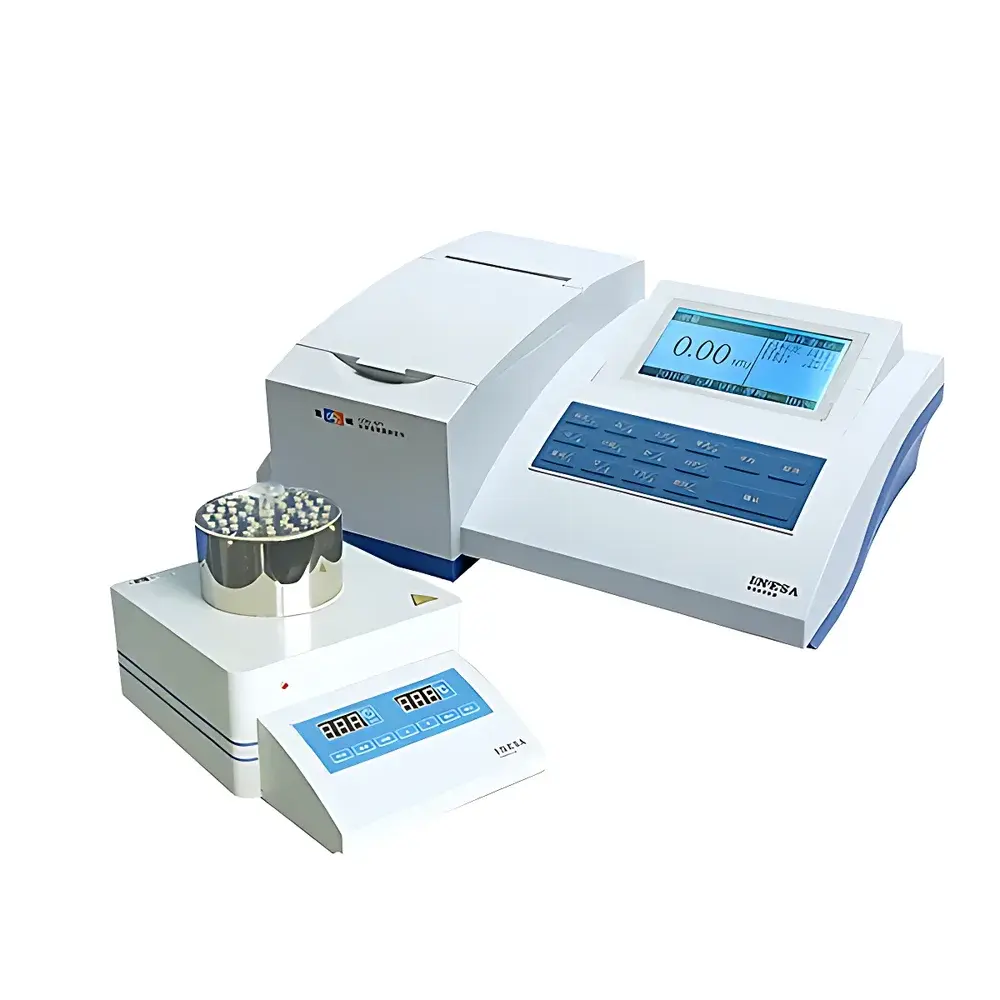
Leici COD-571 Chemical Oxygen Demand Analyzer
| Brand | Leici |
|---|---|
| Origin | Shanghai, China |
| Manufacturer Type | Authorized Distributor |
| Product Origin | Domestic (China) |
| Model | COD-571 |
| Instrument Type | Benchtop Laboratory Analyzer |
| Measurement Principle | Rapid Digestion Method (Closed-Tube, Dichromate Oxidation) |
| Measurement Range | 0–1500 mg/L COD |
| Accuracy | ±8% of reading ±1 mg/L (for 0–150 mg/L) |
| Repeatability | ≤3% RSD |
| Digestion Time | 0–120 min (programmable) |
| Batch Capacity | 21 samples per run |
| Digestion Temperature Range | 50–150 °C (control accuracy: ±5 °C below 150 °C) |
| Timing Accuracy | ±5 min at 120 min setting |
| Stability | ±2 mg/L drift over 15 min |
| Operating Environment | 5–40 °C, RH ≤85%, AC 220 V ±10%, 50 Hz ±1 Hz |
| Safety Features | Overtemperature alarm, auto-shutdown post-digestion |
| Data Output | Integrated thermal printer (PP40 type), direct COD concentration readout |
Overview
The Leici COD-571 is a benchtop laboratory chemical oxygen demand (COD) analyzer engineered for precision, reproducibility, and compliance with standard water quality testing protocols. It implements the rapid digestion method based on closed-tube dichromate oxidation—fully aligned with ISO 6060, ASTM D1252–06 (Method B), and China’s HJ 828–2017 standard for COD determination in wastewater and surface water. Unlike titrimetric approaches, the COD-571 employs spectrophotometric quantification of Cr³⁺ absorbance following controlled thermal digestion, eliminating manual titration and reducing analyst-dependent variability. The system integrates a dedicated 21-position digestion block with independent temperature and timing control, enabling high-throughput batch processing while maintaining traceable thermal uniformity across all reaction vessels.
Key Features
- 21-sample simultaneous digestion module with programmable temperature (50–150 °C) and time (0–120 min), optimized for HJ 828–2017-compliant digestion cycles
- Integrated spectrophotometric detection system with fixed-wavelength optical path (typically 600 nm or dual-wavelength ratio mode) calibrated for Cr³⁺ quantification
- Onboard thermal printer (PP40-compatible) providing immediate hardcopy output of sample ID, digestion parameters, measured absorbance, and final COD concentration (mg/L)
- Intuitive Chinese-language LCD interface with step-by-step guided operation—no external PC required for routine analysis
- Automatic end-of-digestion shutdown and audible/visual overtemperature alert to ensure operator safety and reagent integrity
- Stability performance verified at ±2 mg/L over 15 minutes under ambient lab conditions (25 °C, 50% RH), supporting GLP-aligned measurement consistency
Sample Compatibility & Compliance
The COD-571 accepts standard 16 mm OD borosilicate glass digestion tubes (15 mL capacity) and is validated for use with EPA-approved digestion reagents (e.g., pre-filled vials containing K₂Cr₂O₇, H₂SO₄, Ag₂SO₄, and HgSO₄). It supports raw influent, treated effluent, river water, and industrial process streams—with chloride interference mitigation via mercury sulfate masking. The instrument meets functional requirements of ISO/IEC 17025 for calibration traceability when operated with NIST-traceable COD standards (e.g., potassium hydrogen phthalate solutions). While not FDA 21 CFR Part 11–certified out-of-the-box, audit trails (via printed reports) and user-access controls support basic GMP/GLP documentation needs in municipal and third-party environmental labs.
Software & Data Management
The COD-571 operates as a standalone analytical platform with embedded firmware—no proprietary software installation required. All measurement data, including digestion setpoints, raw absorbance values, and calculated COD results, are retained in non-volatile memory for up to 500 test records. Printed reports include date/time stamps, operator ID fields, and instrument serial number—enabling manual linkage to laboratory notebooks. For laboratories requiring digital archiving, optional RS-232 or USB-to-serial adapters allow ASCII-formatted data export to LIMS or Excel-compatible spreadsheets. Firmware updates are performed via SD card (not included), with version history logged in system diagnostics.
Applications
- Regulatory compliance monitoring for municipal wastewater treatment plants (WWTPs) reporting to local EPBs per GB 18918–2002 discharge limits
- Process control in electroplating, pharmaceutical, food & beverage, and textile manufacturing facilities
- Educational laboratories conducting standardized COD experiments per university environmental chemistry curricula
- Field-deployable lab setups where benchtop reliability and minimal consumables (no titrants, no burettes) reduce operational overhead
- Verification of low-COD groundwater or drinking water sources using the 0–150 mg/L sub-range with enhanced ±1 mg/L absolute error tolerance
FAQ
Does the COD-571 comply with ISO 6060 or ASTM D1252?
Yes—the instrument implements the closed-reflux, dichromate-based rapid digestion protocol specified in Clause 8.2 of ISO 6060:1989 and Method B of ASTM D1252–06, with validation data available upon request.
Can it measure samples with chloride concentrations above 1000 mg/L?
Chloride interference is mitigated using HgSO₄ masking agents supplied with certified digestion vials; however, for Cl⁻ > 2000 mg/L, dilution or alternative chloride-resistant methods (e.g., chlorine-resistant catalysts) are recommended.
Is calibration traceable to national standards?
Calibration is performed using aqueous potassium hydrogen phthalate (KHP) standards traceable to CNAS-accredited reference material providers (e.g., GBW(E) 080250); certificate of analysis provided with each standard batch.
What maintenance is required beyond routine cleaning?
Annual verification of digestion block temperature uniformity (±3 °C across all 21 positions) and photometer linearity (using neutral density filters) is advised per internal QA procedures.
Does the unit support remote diagnostics or network connectivity?
No native Ethernet/Wi-Fi capability exists; connectivity is limited to RS-232 serial output for data logging—consistent with IEC 61000-6-3 EMC compliance for laboratory electromagnetic environments.
Related Products







