
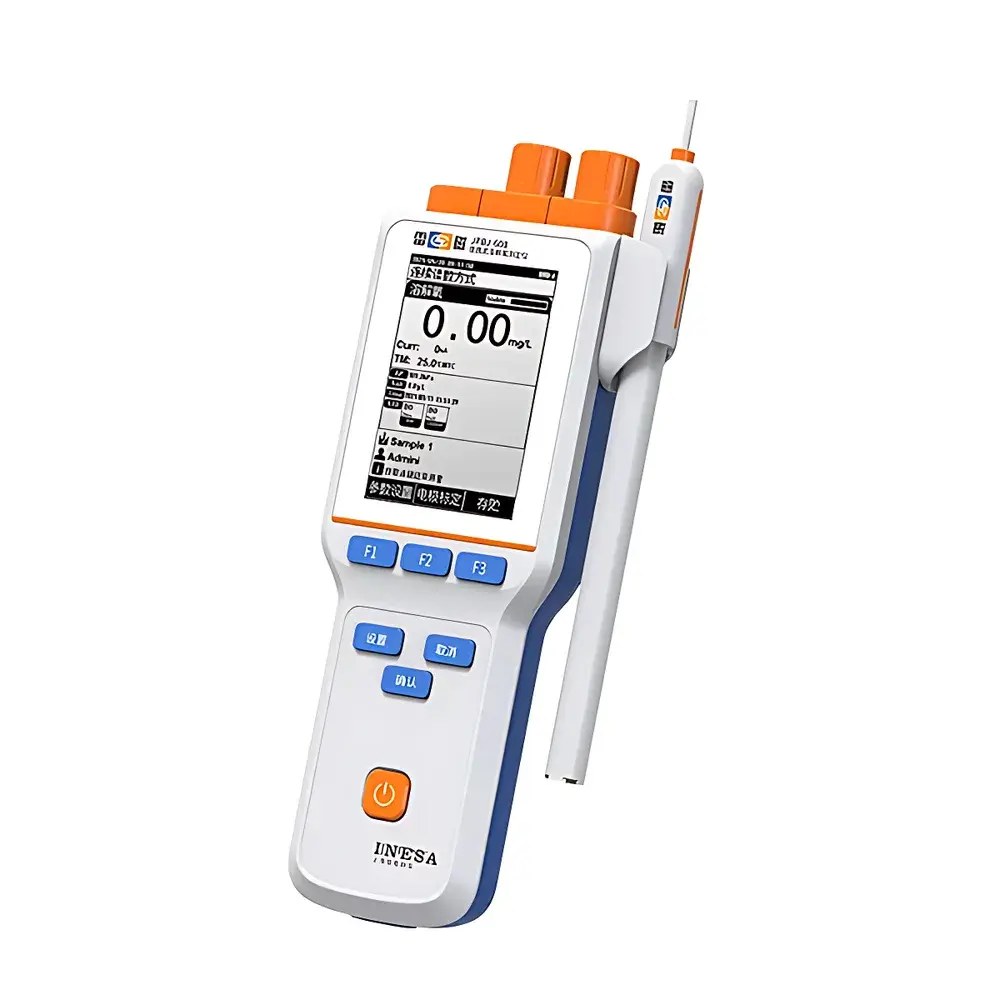
Leici JPBJ-608 Portable Dissolved Oxygen Meter
| Brand | Leici |
|---|---|
| Origin | Shanghai, China |
| Model | JPBJ-608 |
| Instrument Type | Portable |
| Measurement Principle | Electrochemical (Polarographic Membrane-Type Probe) |
| Range | (0.00–19.99) mg/L DO |
| Accuracy | ±0.30 mg/L |
| Repeatability | ±0.10 mg/L |
| Temperature Range | (0.0–40.0) °C |
| Temp. Accuracy | ±0.5 °C |
| Saturation Range | (0.0–199.9) % |
| Saturation Accuracy | ±10 %FS |
| Zero Error | ≤0.10 mg/L |
| Stability | ±0.10 mg/L / 3 h |
| Response Time (90%) | ≤45 s at 20 °C |
| Data Storage Capacity | 500 sets |
| Protection Rating | IP65 |
| Interface | RS-232 |
| Power Supply | 4 × AA alkaline batteries |
Overview
The Leici JPBJ-608 Portable Dissolved Oxygen Meter is a field-deployable electrochemical analyzer engineered for precise, on-site measurement of dissolved oxygen (DO) concentration, saturation percentage, and temperature in natural waters, wastewater, aquaculture systems, and environmental monitoring applications. It operates on the polarographic membrane-type principle—utilizing a Clark-type sensor with a gas-permeable Teflon membrane, cathode-anode redox reaction, and diffusion-limited current detection. This architecture ensures stable baseline response, minimal drift, and reliable performance under variable ambient conditions. Designed to meet routine field requirements without compromising metrological integrity, the JPBJ-608 delivers traceable measurements aligned with standard practices defined in ASTM D888 and ISO 5814 for dissolved oxygen determination in water.
Key Features
- High-contrast backlit LCD display with intuitive icon-based prompts and real-time operation guidance—enabling efficient single-operator use in low-light or outdoor environments.
- Simultaneous triple-parameter readout: dissolved oxygen concentration (mg/L), saturation (%), and sample temperature (°C), all displayed concurrently for immediate contextual interpretation.
- Comprehensive calibration suite including zero-oxygen (sodium sulfite), full-scale (air-saturated water), barometric pressure, and salinity compensation—supporting accurate DO reporting across diverse aquatic matrices (freshwater, estuarine, and low-salinity brackish water).
- Integrated automatic temperature compensation (ATC) using a built-in thermistor probe; eliminates manual correction and reduces operator-induced error in dynamic thermal environments.
- Ruggedized housing rated to IP65—fully protected against dust ingress and low-pressure water jets—validated for extended deployment in rain, humidity, and dusty field settings.
- Intelligent power management: auto-power-off after 10 minutes of inactivity; non-volatile memory retains calibration coefficients and last-measured values during battery replacement or shutdown.
Sample Compatibility & Compliance
The JPBJ-608 is optimized for liquid-phase analysis of aqueous samples within pH 4–9 and conductivity < 2 mS/cm. It accommodates both static grab samples and in-situ immersion via the supplied DO-958-B polarographic electrode—a replaceable membrane-cap assembly with Ag/AgCl reference and Pt cathode configuration. The instrument supports regulatory workflows requiring data integrity: stored measurements include timestamp, temperature, DO value, saturation, and calibration status—facilitating traceability per GLP documentation standards. While not certified to FDA 21 CFR Part 11, its audit-ready data structure (with immutable timestamps and no post-hoc editing capability) aligns with basic laboratory quality system expectations for environmental field data collection.
Software & Data Management
Data transfer is enabled via RS-232 serial interface, compatible with Leici’s proprietary data acquisition software (Windows-based) for bidirectional communication. Users may download stored datasets (up to 500 records), export CSV-formatted logs, and generate summary reports for QA/QC review. Optional connection to TP-16 thermal printers allows hard-copy output of current readings or historical records—useful for chain-of-custody documentation in field surveys. All stored entries are write-protected upon acquisition; deletion requires explicit user confirmation, preventing accidental loss. No cloud synchronization or remote access functionality is implemented—ensuring data sovereignty and compliance with institutional IT security policies.
Applications
- Surface water quality assessment in rivers, lakes, and reservoirs per national EPA or local environmental agency protocols.
- Wastewater treatment plant process control—monitoring aeration basin DO levels to optimize energy consumption and nitrification efficiency.
- Aquaculture health management—tracking diurnal DO fluctuations in ponds and recirculating systems to prevent hypoxic stress.
- Educational field laboratories—supporting undergraduate hydrology and limnology coursework with robust, low-maintenance instrumentation.
- Emergency spill response—rapid screening of DO depression following organic contaminant releases or algal bloom collapse events.
FAQ
What type of sensor does the JPBJ-608 use, and how often must the membrane be replaced?
It employs a polarographic DO-958-B electrode with a disposable Teflon membrane cap. Membrane replacement is recommended every 2–3 months under continuous use or after exposure to fouling agents (e.g., algae, silt, H₂S).
Does the instrument compensate for atmospheric pressure changes during high-altitude field work?
Yes—manual barometric pressure input (in kPa or mmHg) is supported during full-scale calibration to correct for oxygen partial pressure variations.
Can the JPBJ-608 measure in saline or seawater samples?
It includes salinity compensation (0–35 g/kg), enabling acceptable accuracy in estuarine and coastal waters; however, for full marine salinity (>35 g/kg), external correction using Winkler titration validation is advised.
Is the battery life sufficient for full-day field campaigns?
With alkaline AA cells, typical operational endurance exceeds 200 hours under intermittent use—approximately 5–7 consecutive field days assuming 20 measurements/day.
How is calibration verification performed between scheduled calibrations?
Users may conduct a quick air-saturation check at ambient temperature; deviation >±0.3 mg/L from the theoretical saturation value (calculated via temperature and pressure) indicates electrode conditioning or membrane inspection is required.
Related Products







