
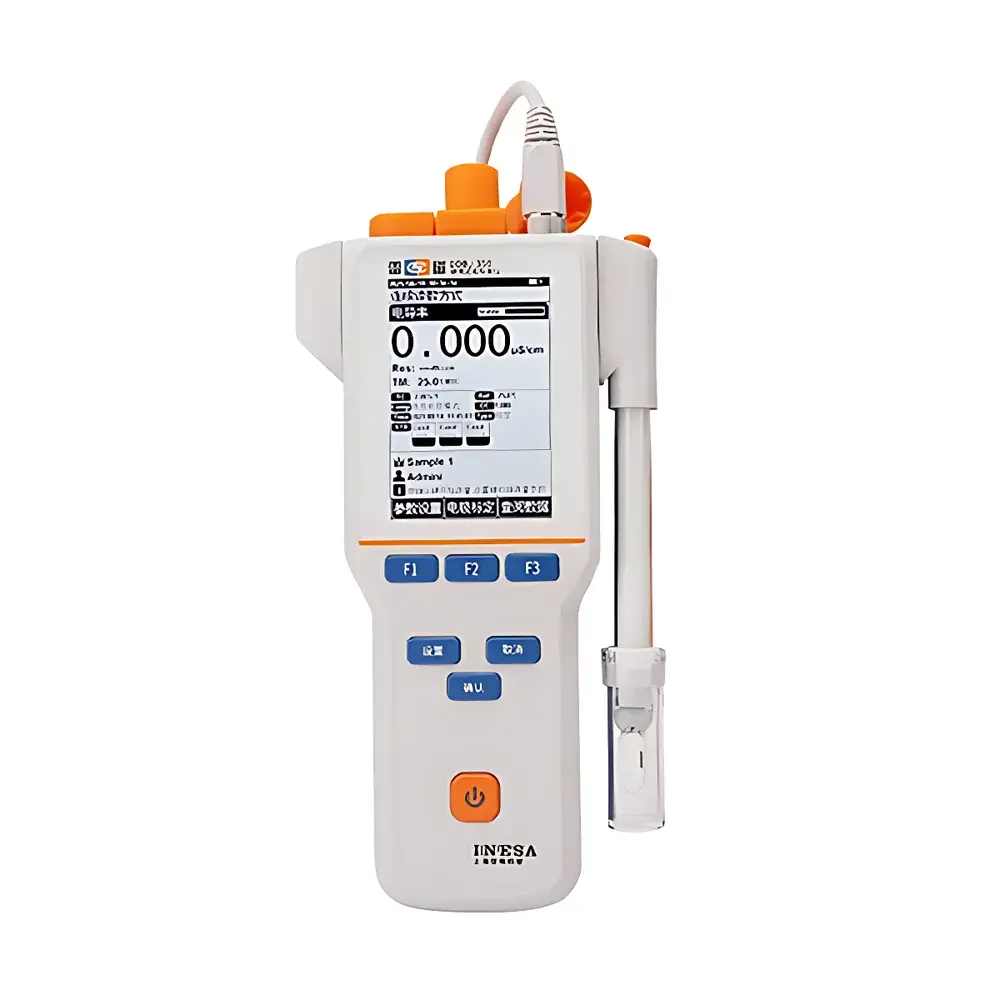
Leici DDBJ-350 Portable Conductivity Meter
| Brand | Leici |
|---|---|
| Origin | Shanghai, China |
| Model | DDBJ-350 |
| Portability | Portable |
| Intended Use | Laboratory & Field |
| Conductivity Range | (0.00–1.999×10⁵) µS/cm (5 auto-ranging spans) |
| TDS Range | (0.00–19,990) mg/L (5 auto-ranging spans) |
| Salinity Range | (0.00–8.00)% |
| Resistivity Range | 0–100 MΩ·cm |
| Temperature Range | (0.0–40.0) °C |
| Conductivity Accuracy | ±1.0% FS ±1 digit |
| Salinity Accuracy | ±0.2% ±1 digit |
| Temperature Accuracy | ±0.3 °C ±1 digit |
| Temperature Compensation | 0.0–40.0 °C (reference 25 °C for conductivity, 18 °C for salinity) |
| Electrode Constants Available | 0.01, 0.1, 1.0, 10.0 cm⁻¹ |
| Data Storage Capacity | 250 sets |
| Interface | RS-232 |
| IP Rating | IP65 |
| Power Management | Low-power design with low-battery indicator and auto-off |
Overview
The Leici DDBJ-350 Portable Conductivity Meter is an engineered electrochemical instrument designed for precise, field-deployable measurement of aqueous solution conductivity, total dissolved solids (TDS), salinity, and temperature. Based on the fundamental principle of two-electrode AC conductometric measurement—applying a low-frequency alternating current to minimize polarization and electrode fouling—the DDBJ-350 delivers traceable, reproducible results across five decades of conductivity (0.00–199.9 mS/cm, equivalent to 0.00–1.999×10⁵ µS/cm) using interchangeable electrodes with standardized cell constants (0.01, 0.1, 1.0, or 10.0 cm⁻¹). Its architecture supports both laboratory-grade calibration rigor and outdoor operational resilience, making it suitable for environmental monitoring, water quality assessment, pharmaceutical process water verification, and educational electrochemistry applications where portability and regulatory traceability are required.
Key Features
- Auto-ranging conductivity measurement across five calibrated spans—(0.00–19.99) µS/cm, (20.0–199.9) µS/cm, (200.0–1999) µS/cm, (2.0–19.99) mS/cm, and (20.0–199.9) mS/cm—with seamless switching and full-scale accuracy of ±1.0% FS ±1 digit.
- Integrated TDS calculation with five configurable ranges (0.00–19,990 mg/L), supporting user-defined TDS conversion factors (e.g., NaCl or KCl equivalents) and electrode constant compensation (0.01–10.0 cm⁻¹).
- Salinity quantification per practical salinity scale (PSS-78) principles, calibrated at 18 °C reference and validated from 0.00–8.00%, with ±0.2% ±1 digit uncertainty.
- High-stability temperature sensing (±0.3 °C ±1 digit) over 0.0–40.0 °C, enabling linear or non-linear (NTC-based) temperature compensation for conductivity and salinity.
- IP65-rated enclosure with reinforced PC front panel, sealed measurement chamber, and titanium-alloy conductivity cell (0.01 cm⁻¹) optimized for ultrapure water analysis (≥10 MΩ·cm resistivity).
- Onboard data management: stores up to 250 complete measurement records—including timestamp, parameter values, electrode constant, temperature, and calibration status—with recall, deletion, and dual-mode printing (instant or batch via RS-232 to TP-16 printer).
Sample Compatibility & Compliance
The DDBJ-350 accommodates liquid samples ranging from deionized water (resistivity up to 100 MΩ·cm) to high-ionic-strength brines (up to 200 mS/cm), provided appropriate electrode selection and cleaning protocols are followed. It supports ASTM D1125 (Standard Test Methods for Electrical Conductivity and Resistivity of Water), ISO 7888 (Water Quality – Determination of Electrical Conductivity), and USP (Electrical Conductivity of Purified Water and Water for Injection) when operated under documented calibration and temperature control. While not inherently 21 CFR Part 11 compliant, its RS-232 interface enables integration with validated third-party data acquisition systems (e.g., REX DC1.0 software) that support audit trails, electronic signatures, and secure data export—facilitating GLP/GMP-aligned workflows in regulated environments.
Software & Data Management
The meter features embedded firmware supporting full calibration traceability: users may perform single- or multi-point conductivity calibration (KCl standards), adjust TDS conversion coefficients, and directly input electrode constants. All calibrations are logged with date/time stamps and retained through power cycles. Via the RS-232 serial interface, the DDBJ-350 communicates bidirectionally with REX DC1.0 data acquisition software (Windows-compatible), enabling real-time streaming, automated report generation (PDF/CSV), trend visualization, and long-term database archiving. Data exports include raw sensor readings, compensated values, calibration history, and operator ID fields—critical for internal QA reviews and external audit readiness.
Applications
- Environmental field surveys: stream, lake, and groundwater conductivity profiling with GPS-synchronized logging (when paired with external GNSS devices).
- Pharmaceutical water system validation: routine checks of purified water (PW) and water for injection (WFI) per USP acceptance criteria at distribution points.
- Power plant demineralizer monitoring: detection of ion leakage in mixed-bed resin effluents via sub-µS/cm sensitivity.
- Aquaculture and hydroponics: real-time salinity and nutrient concentration tracking in recirculating systems.
- Academic laboratories: undergraduate electrochemistry experiments involving Kohlrausch’s law, molar conductivity, and temperature dependence studies.
FAQ
What electrode constants are supported, and how do they affect measurement?
The DDBJ-350 accepts electrodes with cell constants of 0.01, 0.1, 1.0, and 10.0 cm⁻¹. Lower constants (e.g., 0.01 cm⁻¹) are essential for high-resistivity samples like ultrapure water; higher constants (e.g., 10.0 cm⁻¹) extend dynamic range for concentrated solutions. The instrument applies automatic scaling based on user-input constant.
Does the meter meet ISO/IEC 17025 calibration requirements?
While the DDBJ-350 itself is not certified to ISO/IEC 17025, its documented calibration procedures, traceable to NIST-traceable KCl standards, and stable performance (±0.7% FS/3 h electronic drift) allow accredited labs to validate it per internal SOPs aligned with ISO/IEC 17025 Clause 6.5.
Can the device be used for online continuous monitoring?
No—it is a handheld, batch-measurement instrument. For continuous applications, Leici offers dedicated inline conductivity transmitters (e.g., DDS-307A series) with 4–20 mA output and Modbus RTU support.
Is temperature compensation adjustable or fixed?
Compensation follows the standard NaCl-based algorithm per ISO 7888, with user-selectable reference temperatures (25 °C for conductivity, 18 °C for salinity) and manual override capability for custom media.
How is data integrity ensured during power loss?
All stored measurements and calibration settings are retained in non-volatile memory. The auto-off function preserves battery life without compromising data retention—even after extended storage without charging.





