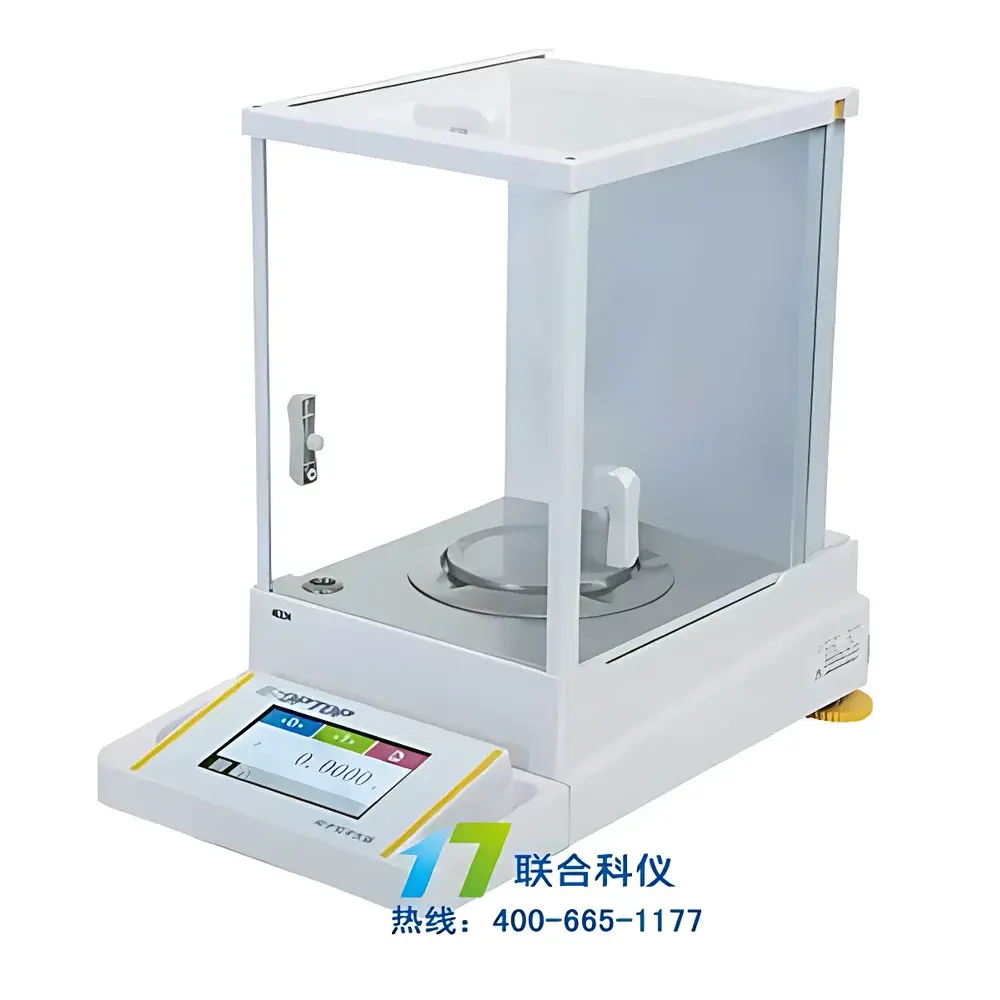
SOPTOP AE223C Internal Calibration Precision Balance
| Brand | SOPTOP |
|---|---|
| Origin | Shanghai, China |
| Model | AE223C |
| Instrument Type | Precision Balance |
| Maximum Capacity | 220 g |
| Readability | 0.001 g |
| Repeatability | 0.001 g |
| Calibration Method | Internal Calibration |
| Pan Diameter | 90 mm |
| Dimensions (W×D×H) | 365 × 223 × 338 mm |
| Net Weight | 5.5 kg |
| Windshield Effective Volume | 160 × 165 × 200 mm |
Overview
The SOPTOP AE223C is a high-reliability internal calibration precision balance engineered for routine quantitative analysis in quality control laboratories, pharmaceutical production environments, academic research settings, and industrial R&D facilities. Utilizing electromagnetic force compensation (EMFC) technology, the AE223C delivers stable, drift-resistant measurements under variable ambient conditions. Its 0.001 g readability and 220 g maximum capacity meet the requirements of ISO/IEC 17025-compliant weighing tasks where traceable accuracy and operational consistency are critical. Designed to operate within standard laboratory temperature (10–30 °C) and humidity (30–80% RH, non-condensing) ranges, the balance features built-in environmental compensation algorithms that minimize thermal drift effects on sensor output. The EMFC transducer architecture ensures long-term stability without mechanical wear—eliminating the need for periodic mechanical recalibration or replacement of load cell components.
Key Features
- True-color TFT LCD display with full-screen capacitive touch interface—engineered for glove-compatible operation and intuitive navigation across multiple user profiles.
- Metro-inspired UI design with low-blue-light color scheme compliant with ISO 9241-305 ergonomic guidelines; reduces visual fatigue during extended weighing sessions.
- Integrated leveling system with front-mounted bubble level indicator and ergonomically positioned adjustable feet—enabling rapid, precise horizontal alignment without tools.
- Reinforced overload-protected weighing pan (Ø90 mm stainless steel) with shock-absorbing structural geometry to safeguard the electromagnetic sensor from accidental impact or overloading.
- Removable acrylic draft shield with optimized internal volume (160 × 165 × 200 mm) for minimal air turbulence and consistent weighing dynamics across volatile or static-sensitive samples.
- Transport lock mechanism with reinforced glass door latch—prevents suspension displacement and sensor stress during relocation or shipping.
- Multi-unit conversion capability (g, mg, oz, ct, carat, %, pcs, etc.) with one-touch switching and real-time display synchronization.
Sample Compatibility & Compliance
The AE223C supports solid, granular, and low-viscosity liquid samples within its defined operating envelope. It complies with international metrological standards including OIML R76-1 (2021), EN 45501:2015, and JJG 1036–2022 (People’s Republic of China National Verification Regulation for Non-Automatic Weighing Instruments). While not certified for GLP/GMP audit trails out-of-the-box, the balance supports external data export via RS232 interface for integration into validated LIMS or ELN platforms. Internal calibration is traceable to national mass standards through factory-applied calibration certificates (available upon request), satisfying baseline requirements for ISO 9001 and ISO/IEC 17025 Clause 6.4.2 (Equipment Verification).
Software & Data Management
The AE223C operates on embedded firmware with no external PC dependency for core functions. All internal calibration routines, unit conversions, and application modes—including piece counting, percentage weighing, density determination (with optional accessories), and net/gross/tare workflows—are preloaded and accessible via touchscreen. Data output is ASCII-formatted via RS232 serial port at configurable baud rates (up to 115200 bps), compatible with common laboratory software such as LabX (Mettler Toledo), WinWedge, and custom Python-based acquisition scripts. Audit trail functionality is not natively implemented; however, timestamped weight logs can be externally captured and archived in accordance with FDA 21 CFR Part 11 if paired with compliant third-party data acquisition systems.
Applications
- Pharmaceutical formulation: Accurate dispensing of active pharmaceutical ingredients (APIs) and excipients during batch preparation and stability testing.
- Chemical synthesis: Precise reagent dosing in stoichiometric reactions requiring ±0.001 g repeatability.
- Materials science: Gravimetric analysis of catalyst loading, polymer fillers, or nanomaterial dispersion ratios.
- Food safety labs: Moisture content determination via loss-on-drying protocols per AOAC 950.46 and ISO 665.
- Environmental testing: Sample preparation for ICP-MS and AAS analysis where sub-milligram sample integrity directly affects detection limits.
- Educational laboratories: Teaching fundamental metrology principles, uncertainty propagation, and measurement traceability concepts.
FAQ
What does “internal calibration” mean for the AE223C?
Internal calibration uses a motor-driven, factory-traceable reference mass integrated within the balance housing. Activation initiates an automated sequence that adjusts gain and zero parameters without manual intervention or external weights.
Is the AE223C suitable for use in a fume hood?
Yes—provided ambient airflow is stabilized below 0.5 m/s at the pan surface and temperature gradients remain within ±1 °C over 30 minutes. Draft shield removal is not recommended in ventilated enclosures.
Can the balance be connected to a networked LIMS?
Direct Ethernet or Wi-Fi connectivity is not supported. Integration requires RS232-to-Ethernet gateways or serial servers configured for Modbus RTU or ASCII streaming protocols.
Does the AE223C support GLP-compliant user access control?
No. User authentication, role-based permissions, and electronic signatures are not implemented in the native firmware.
What maintenance is required beyond routine cleaning?
Annual verification using certified test weights (e.g., Class M2 or better) is recommended. Sensor diagnostics and linearity checks may be performed by authorized SOPTOP service centers upon request.