
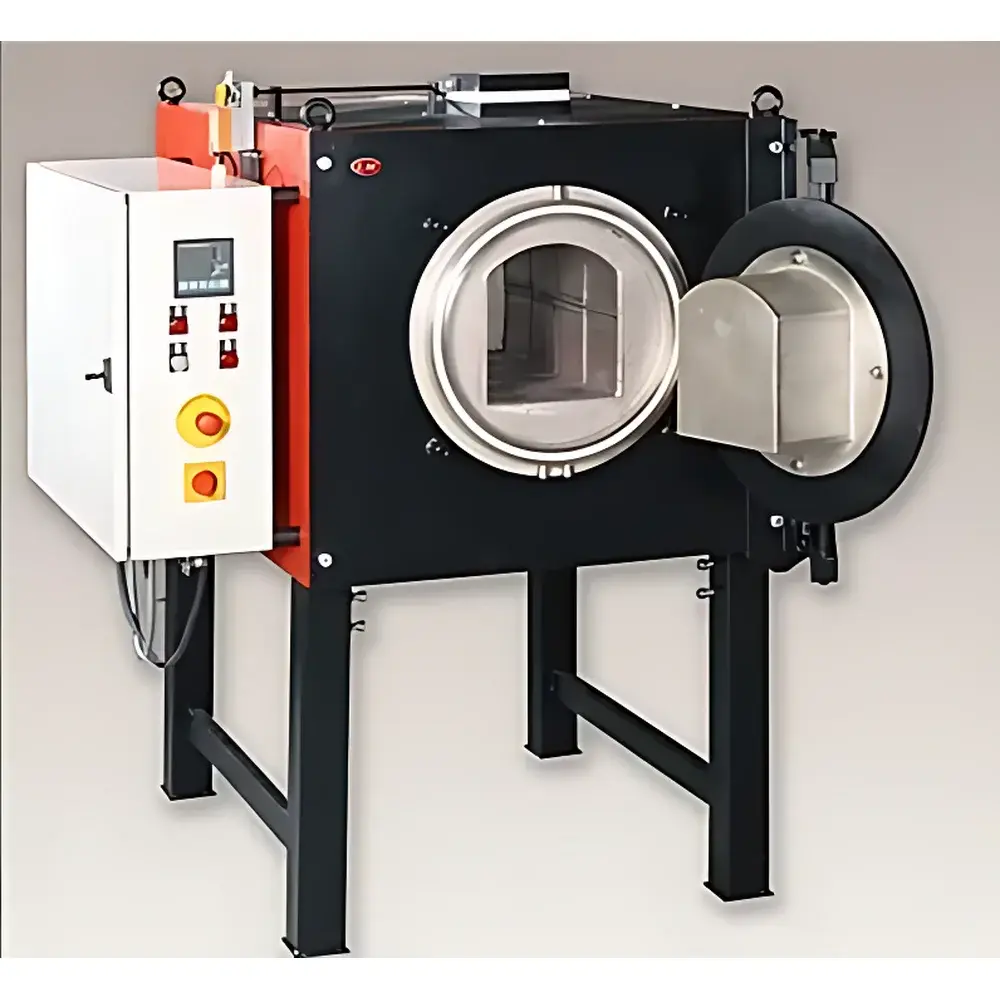
LAC PKR Series Gas-Tight Retort Box Furnace
| Key | Brand: LAC (Czech Republic) |
|---|---|
| Model | PKR / PKRC |
| Max Temperature | 1100 °C |
| Temp Uniformity | Compliant with DIN 17052-1 |
| Control Accuracy | ±2 °C |
| Heating Method | Resistance Wire (Fe-Cr-Al) |
| Internal Dimensions | 220 × 260 × 450 mm (W×H×D) |
| Max Power | 11 kW |
| Ramp Time to 1100 °C | 135 min |
| Atmosphere Compatibility | Argon, Nitrogen, Forming Gas (H₂/N₂), Vacuum (with optional pump) |
| Controller | INDUSTRY Programmable PLC (30 programs × 15 steps, real-time clock, safety interlock) |
| Thermocouple | Type S (Pt/Pt–10% Rh) |
| Retort | Stainless Steel, Water-Cooled Collar, Silicone-Sealed Door |
| Safety | Overpressure Relief Outlet, Door-Mounted Safety Switch, Semiconductor Solid-State Relay |
Overview
The LAC PKR Series gas-tight retort box furnace is a precision-engineered thermal processing system designed for reproducible heat treatment under strictly controlled or inert atmospheres. Built to Czech manufacturing standards and compliant with EU Machinery Directive 2006/42/EC, the PKR operates on the principle of sealed retort technology—where the process chamber (retort) is hermetically isolated from the outer furnace shell, enabling precise regulation of internal gas composition, pressure, and purity. This architecture minimizes protective gas consumption while ensuring thermal stability up to 1100 °C, making it suitable for applications demanding oxide-free surface integrity, such as bright annealing of stainless steels, tempering of tool alloys, vacuum-assisted sintering of powder metallurgy components, and controlled-atmosphere brazing of electronic assemblies. The furnace’s heating elements are embedded in side walls and floor, shielded by high-mechanical-strength silicon carbide (SiC) plates to extend service life and maintain uniform radiant heat distribution—validated per DIN 17052-1 for industrial-grade temperature homogeneity.
Key Features
- Gas-tight stainless steel retort with water-cooled flange collar and high-temperature silicone door seal—ensuring leak rates < 1 × 10⁻³ mbar·L/s under differential pressure
- Programmable INDUSTRY controller with integrated real-time clock, supporting up to 30 independent thermal profiles; each profile configurable with up to 15 ramp/soak/hold steps and scheduled start capability
- Dual-stage atmosphere management: manual single-gas inlet standard; optional fully automated multi-gas dosing with mass flow controllers and overpressure venting
- Safety-certified architecture including door-mounted emergency cut-off switch, semiconductor non-contact relay switching, and overpressure relief valve compliant with PED 2014/68/EU
- Thermal insulation composed of low-conductivity lightweight refractory bricks and ceramic fiber modules—reducing standby heat loss and improving energy efficiency
- Robust mechanical frame with reinforced steel chassis and vibration-damped mounting—designed for continuous operation in QC labs and pilot-scale production environments
Sample Compatibility & Compliance
The PKR accommodates a broad range of sample geometries and materials—including metallic powders (e.g., Fe, Cu, Ni-based compacts), machined alloy components, ceramic green bodies, and coated substrates—within its 220 × 260 × 450 mm working volume. Its gas-tight retort design enables compliance with ASTM F2697 (Standard Guide for Controlled Atmosphere Heat Treatment), ISO 9001:2015 process validation requirements, and GMP-relevant environmental controls when integrated with audit-trail-capable software (via optional RS-232/RS-485 interface). For regulated industries, the system supports GLP documentation workflows through external data logging and time-stamped event recording (e.g., door open/close, gas flow activation, thermocouple fault detection).
Software & Data Management
While the embedded INDUSTRY controller provides local program execution and basic parameter monitoring, optional digital integration extends traceability and remote oversight capabilities. The RS-232 or RS-485 communication port enables bidirectional protocol exchange with laboratory information management systems (LIMS) or SCADA platforms using Modbus RTU. When paired with the optional graphic temperature recorder, users obtain calibrated, time-synchronized thermal profiles compliant with FDA 21 CFR Part 11 for electronic records and signatures—supporting full audit trails, user access logs, and electronic signature enforcement. All firmware updates follow IEC 62443-2-4 secure update protocols, and configuration backups are exportable in CSV format for version-controlled archiving.
Applications
- Bright annealing of austenitic stainless steels and nickel alloys without surface oxidation or discoloration
- Tempering of hardened tool steels (e.g., H13, D2) with repeatable microstructural control
- Sintering of metal injection molded (MIM) parts and pressed powder compacts under nitrogen or forming gas
- Low-temperature brazing of copper-to-copper or copper-to-stainless joints using hydrogen-containing atmospheres
- Pre-oxidation conditioning of catalyst substrates prior to catalytic testing
- Thermal aging studies of high-temperature alloys under inert conditions per ASTM E2357
FAQ
What atmosphere gases are compatible with the PKR retort?
Argon, nitrogen, dissociated ammonia, and forming gas (typically 5–10% H₂ in N₂) are routinely used. Hydrogen-only operation requires additional safety certification and is not supported in standard configuration.
Can the PKR operate under vacuum?
The base PKR model is not vacuum-rated. However, the PKRC variant—equipped with vacuum-tight flanges, reinforced retort welds, and optional vacuum pump interface—is certified for rough vacuum operation up to 10⁻² mbar.
Is temperature uniformity validated across the entire working zone?
Yes. Per DIN 17052-1, uniformity is verified at three load conditions (empty, 50% load, full load) at 1100 °C using nine-point sensor mapping. Typical deviation is ≤ ±3 °C in the central 70% volume.
How is gas consumption minimized?
Through optimized retort geometry, low-leakage sealing, and programmable purge cycles—average argon usage is typically 0.8–1.2 L/min during steady-state operation at 1100 °C.
What regulatory documentation is supplied with the furnace?
CE Declaration of Conformity (including EN 61000-6-2/6-4 EMC, EN 61000-3-2 harmonic limits), EC Type Examination Certificate (for retort pressure containment), and full technical file available upon request for FDA or MHRA inspection readiness.
Related Products



