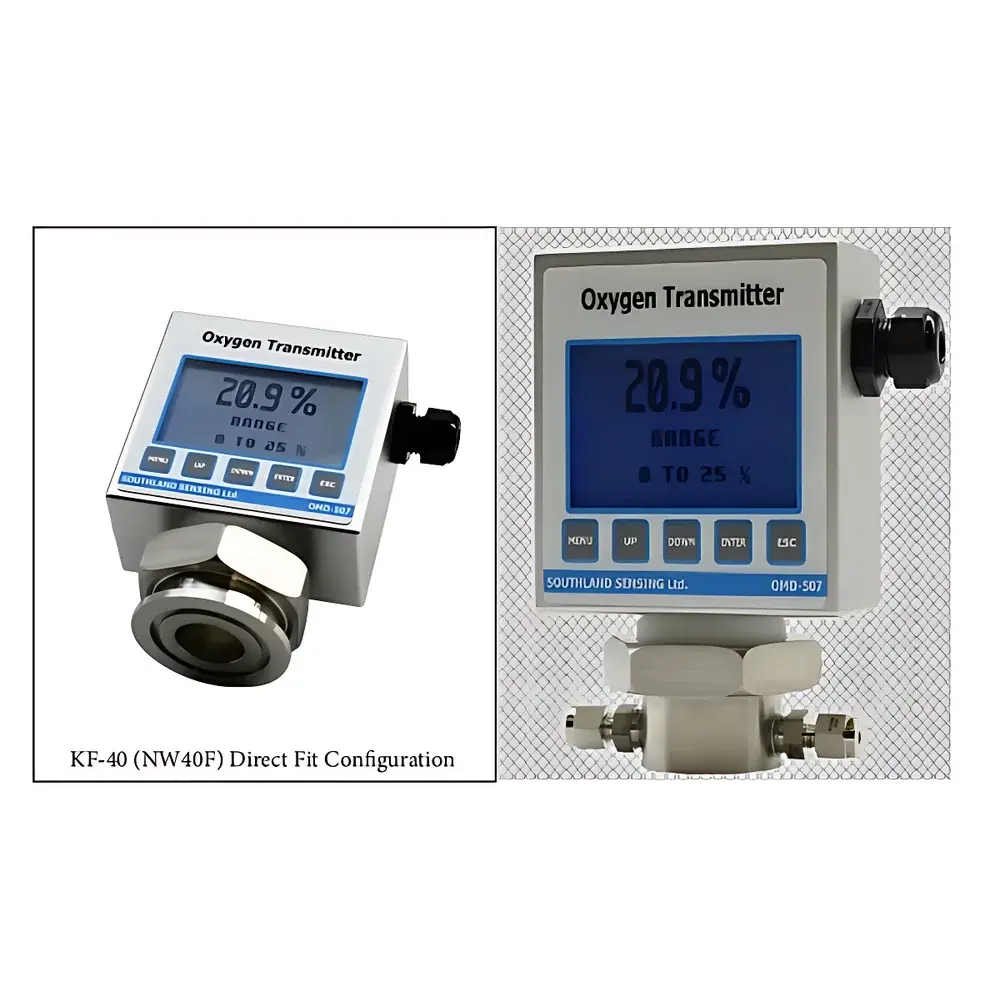
Southland Sensing OMD-507 RS485 Oxygen Analyzer for Glovebox Applications
| Origin | USA |
|---|---|
| Manufacturer Type | Authorized Distributor |
| Origin Category | Imported |
| Model | OMD-507 |
| Price Range | USD 1,400 – 4,200 |
| Measurement Ranges | 0–10 ppm, 0–100 ppm, 0–1,000 ppm, 0–1 %, 0–25 %, 0–100 % |
| Accuracy | < ±1 % FS |
| Certifications | CE |
| Dimensions | 241 × 165 × 96 mm |
| Operating Temperature | –10 to +50 °C |
| Temperature Compensation | Yes |
| Sensor Type | Micro-fuel-cell oxygen sensor |
| Warranty | 12 months |
| Power Supply | 12–24 VDC |
| Current Consumption | 25 mA |
| Output Signals | MODBUS RTU over RS485 (ASCII), 4–20 mA, 0–10 VDC |
| Sample Flow Rate | 230–2500 mL/min |
| Compatible Gases | N₂, Ar, He, H₂, hydrocarbon mixtures |
| Enclosure | IP65-rated housing (standard) |
Overview
The Southland Sensing OMD-507 is a high-stability, micro-fuel-cell-based oxygen analyzer engineered specifically for inert and reducing atmosphere monitoring in glovebox systems, controlled-atmosphere manufacturing cells, and ultra-low-oxygen process environments. Unlike paramagnetic or zirconia-based analyzers, the OMD-507 employs an electrochemical fuel-cell transducer that generates a current proportional to the partial pressure of O₂—delivering inherently linear, drift-free output with no internal reference gas requirement. Its design prioritizes long-term baseline stability (<0.5 ppm/day drift typical), low power consumption (25 mA @ 24 VDC), and immunity to background gas composition shifts common in nitrogen-purged or hydrogen-flushed enclosures. The analyzer meets the stringent requirements of ISO 8573-1 Class 1 compressed air purity verification and supports continuous compliance tracking for ISO/IEC 17025-accredited laboratories performing inert-gas qualification per ASTM D6377 and USP .
Key Features
- Modular range selection: User-configurable measurement spans from 0–10 ppm up to 0–100 % O₂ via firmware-defined calibration points—no hardware change required.
- True bi-directional MODBUS RTU communication over industrial-grade RS485 interface, supporting multi-drop networks (up to 32 devices) with ASCII protocol fallback for legacy SCADA integration.
- Integrated temperature compensation circuitry ensures <±0.1 % FS thermal error across –10 to +50 °C ambient operation—critical for gloveboxes subject to thermal cycling during material transfer cycles.
- Compact, IP65-rated enclosure (241 × 165 × 96 mm) designed for panel-mount or inline flow-cell installation using standard H1 or KF-40 flange interfaces.
- Optional acid-resistant sensor variant available for applications involving CO₂, H₂S, or SO₂—preventing electrolyte degradation and extending service life in semiconductor purge gas lines or metallurgical off-gas streams.
- Self-diagnostics including sensor health monitoring, open-circuit detection, and analog output verification—loggable via MODBUS register mapping for predictive maintenance planning.
Sample Compatibility & Compliance
The OMD-507 is validated for use with non-corrosive, non-condensing sample streams including high-purity N₂, Ar, He, H₂, and hydrocarbon blends. It is not suitable for direct sampling of wet or particulate-laden gases without upstream filtration and dew-point control. For applications involving acidic contaminants (e.g., CO₂-rich synthesis gas, sour natural gas bleed streams), the acid-resistant sensor option must be specified at time of order. The instrument complies with CE marking directives (2014/30/EU EMC, 2014/35/EU LVD) and conforms to IEC 61000-6-2/6-4 immunity/emission standards. Its analog outputs meet NAMUR NE43 fault signaling conventions, and digital communications support audit-trail-capable data logging compatible with FDA 21 CFR Part 11–compliant systems when deployed with appropriate software infrastructure.
Software & Data Management
Configuration, calibration, and real-time diagnostics are performed via Southland’s free PC-based OMD ConfigTool (Windows 10/11), which supports firmware updates, zero/span calibration storage, and MODBUS register mapping export. All calibration events—including date, operator ID, span gas lot number, and post-calibration residuals—are timestamped and stored in non-volatile memory. The RS485 interface enables seamless integration with LabVIEW, Ignition SCADA, or custom Python-based DAQ platforms using standard PyModbus libraries. Raw sensor voltage, temperature-compensated O₂ concentration, and diagnostic flags are accessible as discrete MODBUS holding registers (4×0001–4×0032), enabling full traceability in GLP/GMP environments.
Applications
- Real-time O₂ monitoring in argon- or nitrogen-purged gloveboxes used for lithium battery electrode handling, organometallic synthesis, and air-sensitive catalyst preparation.
- In-line verification of nitrogen generator outlet purity in pharmaceutical inerting systems (ISO 8573-1 Class 0 compliance).
- Oxygen leak detection in vacuum furnace purge loops and semiconductor CVD chamber backfilling lines.
- Process validation for 3D metal printing build chambers requiring sustained <1 ppm O₂ during Ti-6Al-4V or Inconel 718 sintering.
- Continuous monitoring of hydrogen reformer tail gas for safety-critical O₂ breakthrough detection prior to fuel cell feed conditioning.
FAQ
What sample flow rate is required for optimal accuracy?
A stable flow of 500–1500 mL/min is recommended; flow rates below 230 mL/min may increase response time, while rates above 2500 mL/min do not improve precision and may accelerate sensor wear.
Can the OMD-507 be calibrated with synthetic air?
Yes—calibration gases must be certified traceable to NIST or equivalent national metrology institute standards; for sub-ppm ranges, certified zero gas (99.9999 % N₂) and 10 ppm O₂ in N₂ are recommended.
Is field replacement of the fuel-cell sensor possible?
Yes—the sensor module is user-replaceable without soldering or alignment tools; replacement requires only a Torx T10 driver and recalibration using the OMD ConfigTool.
Does the analyzer support automatic temperature compensation for sample gas temperature variations?
No—the built-in temperature sensor compensates for ambient electronics temperature only; for applications with significant sample gas temperature deviation (>±5 °C from ambient), an external inline thermocouple input option is available upon request.
How often is recalibration required under typical glovebox operating conditions?
Southland recommends quarterly zero/span verification for critical applications; annual full recalibration is sufficient for non-GxP environments where drift remains within ±0.5 % FS of initial calibration.
Related Products