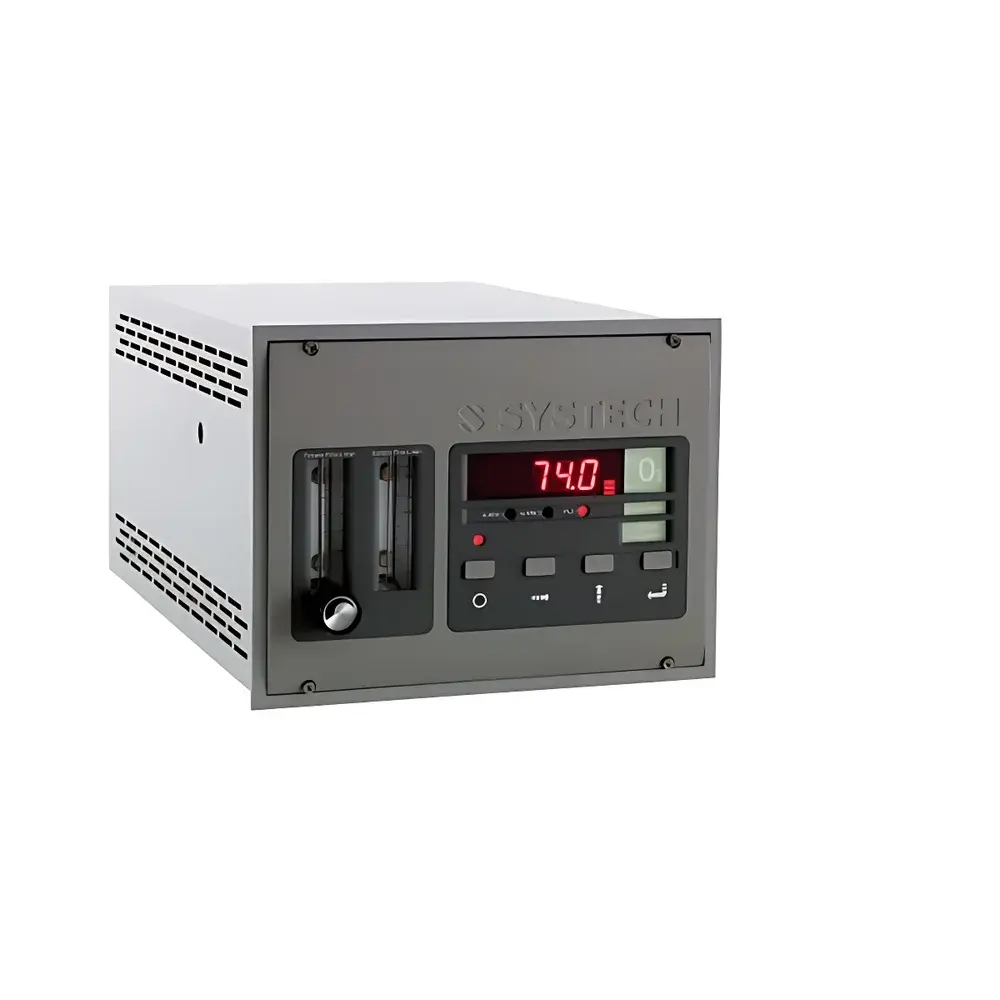
Systech EC900 Oxygen Analyzer
| Origin | USA |
|---|---|
| Manufacturer Type | Authorized Distributor |
| Origin Category | Imported |
| Model | EC900 |
| Price Range | USD 7,000 – 14,000 |
Overview
The Systech EC900 Oxygen Analyzer is a high-stability, electrochemical-based trace and percent-level oxygen measurement instrument engineered for continuous, real-time monitoring in demanding industrial process control and inerting applications. Utilizing a proprietary long-life galvanic fuel cell sensor, the EC900 delivers stable, drift-free performance without requiring zero gas, span gas, or auxiliary support gases—making it uniquely suited for closed-loop purge monitoring, glovebox atmosphere control, heat-treatment furnaces, pharmaceutical nitrogen blanketing, and semiconductor manufacturing environments. Its measurement principle relies on diffusion-controlled electrochemical reduction of O₂ at a cathode, generating a current linearly proportional to partial pressure—ensuring inherent selectivity against hydrocarbons, CO₂, NOₓ, SO₂, and other common oxidizing or interfering species. Designed for Class 1, Division 2, Groups C and D hazardous locations, the analyzer meets UL 61010-1 and CSA C22.2 No. 61010-1 safety requirements, with RFI/EMI immunity compliant to IEC 61326-1.
Key Features
- True zero-gas-free operation: Eliminates dependency on calibration gases for routine verification—reducing operational cost and logistical complexity
- Front-access sensor path: Enables rapid, tool-free sensor replacement without disassembling the enclosure or interrupting process piping
- Flow-rate independence: Maintains accuracy across sample flow variations from 0.1 to 2.0 L/min—critical for bypass and low-flow sampling configurations
- Dual analog outputs: Isolated 4–20 mA (HART-compatible) and buffered 0–1 VDC signals for integration with DCS, PLC, or SCADA systems
- Two fully configurable alarm relays: SPDT contacts rated 3 A @ 100 VAC, programmable for high/low O₂ thresholds with latching or non-latching behavior
- Temperature-compensated electronics: Achieves <±3% FS/day stability over 0–45 °C ambient range—no external temperature stabilization required
- Robust mechanical design: IP65-rated front panel, 316 stainless steel sample inlet fitting (¼” compression), and nickel-plated internal wetted parts for corrosion resistance
- RS-232 bidirectional serial interface: Supports remote configuration, real-time data logging, and firmware updates via terminal emulation or custom host software
Sample Compatibility & Compliance
The EC900 is validated for use with dry, non-condensing, non-corrosive gas streams—including N₂, Ar, He, CO₂, and synthetic air mixtures. It is incompatible with halogenated gases, strong acids (e.g., HCl, HF), or vapors containing >10 ppm condensable organics. All wetted materials comply with USP Class VI biocompatibility standards. The analyzer supports compliance with FDA 21 CFR Part 11 when integrated with validated data acquisition software (audit trail, electronic signatures, and change control enabled). It satisfies ISO 8573-1:2010 Class 2 purity monitoring requirements for compressed air and inert gas systems, and its measurement uncertainty profile aligns with ASTM D6299-22 guidelines for precision and bias estimation in trace gas analyzers.
Software & Data Management
Configuration and diagnostics are performed via ASCII command protocol over RS-232, enabling seamless integration into LabVIEW, Python-based control frameworks, or custom MES interfaces. Optional PC utility software provides real-time trend plotting, alarm event history export (CSV), and automated calibration log generation. All parameter changes—including range selection, alarm setpoints, and output scaling—are timestamped and stored in non-volatile memory with read-only access to historical values. Firmware revision tracking and sensor life-cycle counters support GLP/GMP documentation workflows and preventive maintenance scheduling.
Applications
- Pharmaceutical lyophilization and vial stoppering: Monitoring O₂ ingress in nitrogen-purged isolators (≤1 ppm detection)
- Food packaging headspace analysis: Verifying residual O₂ in modified-atmosphere packaging (MAP) lines
- Heat-treating furnace atmospheres: Controlling endothermic gas mixtures in carburizing and annealing processes
- Electronics manufacturing: Ensuring ultra-low O₂ (<5 ppm) in solder reflow and wire-bonding gloveboxes
- Chemical synthesis reactors: Inerting verification prior to catalyst charging or pyrophoric reagent addition
- Power generation: Turbine oil seal gas monitoring and hydrogen-cooled generator purity assurance
FAQ
Does the EC900 require periodic zero or span calibration?
No—its galvanic sensor operates without zero gas; span verification using certified standard gas is recommended annually or after sensor replacement.
Can the EC900 measure oxygen in high-humidity samples?
It is not designed for wet gas streams; sample dew point must remain ≥20 °C below ambient temperature to prevent condensation-induced drift.
What is the expected sensor lifetime under typical operating conditions?
Typically 24–36 months in clean, dry, non-acidic gas environments; lifetime is logged internally and accessible via RS-232.
Is the 4–20 mA output intrinsically safe?
No—the output is isolated but not IS-rated; for hazardous area installations, a separately certified signal isolator or barrier must be used.
How does the EC900 handle cross-sensitivity to carbon monoxide or nitric oxide?
The sensor exhibits negligible response to CO, NO, NO₂, SO₂, and Cl₂—verified per IEC 62591 Annex E interference testing protocols.
Related Products