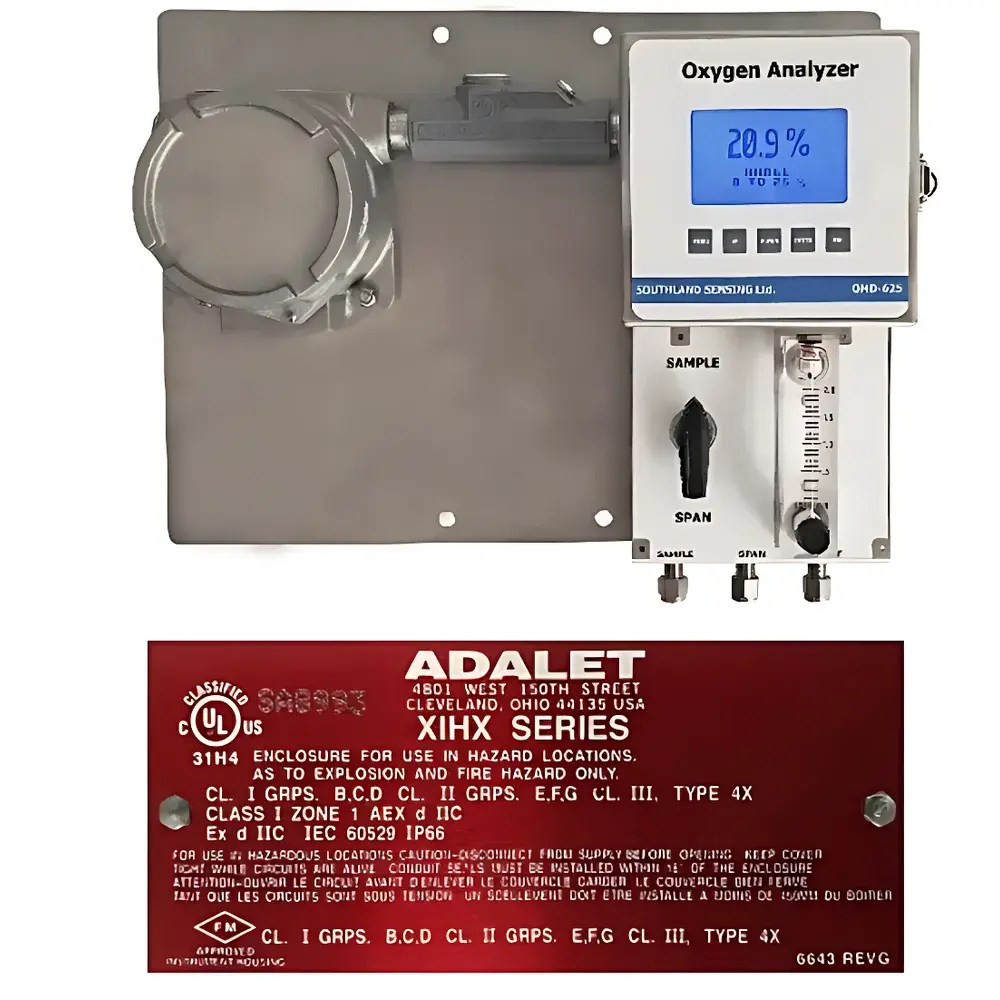
Southland Sensing OMD-625D Intrinsically Safe Oxygen Transmitter
| Origin | USA |
|---|---|
| Manufacturer Type | Authorized Distributor |
| Origin Category | Imported |
| Model | OMD-625D |
| Price Range | USD 4,200 – 7,000 |
| Certification | UL Class I, Div 2, Groups B, C, D |
| Measurement Ranges | 0–10 ppm / 0–100 ppm / 0–1000 ppm / 0–1% / 0–25% O₂ |
| Accuracy | < ±1% FS |
| Sensor Type | Micro-fuel-cell (electrochemical) |
| Operating Temperature | −10 to +50 °C |
| Sample Flow Rate | 230–2500 mL/min |
| Output Signals | 4–20 mA, 0–10 VDC, MODBUS RTU over RS485 (ASCII bi-directional) |
| Power Supply | 12–24 VDC |
| Current Consumption | 25 mA |
| Dimensions | 241 × 165 × 96 mm |
| Temperature Compensation | Built-in |
| Enclosure Rating | IP65 |
| Sensor Lifetime | Typically >24 months in clean inert gas streams |
| Compliance | Meets IEC 60079-0, IEC 60079-11, ATEX Directive 2014/34/EU (via equivalent Class I, Div 2 certification), FDA 21 CFR Part 11 ready (when integrated with compliant SCADA/HMI) |
Overview
The Southland Sensing OMD-625D is an intrinsically safe oxygen transmitter engineered for continuous, high-stability measurement of trace to percent-level oxygen concentrations in hazardous and process-critical environments. It employs a temperature-compensated, micro-fuel-cell electrochemical sensor—distinct from paramagnetic or zirconia-based technologies—which delivers stable zero baseline, minimal drift, and immunity to background gas interference from non-acidic inert or reducing atmospheres (e.g., N₂, Ar, He, H₂, CH₄). Its intrinsic safety design conforms to UL Class I, Division 2, Groups B, C, and D, enabling deployment in classified areas without explosion-proof enclosures. The instrument operates across five user-selectable ranges—from ultra-trace (0–10 ppm) to high-concentration (0–25% O₂)—with automatic range switching and real-time digital compensation for ambient temperature fluctuations. Unlike optical or thermal conductivity analyzers, the fuel-cell principle ensures direct, linear current output proportional to partial pressure of O₂, supporting high reproducibility (<1% FS accuracy) and long-term stability under unattended operation.
Key Features
- Intrinsically safe architecture certified to UL Class I, Div 2, Groups B/C/D—eliminates need for purged or flameproof housings in hydrocarbon, hydrogen, or CO₂-rich process streams
- Five configurable measurement ranges: 0–10 ppm, 0–100 ppm, 0–1000 ppm, 0–1%, and 0–25% O₂—enabling single-instrument flexibility across purge validation, inerting control, and safety monitoring
- Micro-fuel-cell sensor with built-in temperature compensation and low-power electronics (25 mA @ 24 VDC), optimized for battery-backed or remote installations
- Dual programmable alarm relays (SPDT, 5 A @ 250 VAC) with configurable setpoints, hysteresis, and latching/non-latching modes
- Simultaneous analog outputs: isolated 4–20 mA (HART-compatible) and 0–10 VDC, plus bidirectional MODBUS RTU over RS485 for integration into DCS, PLC, or SCADA systems
- Backlit graphical LCD with intuitive menu navigation, real-time concentration display, diagnostics, and calibration status logging
- Optional acid-gas-resistant sensor variant available for applications involving H₂S, SO₂, or CO₂—prevents electrolyte degradation and extends service life in sour gas environments
- Robust aluminum enclosure rated IP65, designed for panel mounting or direct pipe installation with standard ½” NPT sample port
Sample Compatibility & Compliance
The OMD-625D is validated for use with inert gases (N₂, Ar, He), reducing atmospheres (H₂, syngas), hydrocarbon streams (CH₄, C₂H₆), and mixed process gases containing CO₂ or low-concentration acid gases—provided the optional acid-resistant sensor is specified. It is incompatible with chlorine, ozone, or high-humidity (>90% RH) samples without external conditioning. The instrument meets CE marking requirements and complies with electromagnetic compatibility (EMC) standards per EN 61326-1 and safety standards per EN 61010-1. For regulated industries—including pharmaceutical manufacturing, semiconductor fabrication, and aerospace testing—the device supports audit-ready operation when paired with compliant data acquisition software: full calibration logs, operator ID tagging, timestamped events, and electronic signature capability align with FDA 21 CFR Part 11 and EU Annex 11 expectations. All units ship with factory calibration certificate traceable to NIST standards.
Software & Data Management
Configuration, calibration, and diagnostics are performed via front-panel interface or PC-connected utility software using MODBUS ASCII protocol. The embedded firmware supports dual-point calibration (zero and span) with user-defined gas references (e.g., certified N₂ for zero, air or certified O₂ mix for span). All calibration parameters, alarm thresholds, and system events are stored in non-volatile memory with time/date stamping. When integrated into a validated control system, the OMD-625D supports full audit trail generation—including changes to range, output scaling, or alarm logic—with immutable records exportable as CSV or PDF. Firmware updates are performed via USB-to-RS485 adapter, requiring no hardware modification. No cloud connectivity or proprietary SaaS platform is required; data remains under end-user control at all times.
Applications
- Natural gas transmission pipelines: monitoring O₂ ingress during compression, dehydration, and custody transfer to prevent corrosion and ensure pipeline integrity
- Metallurgical processes: real-time oxygen control in vacuum furnaces, annealing atmospheres, and sintering tunnels where ppm-level purity dictates material grain structure
- Semiconductor cleanrooms & gloveboxes: maintaining <1 ppm O₂ in nitrogen-purged fabrication environments to prevent gate oxide defects and wafer oxidation
- Pharmaceutical lyophilization and inert packaging: verifying residual oxygen in headspace analysis prior to stoppering and blister sealing
- CO₂ capture and utilization (CCUS) systems: measuring breakthrough O₂ in amine scrubber off-gas and storage wellhead monitoring
- Aerospace propulsion testing: quantifying oxidizer purity in liquid oxygen (LOX) feed lines and combustion chamber purge streams
- Hydrogen production & distribution: detecting air leakage into PEM electrolyzer purge streams and pipeline integrity verification
FAQ
What certifications does the OMD-625D hold for hazardous area installation?
It is certified to UL Class I, Division 2, Groups B, C, D per ANSI/UL 1203 and complies with IEC 60079-0 and IEC 60079-11 for intrinsic safety. ATEX marking is achieved equivalently through its Class I, Div 2 listing.
Can the OMD-625D measure oxygen in hydrogen-rich streams?
Yes—its micro-fuel-cell sensor is inherently compatible with H₂, provided the sample contains no catalytic poisons (e.g., silicone vapors) or acid gases exceeding the standard sensor’s tolerance. For H₂S >10 ppm, the acid-resistant sensor option is mandatory.
Is temperature compensation automatic or manual?
Fully automatic—integrated Pt1000 RTD measures both sensor and ambient temperature, applying real-time correction to output signals without user intervention.
What is the expected service life of the fuel-cell sensor?
Typically 24–36 months in clean, dry, inert gas environments. Service life decreases proportionally with cumulative O₂ exposure and presence of contaminants; acid-resistant variants extend longevity in sour gas applications.
Does the device support remote calibration verification?
Yes—MODBUS registers provide access to raw sensor mV output, internal temperature, zero/span offset values, and diagnostic flags, enabling remote health assessment without physical access.
Related Products