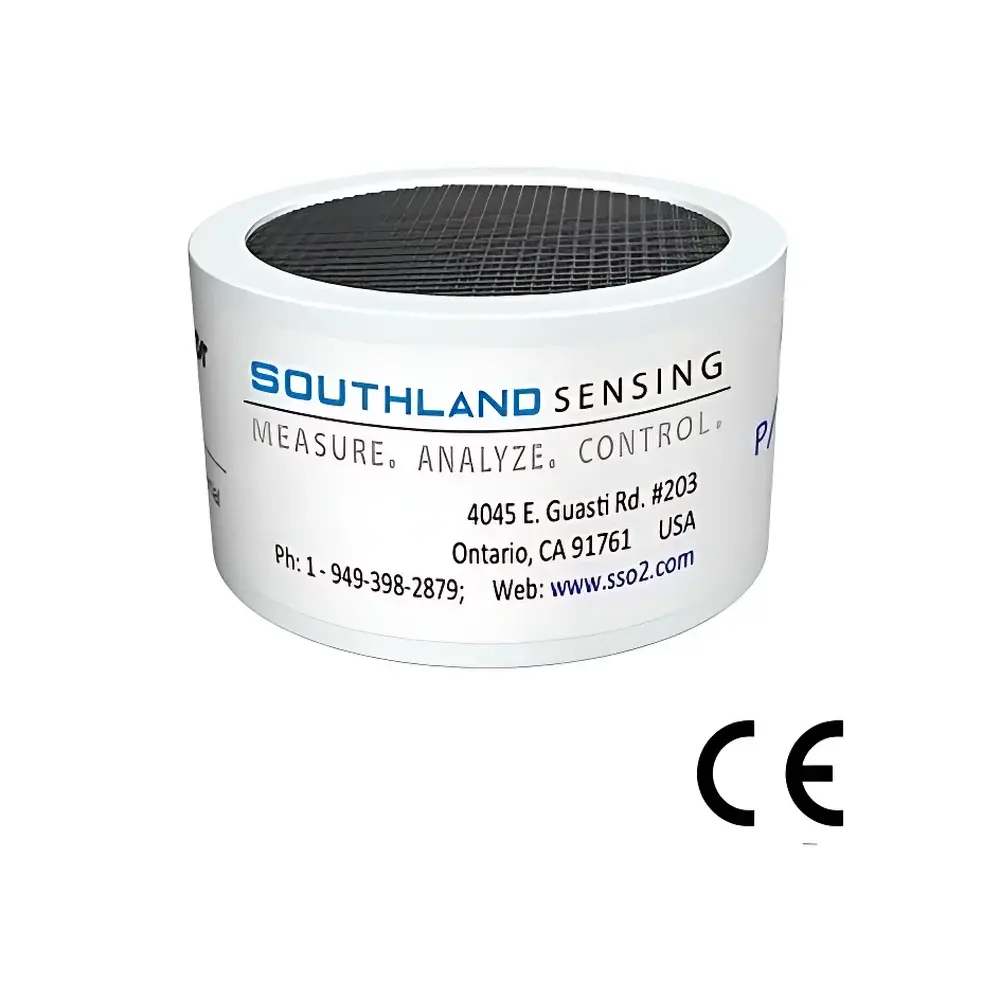
Southland Sensing PO2-1120 Percent Oxygen Sensor
| Origin | USA |
|---|---|
| Manufacturer Type | Authorized Distributor |
| Origin Category | Imported |
| Model | PO2-1120 |
| Output Signal | 285–590 µA (fuel cell, linear vs. O₂ concentration) |
| Measurement Ranges | 0–1%, 0–5%, 0–10%, 0–25%, 0–100% O₂ (selectable via configuration) |
| Response Time (T90) | ≤13 s |
| Full-Scale Accuracy | ±1% FS |
| Repeatability | ±0.5% FS |
| Temperature Coefficient | 2.54%/°C |
| Operating Temperature | 0–50°C |
| Storage Temperature | 0–45°C |
| Recommended Flow Rate | 0.5–5 SCFH |
| Humidity Range | 0–100% RH (non-condensing) |
| Expected Service Life | 20–25 months (under nominal operating conditions) |
| Warranty | 12 months |
| Electrical Interface | PCB-mounted, center foil (negative), outer foil (positive) |
Overview
The Southland Sensing PO2-1120 is a high-stability, electrochemical fuel cell-based oxygen sensor engineered for continuous, reliable measurement of oxygen concentration across multiple percent-level ranges—from trace (<1% O₂) to ambient and pure oxygen (up to 100% O₂). Unlike paramagnetic or zirconia-based analyzers, the PO2-1120 employs a self-powered, galvanic fuel cell principle: molecular oxygen diffuses through a selective membrane and undergoes reduction at the cathode, generating a current proportional to partial pressure—linearly calibrated in % O₂. This architecture eliminates external power requirements for the sensing element, ensures intrinsic safety in hazardous environments, and delivers long-term baseline stability without zero drift under constant flow conditions. Designed for integration into OEM gas analyzers, process skids, and standalone transmitters, the PO2-1120 meets the demanding reliability expectations of industrial process control, particularly where maintenance access is limited or calibration intervals must be extended.
Key Features
- Fuel cell sensor core with no internal battery or polarization voltage—enabling true passive operation and Class I, Division 1 compatibility when housed in appropriate enclosures
- Five factory-configurable measurement spans: 0–1%, 0–5%, 0–10%, 0–25%, and 0–100% O₂—selected at time of order to optimize signal-to-noise ratio and resolution per application
- Fast T90 response ≤13 seconds across all ranges, validated per ISO 10156 and ASTM D6159 protocols for gas detection system qualification
- High repeatability (±0.5% FS) and full-scale accuracy (±1% FS) traceable to NIST-traceable calibration gases (e.g., certified O₂/N₂ blends)
- Integrated temperature compensation circuitry mitigates thermal drift; coefficient of 2.54%/°C is characterized and compensated in host instrumentation firmware
- Robust mechanical design: gold-plated PCB termination, corrosion-resistant stainless steel housing option, and membrane optimized for hydrocarbon and H₂-rich gas matrices
- Two programmable alarm relays (SPDT, 250 VAC/3 A) support fail-safe shutdown, purge initiation, or data logging triggers in accordance with IEC 61511 functional safety guidelines
Sample Compatibility & Compliance
The PO2-1120 is validated for use in non-corrosive, dry-to-humid (0–100% RH, non-condensing) process streams containing N₂, Ar, He, H₂, CH₄, CO₂, and other inert or reducing gases. It is routinely deployed in nitrogen generation systems (PSA/VSA), hydrogen purification loops, semiconductor annealing atmospheres, and aerospace purge validation—where residual O₂ must remain below 10 ppm (achieved via signal extrapolation from the 0–1% range). The sensor complies with RoHS Directive 2011/65/EU and meets EMC immunity per IEC 61326-1 for industrial environments. While not intrinsically rated as a complete analyzer, its low-energy output (µA-level) facilitates SIL-2 integration when paired with certified safety barriers and logic solvers compliant with IEC 61508.
Software & Data Management
As a two-wire analog sensor, the PO2-1120 outputs a linear 285–590 µA current proportional to O₂ concentration. It interfaces seamlessly with standard 4–20 mA input modules via external shunt resistors (e.g., 250 Ω → 0.71–1.48 V), enabling direct digitization by PLCs (Rockwell, Siemens), DCS platforms (Emerson DeltaV, Honeywell Experion), or SCADA systems. Host firmware must implement linearization, temperature compensation, and span scaling per supplied calibration coefficients. For audit-ready operations, integration with systems supporting FDA 21 CFR Part 11 requires electronic signature-capable HMI layers and secure audit trails for calibration events and alarm acknowledgments—functions managed externally, as the sensor itself contains no onboard memory or firmware.
Applications
- On-line monitoring of O₂ breakthrough in pressure-swing adsorption (PSA) nitrogen generators for food packaging and electronics manufacturing
- Real-time verification of inerting efficacy in transformer oil blanketing, turbine enclosures, and pharmaceutical reactor headspaces
- Process gas quality assurance in hydrogen production (alkaline/PED electrolysis) and purification (Pd-membrane systems)
- Atmosphere control in high-temperature sintering furnaces (up to 50°C ambient) for powder metallurgy and ceramic co-firing
- Leak detection and purge validation in aerospace ground support equipment and missile propulsion test stands
- Quality control in specialty gas blending systems supplying ultra-high-purity (UHP) N₂, Ar, and He to semiconductor fabs
FAQ
What gas matrices are compatible with the PO2-1120?
The sensor is validated for use in N₂, Ar, He, H₂, CO₂, CH₄, and air. Avoid exposure to halogenated compounds, SO₂, Cl₂, NOₓ, or condensable vapors, which degrade the electrolyte and membrane.
Can the PO2-1120 measure below 100 ppm O₂?
While rated for 0–1% (10,000 ppm) full scale, the sensor’s inherent resolution supports reliable quantification down to ~50 ppm when used with low-noise signal conditioning and 24-bit ADC acquisition—though dedicated PPM-grade sensors (e.g., PO2-1130) are recommended for sub-10 ppm applications.
Is field recalibration possible?
No. The fuel cell is factory-calibrated using certified gas standards. Zero and span adjustments must be performed in the connected transmitter or controller—not at the sensor level.
How does humidity affect performance?
Operation up to 100% RH is supported provided no liquid water contacts the membrane. Condensation causes temporary signal suppression and may permanently damage the electrolyte if sustained.
What is the recommended replacement interval?
Southland Sensing specifies 20–25 months of service life under continuous operation at 25°C and 1–5 SCFH flow. Actual lifespan varies with O₂ partial pressure, temperature cycling, and exposure to reactive contaminants.