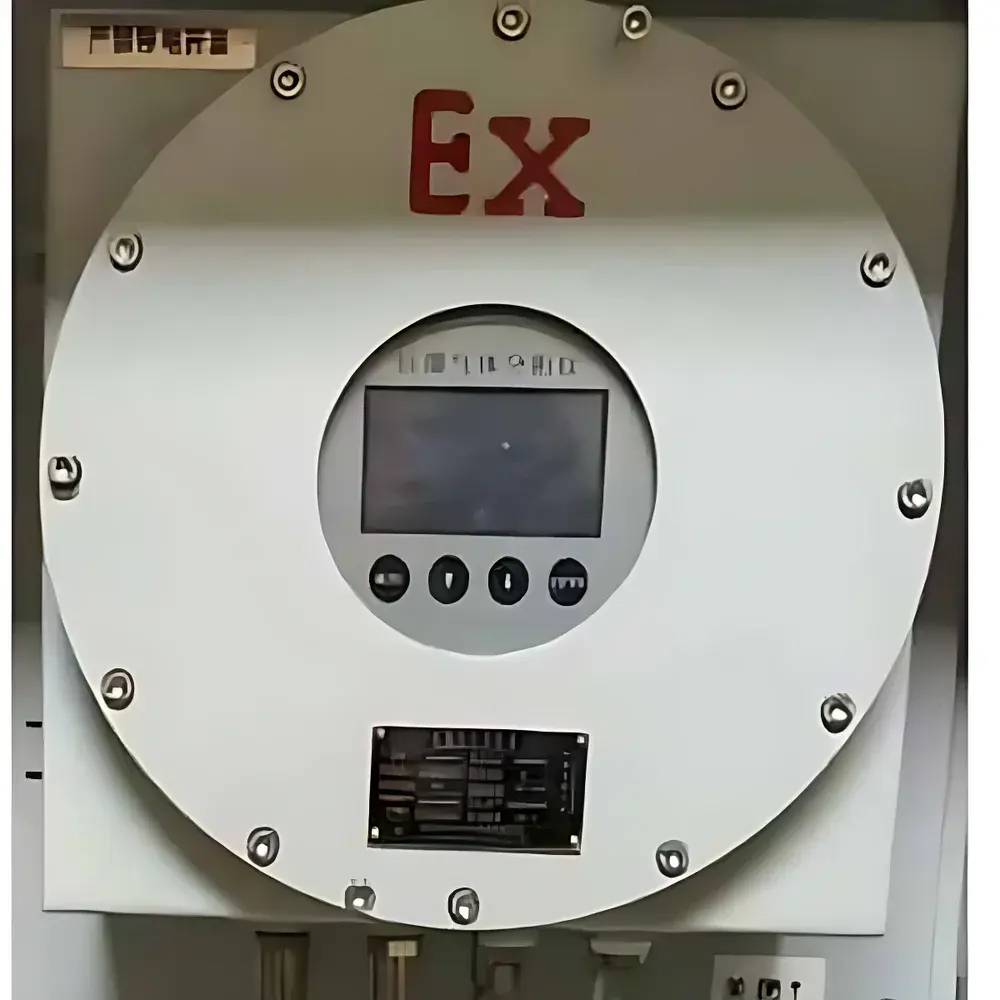
Southland Sensing FSR-600FB Natural Gas Calorific Value Analyzer
| Brand | Southland Sensing |
|---|---|
| Origin | Beijing, China |
| Model | FSR-600FB |
| Linear Error | ≤ ±1% F.S. |
| Repeatability | ≤ ±1% F.S. |
| Span Drift | ≤ ±1% F.S. / 7 days |
| Response Time (T90) | ≤ 1 s |
| Explosion Protection Rating | Ex d II C T6 |
| Sample Flow Rate | 0.3–0.5 L/min |
| Power Supply | AC 220 V ±10%, 50 Hz |
| Operating Temperature | −5 °C to +45 °C |
| Relative Humidity | ≤ 90% RH |
| Inlet Pressure Range | 0.05–0.1 MPa |
| Analog Output | 4–20 mA |
| Electrical Interface | 1/2 NPT |
| Sample Port | G1/2 |
| Zero Drift | ±1% F.S. / 7 days |
| Resolution | 0.01% vol |
| Warm-up Time | 10 min |
| MTBF | > 3 years |
Overview
The Southland Sensing FSR-600FB Natural Gas Calorific Value Analyzer is an industrial-grade, fully automated online gas analysis system engineered for continuous, real-time determination of the higher heating value (HHV) and lower heating value (LHV) of natural gas, coalbed methane, and mixed fuel gases (e.g., natural gas–coal gas blends). Unlike traditional combustion-based calorimeters, the FSR-600FB employs a composition-based calculation methodology grounded in physical gas laws and standardized thermodynamic correlations. It measures volumetric concentrations of key combustible components—CH4, CO, and H2—using non-dispersive infrared (NDIR) and thermal conductivity (TCD) detection principles. These measurements are fed into a rigorously validated stoichiometric model embedded in the onboard PLC, enabling accurate, traceable, and repeatable calorific value computation without sample combustion or external calibration gases. The system is designed for installation at critical process points: upstream of burners, in main fuel gas headers, or at blending stations—ensuring compliance with dynamic combustion control requirements in power generation, industrial heating, and distributed energy systems.
Key Features
- Fully integrated, PLC-controlled automation: automatic sampling, zero-air purging, condensate drainage, and self-diagnostic sequencing—eliminating manual intervention and ensuring uninterrupted operation.
- Robust dry-filtration architecture: proprietary multi-stage particulate and aerosol filtration (≤0.1 µm cutoff) with dust loading capacity <200 g/Nm³; eliminates plugging from tar, naphthalene, benzene, and condensed moisture common in raw fuel gas streams.
- Ultra-fast response: instrument T90 ≤ 1 s; end-to-end system response <10 s (including sampling line transport and conditioning), meeting stringent closed-loop combustion control timing requirements.
- Intrinsically stable measurement platform: zero drift ≤ ±1% F.S./7 days and span drift ≤ ±1% F.S./7 days under continuous operation—validated per ISO 10723:2012 Annex D for hydrocarbon gas analysis systems.
- Explosion-proof certified design: Ex d II C T6 enclosure (IEC 60079-1), suitable for Zone 1 hazardous areas in petrochemical, refinery, and municipal gas infrastructure.
- High-reliability hardware: MTBF > 3 years; maintenance-free probe design; no consumables beyond standard filter elements replaced annually under normal duty cycles.
Sample Compatibility & Compliance
The FSR-600FB is qualified for continuous analysis of wet, dirty, and variable-composition fuel gases—including pipeline-quality natural gas, field-sourced coalbed methane, and industrial syngas blends containing CH4, CO, H2, CO2, N2, and trace hydrocarbons. All wet-gas handling components (probe, heated sample line, coalescing filter, and water trap) operate at elevated temperatures (>60 °C) to prevent condensation-induced measurement bias. The system meets mechanical and environmental specifications outlined in ANSI/ISA-12.12.01 (Class I, Division 1) and conforms to functional safety expectations aligned with IEC 61511 for SIL 2-capable instrumentation loops. While not certified to UL 61010-1 or ATEX for standalone safety integrity, its 4–20 mA analog outputs and Modbus RTU interface support integration into third-party SIS/DCS architectures compliant with IEC 61508 and ISA-84.
Software & Data Management
Data acquisition and calorific value computation are executed within a deterministic ladder logic program running on an industrial PLC (Siemens S7-1200 or equivalent), ensuring deterministic cycle times and audit-ready execution logs. All measured component concentrations (CH4, CO, H2) and derived HHV/LHV values are output via isolated 4–20 mA channels with HART capability. Optional Ethernet/IP or Modbus TCP interfaces enable seamless integration with MES, SCADA, or historian platforms (e.g., Siemens Desigo CC, Honeywell Experion, or OSIsoft PI System). Raw sensor diagnostics—including detector temperature, reference cell pressure, and filter differential pressure—are logged locally and accessible via password-protected web interface. Audit trails, configuration changes, and calibration events comply with GLP-aligned record-keeping practices, though native 21 CFR Part 11 electronic signature functionality requires external validation when deployed in regulated pharmaceutical or biogas certification workflows.
Applications
- Real-time combustion optimization in gas-fired boilers, furnaces, and turbine inlet fuel trains.
- Energy content verification at city gate stations and interconnection points per ASTM D3588 and ISO 6976 standards.
- Process feedforward control in hydrogen-blended natural gas (H2/NG) injection systems.
- Continuous monitoring for energy efficiency audits and ISO 50001 EnMS reporting.
- Quality assurance in LNG re-gasification terminals and biogas upgrading facilities.
- Regulatory compliance support for EPA Subpart OOOOa (methane emissions monitoring) and EU ETS fuel carbon content reporting.
FAQ
How does the FSR-600FB calculate calorific value without direct calorimetry?
It uses empirically validated thermodynamic equations (ISO 6976:2016) to compute HHV/LHV from real-time volumetric concentrations of CH4, CO, and H2, measured by NDIR and TCD sensors. No combustion, flame, or reference gas is required.
Is the system compatible with high-humidity or tar-laden biogas?
Yes—its heated, dry-filtration sampling train prevents condensation and removes particulates down to 0.1 µm, maintaining accuracy even at dew points up to 60 °C and dust loadings <200 g/Nm³.
Can it be integrated into an existing DCS with redundant I/O?
Yes—the 4–20 mA outputs support HART 7, and optional Modbus TCP or Ethernet/IP enables dual-network redundancy per ISA-18.2 alarm management guidelines.
What calibration protocol is recommended for long-term stability?
Initial span calibration using certified CH4/CO/H2 in N2 standards per ISO 6141; subsequent verification every 90 days using zero air and single-component challenge gases—documented in accordance with ISO/IEC 17025 internal calibration procedures.
Does the system meet emission monitoring requirements for regulatory reporting?
While not certified as a CEMS per EN 15267 or EPA PS-15, its performance specifications align with QA/QC criteria for fuel parameter inputs used in Tier 2 and Tier 3 GHG inventories under IPCC 2006 Guidelines and EPA e-GGRT.