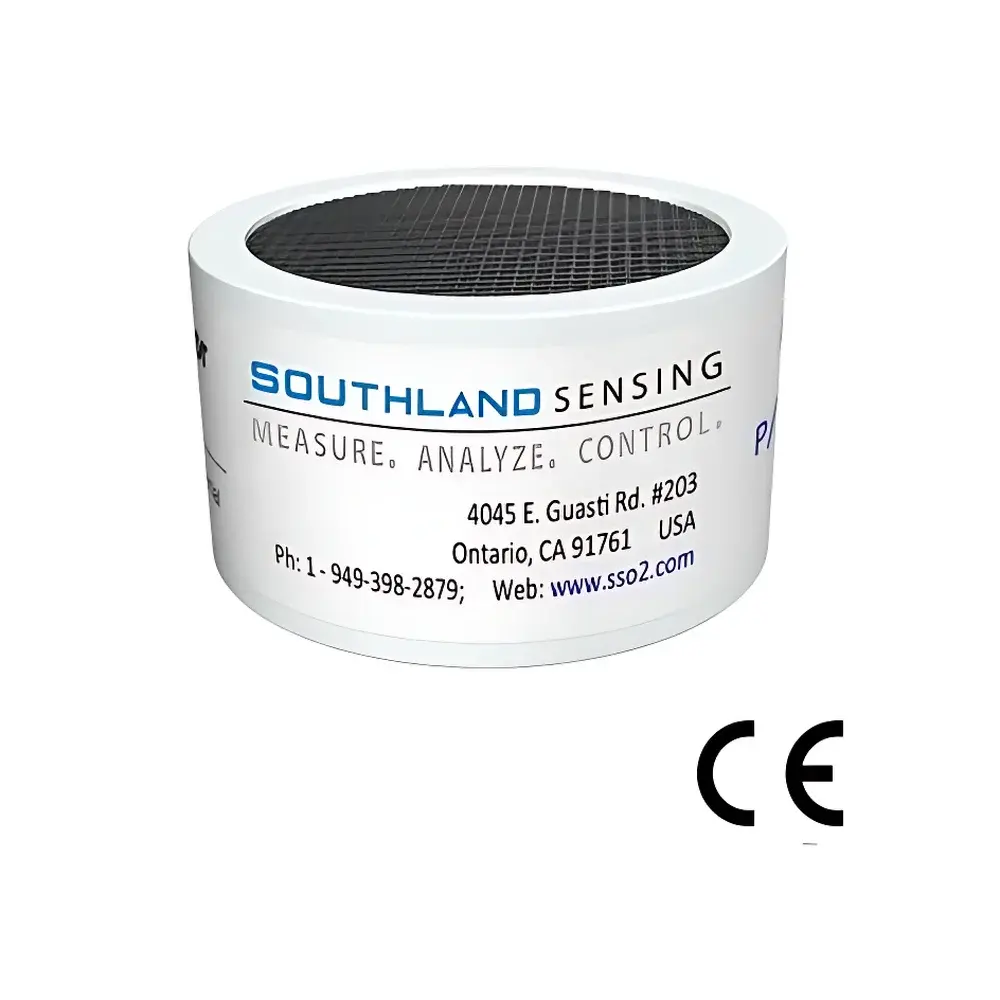
Southland Sensing TO2-233-T PPM-Level Electrochemical Oxygen Sensor
| Origin | USA |
|---|---|
| Manufacturer Type | Authorized Distributor |
| Origin Category | Imported |
| Model | TO2-233-T |
| Price Range | USD 1–9,999 |
Overview
The Southland Sensing TO2-233-T is a high-stability, electrochemical fuel-cell-based oxygen sensor engineered for trace-level (ppm) and percent-range oxygen detection in demanding industrial process gas streams. Unlike paramagnetic or zirconia-based analyzers, the TO2-233-T employs a proprietary miniature galvanic fuel cell that generates a current proportional to O₂ partial pressure—enabling direct, zero-power-consumption measurement without external bias voltage. This principle delivers inherent linearity, low drift, and immunity to background gas interference from N₂, H₂, Ar, He, CO₂, and most hydrocarbons—making it ideal for inert atmosphere monitoring, purge gas verification, and high-purity gas certification. Designed for continuous online operation in fixed-installation analyzer systems, the TO2-233-T integrates seamlessly into OEM gas analyzers and standalone transmitters used across semiconductor fab tools, nitrogen generation skids, hydrogen production units, and cryogenic air separation plants.
Key Features
- True ppm-to-percent dual-range capability: factory-configurable spans of 0–1 ppm, 0–10 ppm, 0–100 ppm, 0–1,000 ppm, 0–1% vol, and 0–25% vol O₂
- Fuel-cell architecture with no internal heater or reference gas—ensuring intrinsic safety and minimal power draw (self-powered signal output)
- High-resolution analog current output: 285–590 µA full-scale, linear over entire range; compatible with standard 4–20 mA transmitter modules via precision shunt resistor
- Fast T₉₀ response time of ≤13 seconds across all ranges, validated per ISO 10726:2015 for dynamic gas analysis
- Stable baseline performance: ±1% FS accuracy and ±0.5% FS repeatability under controlled calibration conditions
- Robust mechanical design: gold-plated PCB termination with center foil (cathode) and outer foil (anode); optimized for automated SMT assembly in analyzer OEM production
- Extended service life: 20–25 months typical operational lifetime at 23°C and 50% RH; 6-month shelf life when stored unpowered in sealed packaging
Sample Compatibility & Compliance
The TO2-233-T exhibits broad compatibility with non-corrosive, non-condensing process gases including nitrogen, argon, helium, hydrogen, methane, ethylene, and synthetic air. It is explicitly rated for use in Class I, Division 2 hazardous locations when installed within certified explosion-proof housings per UL 913 and ATEX/IECEx standards. The sensor is not suitable for acidic gas environments (e.g., SO₂, HCl, NOₓ), chlorine, ozone, or oxidizing halogen compounds—applications requiring acid-resistant sensing elements must utilize alternative chemistries (e.g., stabilized zirconia or laser-based TDLAS). All units are manufactured under ISO 9001:2015 quality management systems and comply with RoHS Directive 2011/65/EU. Calibration traceability follows NIST-traceable standards per ASTM D6232 and ISO 8573-7 for compressed gas purity testing.
Software & Data Management
As a component-level sensor, the TO2-233-T does not include embedded firmware or user-accessible software. Its analog output is intended for integration into host analyzer platforms supporting configurable linearization algorithms, auto-ranging logic, and digital diagnostics. When deployed in analyzers compliant with FDA 21 CFR Part 11, the host system must implement audit trail functionality—including timestamped calibration events, sensor replacement logs, and alarm state history—to satisfy GLP/GMP data integrity requirements. Southland Sensing provides detailed electrical interface schematics, temperature compensation coefficients, and span/gain adjustment procedures in its Engineering Integration Manual (EM-TO2-233-T Rev. 4.2), available under NDA to qualified OEM partners.
Applications
- On-line purity verification in pressure-swing adsorption (PSA) and membrane-based nitrogen generators
- Leak detection and blanketing gas monitoring in semiconductor CVD/PVD tool chambers
- O₂ impurity control in hydrogen fuel gas streams for PEM electrolyzers and fuel cells
- Residual oxygen quantification in inert gloveboxes and vacuum furnace backfilling systems
- Quality assurance testing of medical-grade and electronics-grade specialty gases (per ISO 8573-1 Class 1–2)
- Process safety interlocks in chemical reactors where O₂ ingress poses combustion risk
FAQ
Is the TO2-233-T suitable for measuring oxygen in acidic gas streams such as those containing H₂S or SO₂?
No. The fuel-cell electrolyte is susceptible to irreversible poisoning by acidic species. For sour gas applications, consult Southland Sensing’s zirconia-based ZR-200 series or request application-specific validation data.
What is the recommended flow rate for optimal accuracy and response time?
0.5–5 SCFH (standard cubic feet per hour) across the sensor inlet; laminar flow with minimal pulsation is required to avoid boundary layer disruption.
Does the sensor require periodic zero or span calibration?
Yes. While inherently stable, annual calibration against certified NIST-traceable gas standards is recommended per ISO/IEC 17025 guidelines; more frequent calibration may be required in high-dynamic or high-contamination environments.
Can the TO2-233-T be used at elevated temperatures above 50°C?
Operation beyond 50°C ambient invalidates specifications and accelerates electrolyte evaporation; for >50°C applications, consider heated sample conditioning or alternative high-temp sensor platforms.
Is the sensor compatible with SIL-2 functional safety systems?
The TO2-233-T itself is not SIL-certified; however, it may be incorporated into SIL-2–rated analyzer systems when paired with appropriate redundancy, diagnostics, and failure mode analysis per IEC 61511.
Related Products