
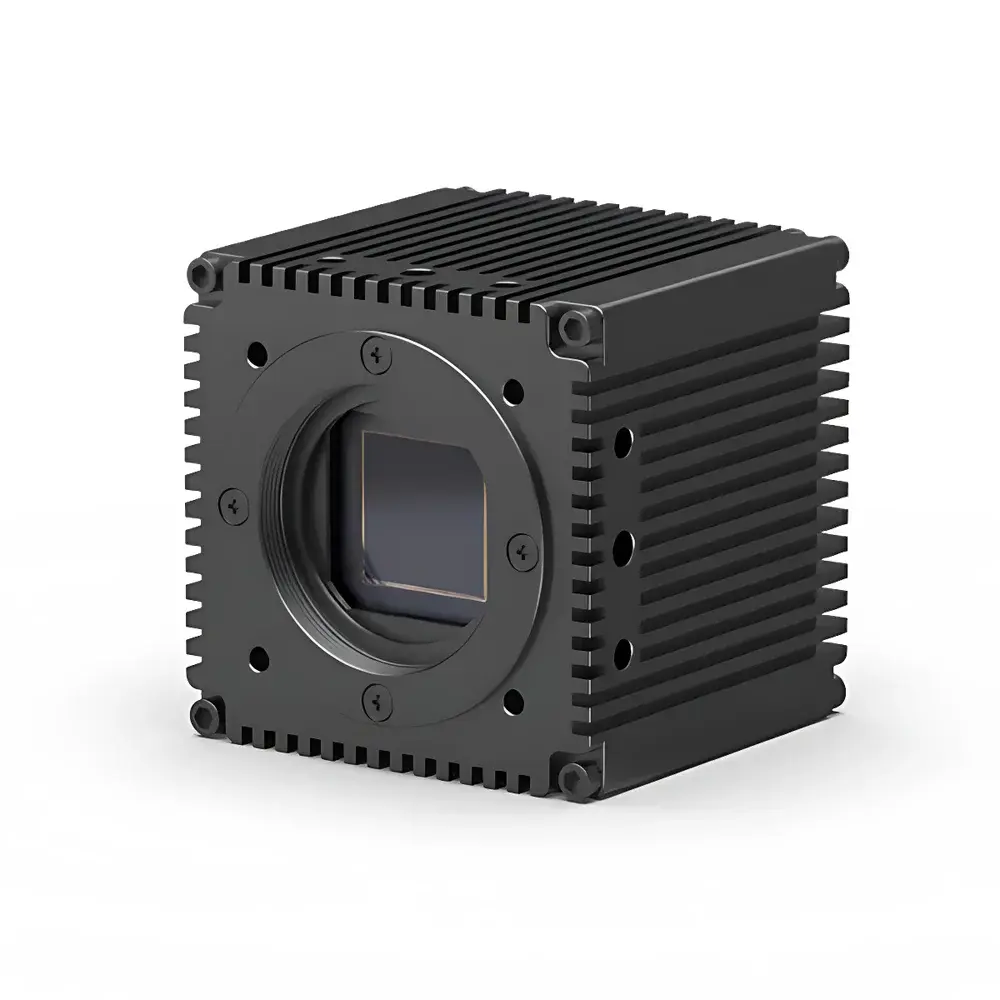
Tucsen Dhyana 401A-G sCMOS Camera for Laser Beam Profiling, Single-Molecule Imaging, and Spectral Analysis
| Brand | Tucsen |
|---|---|
| Origin | Fujian, China |
| Manufacturer Type | Original Equipment Manufacturer (OEM) |
| Origin Category | Domestic (China) |
| Model | Dhyana 401A-G |
| Pricing | Upon Request |
| Image Resolution | 2048 (H) × 2048 (V) |
| Pixel Size | 11 µm × 11 µm |
| Active Sensor Area | 22.5 mm × 22.5 mm |
| Diagonal Sensor Size | 32 mm |
| Read Noise | 1.5 e⁻ (Median) |
| Quantum Efficiency | 58 % @ 600 nm |
| Full Well Capacity | 91 ke⁻ |
| Dynamic Range | 95 dB |
| Frame Rate | 20 fps |
| Exposure Time | 21 µs – 1 s |
| Shutter Type | Rolling |
| Binning | 2×2 |
| ROI Support | Yes |
| Trigger Modes | Hardware & Software |
| Interface | Hirose connector, GigE Vision |
| Bit Depth | 12-bit / 16-bit |
| Optical Mount | M42 |
| Power Supply | 12 V / 2 A |
| Power Consumption | 6 W |
| Dimensions | 70 mm × 70 mm × 68 mm |
| Weight | 540 g |
| Operating Temperature | 0–40 °C |
| Humidity | 10–85 % RH |
| SDK | SamplePro SDK (C/C++/C#) |
| OS Support | Windows & Linux |
Overview
The Tucsen Dhyana 401A-G is a high-performance scientific-grade sCMOS camera engineered for demanding optical metrology applications including laser beam profiling, single-molecule fluorescence imaging, and low-light spectral analysis. Built around the Gpixel GSENSE400 front-side illuminated (FSI) sCMOS sensor, it delivers an optimal balance of large-format imaging, high quantum efficiency, low read noise, and wide dynamic range—critical attributes for quantitative photon-limited measurements. Its 32 mm diagonal sensor enables direct wide-field imaging without relay optics, reducing system complexity and optical aberrations in integrated setups such as confocal microscopes, Raman spectrometers, and laser diagnostics platforms. The camera operates on the GigE Vision standard, ensuring compatibility with industrial machine vision frameworks and facilitating seamless integration into automated laboratory workflows governed by ISO/IEC 17025 or GLP-compliant environments.
Key Features
- 32 mm diagonal FSI sCMOS sensor with 2048 × 2048 active pixels and 11 µm pixel pitch, enabling high spatial fidelity over extended fields-of-view
- Peak quantum efficiency of 58 % at 600 nm—optimized for visible and near-visible fluorescence and laser characterization wavelengths
- Ultra-low read noise of 1.5 e⁻ (median), supporting high-fidelity detection of sparse photon events in single-molecule tracking and time-resolved spectroscopy
- 91 ke⁻ full-well capacity and 95 dB dynamic range, permitting simultaneous quantification of weak and saturated signals within a single exposure—essential for structured illumination or multi-intensity calibration protocols
- GigE Vision interface with GenICam compliance, enabling deterministic triggering, precise exposure synchronization, and metadata-embedded image acquisition
- Compact form factor (70 × 70 × 68 mm) and low power consumption (6 W), suitable for space-constrained OEM integrations and portable instrumentation
- Support for hardware-triggered exposure start/readout end signals via Hirose connector, meeting timing-critical requirements in pump-probe or gated imaging systems
Sample Compatibility & Compliance
The Dhyana 401A-G is designed for use with a broad spectrum of optical configurations—from collimated laser beams to diffraction-limited point sources—and supports both monochromatic and broadband illumination. Its M42 lens mount allows direct coupling to spectrographs, beam samplers, and microscope intermediate tubes without adapter-induced vignetting. The camera complies with CE marking requirements for electromagnetic compatibility (EN 61326-1) and safety (EN 61010-1). Firmware and SDK adhere to GenICam 3.x specifications, ensuring interoperability with third-party acquisition software used in regulated environments. While not FDA-cleared as a medical device, its deterministic data capture architecture—including timestamped frame headers and non-destructive ROI readout—supports audit-trail generation aligned with 21 CFR Part 11 principles for research data integrity.
Software & Data Management
Tucsen provides the SamplePro SDK, a cross-platform development toolkit supporting C, C++, and C# for custom application development under Windows and Linux. The SDK includes memory-mapped buffer access, real-time ROI streaming, and synchronized multi-camera control—enabling scalable deployment in multi-sensor optical benches. Acquired images embed EXIF-like metadata (exposure time, gain, temperature, trigger mode), facilitating traceable post-processing in MATLAB, Python (via NumPy/Pillow bindings), or commercial packages such as NIS-Elements or Micro-Manager. All firmware updates are delivered via signed binary packages, preserving chain-of-custody integrity during instrument lifecycle management.
Applications
- Laser beam quality assessment per ISO 11146-1/2: M² measurement, beam centroid tracking, and intensity distribution analysis
- Single-molecule localization microscopy (SMLM), including PALM and STORM, where sub-pixel centroid accuracy and low background noise are essential
- Raman and fluorescence spectral imaging—leveraging high QE and linearity across 400–800 nm for spectral deconvolution and multivariate analysis
- Time-resolved photoluminescence decay profiling using external TTL gating and precise exposure control
- OEM integration into automated QC stations for optical component inspection, where consistent SNR and geometric stability across thermal cycles are required
FAQ
Is the Dhyana 401A-G compatible with existing microscope or spectrometer mounts?
Yes—the M42 thread mount ensures mechanical and optical compatibility with standard C-mount adapters and most commercial spectrograph entrance slits. Custom flange options are available upon request.
Does the camera support hardware triggering for synchronized multi-instrument acquisition?
Yes—it features dual Hirose I/O lines for exposure start and readout completion signals, enabling sub-millisecond jitter synchronization with lasers, shutters, or other cameras.
Can the SDK be used in Linux-based embedded systems?
Yes—SamplePro SDK provides static libraries and header files for ARM64 and x86_64 Linux distributions, with documented build instructions for Yocto and Ubuntu LTS targets.
What is the thermal stability of dark current over extended exposures?
At 25 °C ambient, dark current remains below 0.01 e⁻/pix/s; active cooling is not integrated, but the sealed aluminum housing supports passive heatsinking in controlled lab environments.
Is binning applied before or after ADC conversion?
Binning is performed digitally in the FPGA post-readout, preserving full 16-bit linearity and avoiding analog signal degradation associated with on-chip charge-domain binning.





