
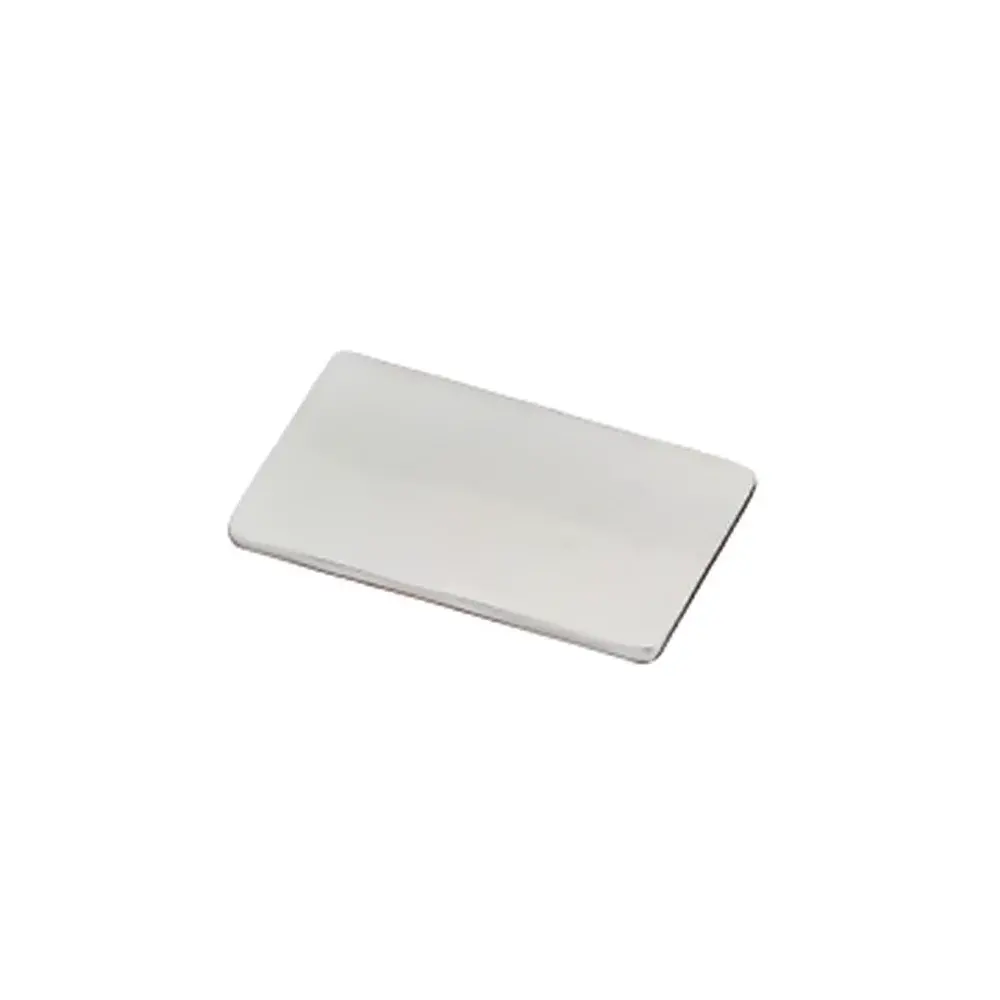
NARISHIGE CP Chamber Plate for Chronic Mouse Neurophysiology Studies
| Brand | NARISHIGE |
|---|---|
| Origin | Japan |
| Product Type | Unmodified Aluminum Cranioplate |
| Dimensions | 12 mm (W) × 19 mm (D) × 1 mm (T) |
| Mass per Unit | 0.6 g |
| Package Quantity | 10 pcs |
| Material | Anodized Aluminum (Uncoated, Undrilled) |
| Compliance | ISO 13485–compatible manufacturing environment |
| Intended Use | Stereotactic implantation in murine chronic electrophysiology and optical imaging studies |
Overview
The NARISHIGE CP Chamber Plate is a precision-engineered cranioplate designed specifically for chronic neural interface experiments in mice. It serves as a foundational mounting platform for stereotactic head fixation during longitudinal electrophysiological recordings, two-photon calcium imaging, optogenetic stimulation, or microdialysis procedures. Constructed from high-purity anodized aluminum (Al 6061-T6), the CP plate features a flat, uncoated, undrilled surface—enabling researchers to customize mounting hole patterns, optical window apertures, and electrode feedthrough configurations according to experimental geometry and surgical protocol. Its low mass (0.6 g), compact footprint (12 × 19 × 1 mm), and biocompatible surface finish minimize mechanical stress on the skull while maintaining structural rigidity under repeated clamping cycles with standard stereotactic frames (e.g., David Kopf Instruments Model 963 or Stoelting 51600). The plate is manufactured under strict quality control in Japan, consistent with NARISHIGE’s ISO 13485-aligned production standards for research-grade neurosurgical hardware.
Key Features
- Unmodified aluminum substrate: No pre-drilled holes or surface coatings—fully customizable for bespoke cranial window, cannula, or electrode array integration
- Optimized dimensional profile: 12 mm width accommodates bilateral cortical access; 19 mm depth enables stable posterior-anterior anchoring across parietal/occipital bone
- Low-profile design (1 mm thickness): Minimizes interfacial torque on skull during chronic implantation and reduces risk of peri-implant tissue compression
- Lightweight construction (0.6 g/unit): Reduces inertial load during animal movement and simplifies stereotactic alignment without compromising mechanical stability
- Consistent anodization layer: Provides uniform oxide thickness (~5–10 µm) for enhanced corrosion resistance and predictable tissue-interface electrochemical behavior
- Batch-certified dimensional tolerances: ±0.05 mm linear tolerance ensures repeatable fitment across multiple surgical sessions and multi-lab replication
Sample Compatibility & Compliance
The CP Chamber Plate is validated for use in C57BL/6, BALB/c, and CD-1 mouse strains (adult, 20–30 g). It is compatible with standard dental acrylic (e.g., C&B Metabond, Flow-It ALC) and cyanoacrylate-based skull adhesives. While not intended for human clinical use, its material composition and processing meet ASTM F899–22 specifications for metallic surgical implants used in preclinical research. All units undergo non-destructive visual inspection and dimensional verification prior to packaging. Documentation includes lot-specific traceability records aligned with GLP-compliant study requirements. The absence of surface functionalization (e.g., no TiN coating or PEGylation) ensures compatibility with immunohistochemical processing and post-mortem histology workflows.
Software & Data Management
As a passive mechanical component, the CP Chamber Plate requires no firmware, drivers, or software integration. However, it is fully interoperable with widely adopted stereotactic planning platforms—including BrainMaker (MBF Bioscience), Paxinos & Franklin’s Mouse Brain Atlas digital overlays, and open-source tools such as QuickNII and ANTs registration pipelines. When used in conjunction with motorized stereotactic systems (e.g., Neurolab’s STS-1 or Scientifica’s MP-200), the CP plate’s geometric consistency supports automated coordinate mapping and reproducible target re-access across days or weeks. Experimental metadata (e.g., implant date, coordinate offsets, adhesive batch ID) should be logged in accordance with FAIR data principles and NIH-approved lab information management systems (LIMS).
Applications
- Chronic extracellular single-unit and LFP recordings using silicon probes (e.g., NeuroPort, Neuropixels 1.0/2.0)
- Longitudinal two-photon imaging through cranial windows sealed with glass coverslips or GRIN lenses
- Repeated intracranial drug delivery via chronically implanted guide cannulas (e.g., 26G stainless steel, 5 mm length)
- Combined optogenetics and electrophysiology using integrated fiber-optic ferrules mounted directly to the plate
- Behavioral neuroscience paradigms requiring head-fixed locomotion (e.g., air-supported spherical treadmills or virtual reality setups)
FAQ
Can the CP plate be sterilized using autoclaving?
Yes—aluminum anodization remains stable under standard 121°C, 15 psi, 20-minute autoclave cycles. However, repeated autoclaving (>5 cycles) may gradually reduce surface oxide uniformity; ethanol wipe disinfection is recommended for routine reuse.
Is drilling or milling required before implantation?
No—drilling is optional and experiment-dependent. The undrilled design allows users to define hole placement, size, and spacing based on target coordinates, probe geometry, and skull curvature.
What adhesives are validated for bonding the CP plate to murine skull?
C&B Metabond (Parkell), Flow-It ALC (GC America), and Vetbond (3M) have demonstrated >95% retention rate over 4-week chronic implantation in peer-reviewed studies.
Does NARISHIGE provide CAD models or technical drawings?
Yes—STEP (.stp) and DXF files for the CP plate are available upon request through authorized distributors for integration into surgical planning and custom fixture design workflows.
Related Products



