
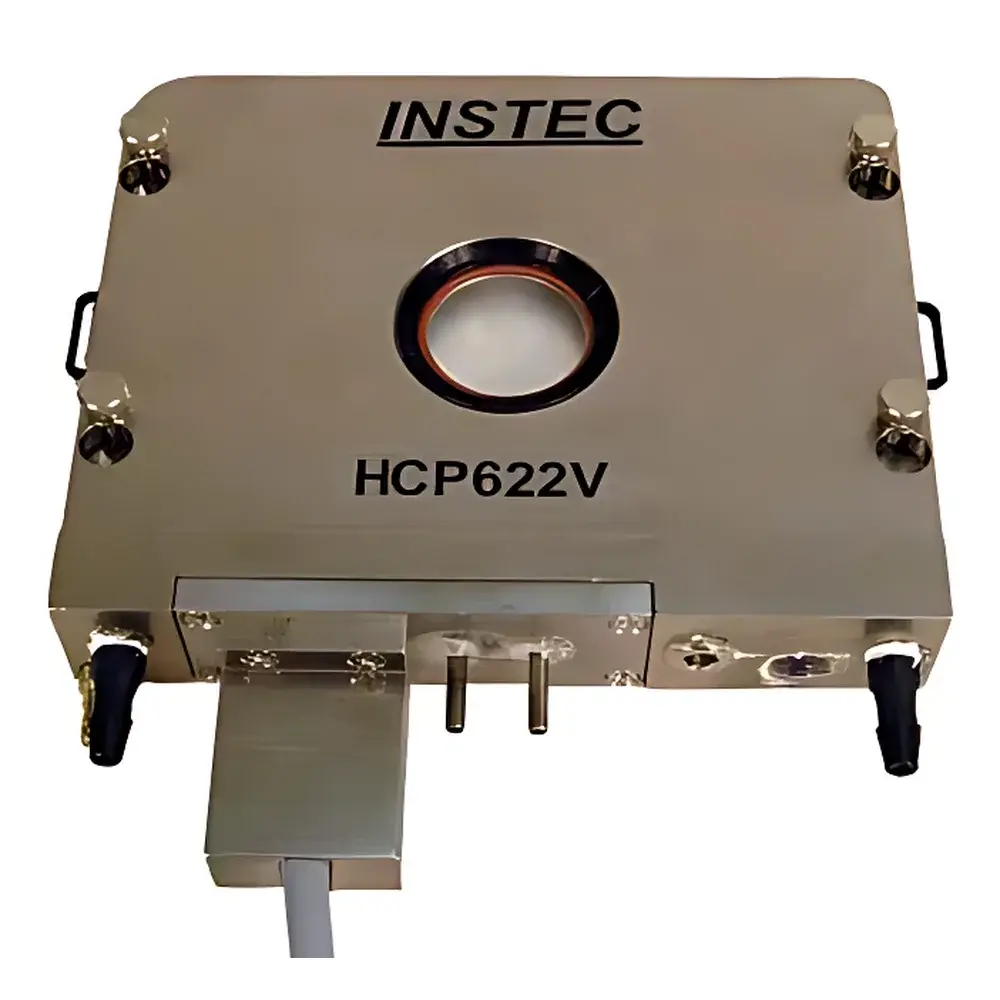
Instec HCS602 Microscope Hot and Cold Stage
| Brand | Instec |
|---|---|
| Origin | USA |
| Model | HCS602 |
| Temperature Range | –190 °C to +600 °C (optional up to +700 °C) |
| Temperature Stability | ±0.1 °C at 100 °C |
| Minimum Temperature Resolution | 0.01 °C |
| Max Heating Rate | +200 °C/min at 100 °C |
| Max Cooling Rate | –130 °C/min at 100 °C (with LN2-P4 accessory) |
| Sample Area | 35 mm × 35 mm |
| Standard Optical Window | 20 mm × 20 mm |
| Optional Large Optical Window | 38 mm × 38 mm |
| Minimum Working Distance | Objective ≥ 5.3 mm, Condenser ≥ 10.0 mm |
| Controller | STC200 standalone unit with RS232 interface and Windows software |
| Software Support | LabVIEW drivers (IEEE-488 & RS232) included |
| Compliance | Designed for ASTM E2267, ISO 11357, and USP <1031> thermal microscopy applications |
Overview
The Instec HCS602 Microscope Hot and Cold Stage is a precision-engineered thermal stage system designed for in situ optical microscopy under controlled temperature conditions. It operates on the principle of resistive heating combined with cryogenic liquid nitrogen (LN₂) cooling, enabling continuous, programmable thermal cycling across an exceptionally broad range—from cryogenic temperatures of –190 °C to high-temperature regimes of +600 °C (with optional configurations extending to +700 °C). The system integrates seamlessly with upright and inverted optical microscopes, supporting real-time observation of phase transitions, crystallization kinetics, thermal expansion, grain boundary evolution, and polymorphic behavior in solid-state materials. Its architecture conforms to the mechanical and thermal constraints typical of high-magnification optical systems, maintaining optical path integrity while delivering stable, reproducible thermal profiles essential for quantitative thermomicroscopy.
Key Features
- Wide operational temperature range: –190 °C to +600 °C (standard), extendable to +700 °C via optional heater modules
- High-resolution temperature control with 0.01 °C minimum resolution and ±0.1 °C stability at 100 °C
- Fast thermal response: up to +200 °C/min heating and –130 °C/min cooling (when paired with LN2-P4 cryogenic accessory)
- Dual optical window options: standard 20 mm × 20 mm viewport and large-format 38 mm × 38 mm viewport for enhanced field-of-view compatibility
- Optimized mechanical design with minimum working distances of ≥5.3 mm (objective) and ≥10.0 mm (condenser) to accommodate high-NA objectives and Köhler illumination setups
- STC200 standalone temperature controller featuring PID tuning, ramp/soak programming, RS232 communication, and Windows-based configuration software
- Full software integration support: native LabVIEW drivers compliant with IEEE-488 (GPIB) and RS232 protocols for automated experiment scripting and data synchronization
Sample Compatibility & Compliance
The HCS602 accommodates a wide variety of sample geometries—including thin films, bulk ceramics, metallic alloys, polymer melts, geological thin sections, and single crystals—within its 35 mm × 35 mm sample area. Its vacuum-compatible construction (optional) and inert-gas purging capability (via integrated gas inlet port) enable experiments under controlled atmospheres. The system meets functional requirements for ASTM E2267 (Standard Test Method for Determining Melting Point by Hot-Stage Microscopy), ISO 11357-3 (Plastics — Differential Scanning Calorimetry — Part 3: Determination of Temperature and Enthalpy of Melting and Crystallization), and USP (Thermal Analysis). It supports GLP/GMP-compliant workflows through audit-trail-enabled controller logging and timestamped thermal profile export.
Software & Data Management
The bundled STC200 controller software provides intuitive graphical programming of multi-step temperature ramps, holds, and cycles, with real-time temperature monitoring and derivative (dT/dt) visualization. All thermal profiles are exportable in CSV format for post-processing in MATLAB, Python, or Origin. LabVIEW driver libraries include VI wrappers for setpoint control, temperature readback, status polling, and error handling—enabling full integration into custom automated microscopy platforms. Data synchronization with camera acquisition timestamps ensures temporal alignment between thermal events and morphological changes. Firmware updates and calibration logs are retained internally with version-stamped metadata.
Applications
- Geological petrography: in situ observation of mineral phase transitions, dehydration reactions, and melt formation in thin sections
- Materials science: characterization of martensitic transformations, eutectic melting, sintering behavior, and thermal stress cracking in ceramics and composites
- Polymers & pharmaceuticals: mapping of glass transitions (Tg), cold crystallization, polymorph interconversion, and hydrate/dehydrate dynamics
- Metallurgy: real-time study of recrystallization, grain growth, and precipitate coarsening during thermal cycling
- Raman and FTIR microscopy: temperature-resolved spectroscopic analysis requiring precise thermal stabilization and minimal thermal drift
- Electronics packaging: evaluation of coefficient of thermal expansion (CTE) mismatch and interfacial delamination under thermal stress
FAQ
What is the minimum working distance required for high-NA oil immersion objectives?
The HCS602 maintains a minimum objective working distance of ≥5.3 mm, compatible with most 40× and 60× oil immersion objectives. For 100× objectives, verification against specific lens specifications is recommended.
Can the stage be used under vacuum or inert gas environments?
Yes—vacuum-rated variants (HCS602-VAC) and gas-purged configurations (with integrated N₂/Ar inlet) are available upon request.
Is the STC200 controller compliant with FDA 21 CFR Part 11 for electronic records?
While the STC200 itself does not provide full Part 11 compliance out-of-the-box, it supports secure user authentication, electronic signatures via external middleware, and audit-trail-capable data export when deployed within validated laboratory informatics systems.
What cryogen is required for operation below –100 °C?
Liquid nitrogen (LN₂) is required; the LN2-P4 accessory includes a 2-L dewar, dual-stage pump, and optimized transfer lines for stable sub-100 °C performance.
Does Instec offer application-specific validation protocols?
Yes—custom IQ/OQ documentation packages and ASTM-aligned test reports are available for GxP-regulated laboratories upon request.



