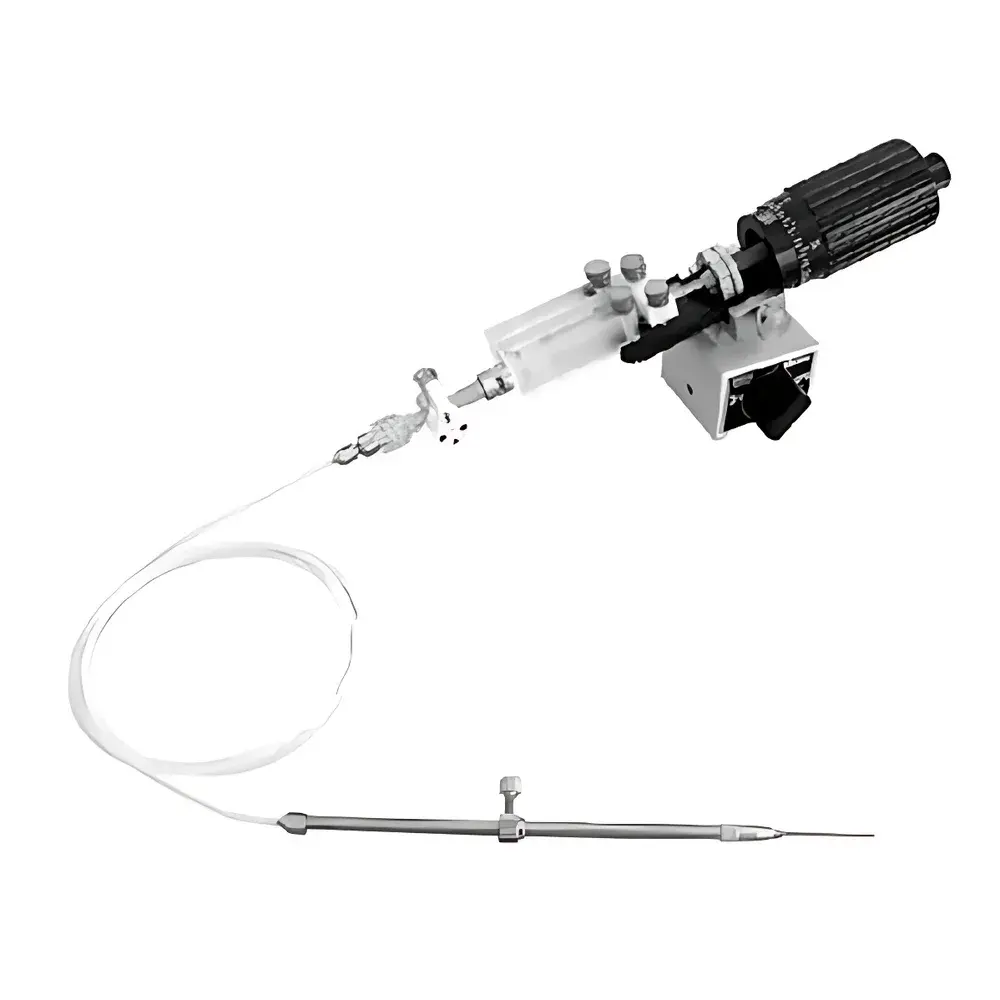
NARISHIGE IM-21 Microinjector
| Brand | NARISHIGE |
|---|---|
| Origin | Japan |
| Model | IM-21 |
| Plunger Stroke | 20 mm |
| Full Knob Rotation Displacement | 500 µm |
| Volume Control per Full Knob Rotation | ~10 µL |
| Compatible Capillary Tube Length | 1 m |
| Dimensions (W×D×H) | 127–147 × 56 × 78 mm |
| Weight | 620 g |
| Accessories | IM-H3 Injection Holder, HI01PK01 Cleaning Rod & Silicone Rubber Pad, IMO4 O-Ring, Silicone Grease |
Overview
The NARISHIGE IM-21 Microinjector is a precision-engineered manual microinjection device designed for high-reproducibility intracellular and subcellular delivery in advanced life science applications. Based on fine mechanical displacement amplification via a calibrated micrometer-style knob mechanism, the IM-21 converts rotational input into linear plunger advancement with deterministic resolution—enabling controlled, stepwise injection of nanoliter-to-microliter volumes into delicate biological specimens. Its compact benchtop footprint and rigid aluminum-alloy chassis ensure stability during micromanipulation workflows, particularly when integrated with upright or inverted microscopes equipped with motorized or manual micromanipulators. Unlike pressure-driven or pneumatic systems, the IM-21 operates entirely mechanically, eliminating drift, overshoot, or dependency on external gas sources—making it especially suitable for low-volume, high-sensitivity injections where temporal precision and absence of pulsatile flow are critical.
Key Features
- Mechanically amplified displacement system: Full 360° knob rotation advances the plunger by precisely 500 µm, enabling predictable volume delivery (~10 µL per full turn) without electronic feedback or calibration routines.
- Adjustable plunger stroke range of 20 mm supports flexible capillary loading and extended injection sequences across diverse needle geometries and viscosities.
- Integrated ergonomic design with dual-position width adjustment (127–147 mm) accommodates varied microscope stage configurations and user hand positioning.
- Robust construction using corrosion-resistant anodized aluminum ensures long-term dimensional stability under repeated sterilization cycles and laboratory environmental fluctuations.
- Modular accessory compatibility—including the IM-H3 injection holder for secure capillary clamping, HI01PK01 cleaning rod with silicone rubber pad for residue-free capillary maintenance, IMO4 fluorosilicone O-rings for leak-tight sealing, and medical-grade silicone grease for smooth actuation—supports GMP-aligned operational hygiene and reproducibility.
Sample Compatibility & Compliance
The IM-21 is routinely deployed in GLP- and IACUC-compliant laboratories for microinjection into mammalian oocytes (e.g., mouse, bovine, human IVF/ICSI), zebrafish and Xenopus embryos, and adherent or suspension-cultured stem cells (ES/iPS). Its mechanical consistency meets the volumetric repeatability requirements outlined in ISO 8549-2 (microinjection equipment performance standards) and supports traceable documentation when used in conjunction with validated lab notebooks or LIMS-integrated procedural logs. While the device itself does not carry CE marking or FDA 510(k) clearance as a standalone instrument, its use in research settings aligns with NIH Guidelines for Genetically Modified Organisms and adheres to standard biosafety level 2 (BSL-2) handling protocols for nucleic acid and cell-based delivery.
Software & Data Management
As a manually operated, analog microinjector, the IM-21 does not incorporate embedded firmware, digital interfaces, or software connectivity. Volume delivery is determined solely by mechanical displacement and operator technique—ensuring zero risk of electromagnetic interference, firmware failure, or data corruption. This architecture simplifies audit readiness: all injection parameters (e.g., knob rotations, timing, capillary type, sample ID) are recorded manually in bound lab notebooks or electronic lab notebooks (ELNs) compliant with 21 CFR Part 11 when paired with appropriate signature and version-control workflows. Users may document injection events alongside corresponding microscope imaging metadata (e.g., time-lapse acquisition timestamps, stage coordinates) for longitudinal experimental correlation.
Applications
- Intracytoplasmic sperm injection (ICSI) and pronuclear transfer in assisted reproductive technology (ART) laboratories.
- Genome editing delivery: Site-specific introduction of CRISPR-Cas9 ribonucleoprotein complexes, sgRNA, or donor DNA templates into single-cell embryos or pluripotent stem cells.
- Functional genomics: Transient or stable transfection of mRNA, shRNA, or fluorescent tracers for lineage tracing or live-cell biosensor expression.
- Nuclear transfer and enucleation support in somatic cell nuclear transfer (SCNT) protocols.
- Cytoplasmic or nuclear extraction from individual cells for downstream omics analysis (e.g., single-cell RNA-seq library preparation).
FAQ
What capillary types are compatible with the IM-21?
The IM-21 accepts standard borosilicate or quartz glass capillaries with outer diameters ranging from 1.0 to 1.5 mm and total lengths up to 1 meter—compatible with most pullers (e.g., Sutter P-1000, Narishige PC-10) and backfilling protocols.
Is the IM-21 suitable for high-throughput injection workflows?
While optimized for precision over speed, the IM-21 supports semi-automated throughput when paired with programmable micromanipulators (e.g., Narishige MN-400) and motorized microscope stages; typical manual throughput ranges from 20–50 oocytes per hour depending on operator experience and sample viability criteria.
How often should O-rings and silicone grease be replaced?
Fluorosilicone O-rings (IMO4) should be inspected before each use and replaced every 3–6 months under routine operation; silicone grease application is recommended prior to each capillary loading cycle to maintain consistent plunger seal integrity and prevent stiction.
Can the IM-21 be sterilized?
The main body is not autoclavable; however, non-electronic components (e.g., IM-H3 holder, cleaning rod, capillary adapters) may be ethylene oxide (EtO) or vaporized hydrogen peroxide (VHP) sterilized per institutional biosafety guidelines—alcohol wiping is recommended for daily surface decontamination.
Related Products