
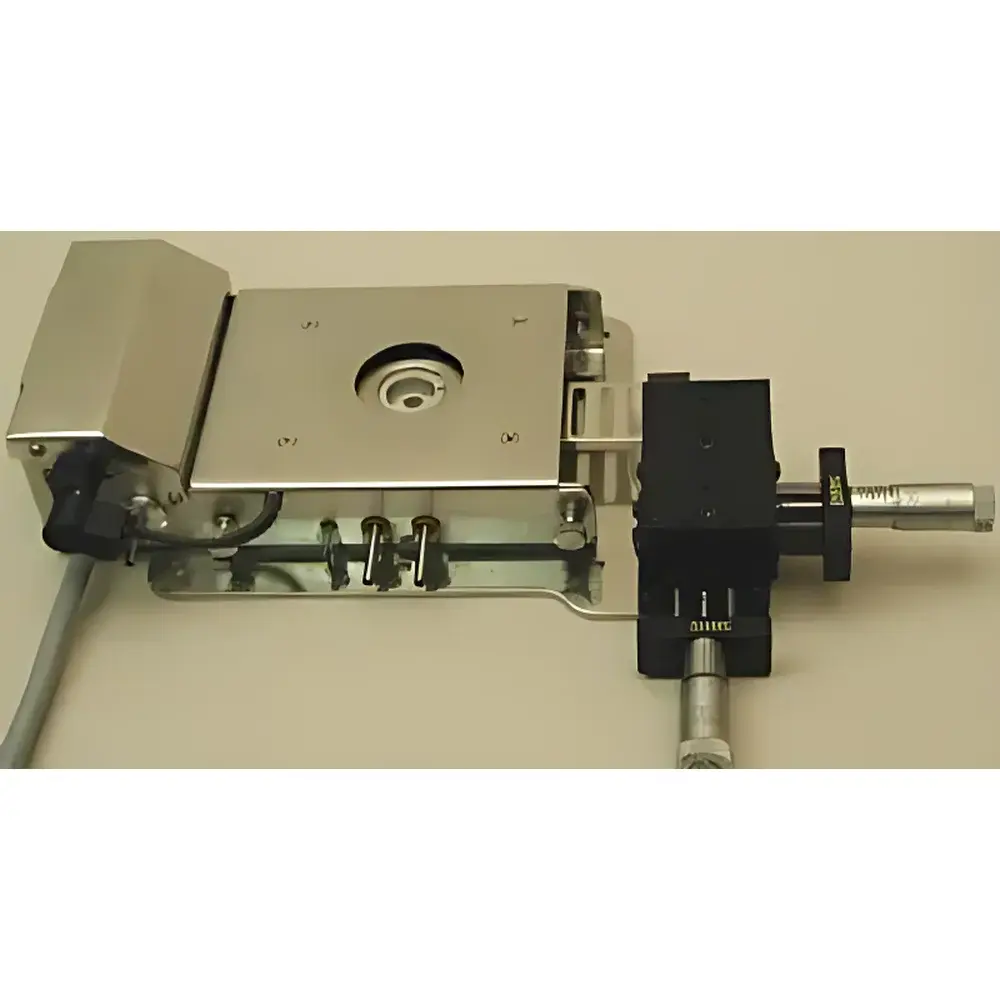
INSTEC HCS410 High-Performance Cryo-Heating Stage
| Brand | Instec |
|---|---|
| Origin | USA |
| Model | HCS410 |
| Temperature Range | –60 °C to 400 °C |
| Temp. Resolution | 0.01 °C |
| Temp. Stability | ±0.02 °C at 100 °C |
| Max. Heating Rate | +50 °C/min |
| Max. Cooling Rate | –50 °C/min |
| Control Method | Switching PID (LVDC PID optional) |
| Sensor | 100 Ω Platinum RTD |
| Sample Area | 38 mm × 50 mm |
| Chamber Height | 2.0 mm / 6.0 mm (w/ spacers) |
| Viewing Aperture | 5 mm |
| Working Distance | 6.5 mm |
| Condenser Distance | 13 mm |
| X-Y Micropositioner (optional) | 10 µm resolution |
Overview
The INSTEC HCS410 High-Performance Cryo-Heating Stage is an engineered thermal stage designed for precise in-situ temperature control during optical, electron, and probe-based characterization of materials. It operates on resistive heating and thermoelectric or liquid-nitrogen-assisted cooling principles—enabling stable, repeatable thermal environments across a broad operational range from –60 °C to +400 °C. Its ultra-flat, low-profile sample platform (38 mm × 50 mm active area) ensures minimal optical path distortion and mechanical interference with high-NA objectives, making it suitable for polarized light microscopy (PLM), differential scanning calorimetry (DSC)-correlative imaging, Raman spectroscopy, and scanning probe microscopy (SPM). The stage integrates seamlessly into inverted and upright microscopes, probe stations, and environmental chambers, supporting both ambient and vacuum-compatible configurations.
Key Features
- High-fidelity temperature control with ±0.02 °C stability at 100 °C and 0.01 °C resolution, validated per ASTM E220 and ISO 17025 traceable calibration protocols
- Dual-mode control architecture: standard switching PID for rapid response; optional Linear Variable DC (LVDC) PID for enhanced linearity and reduced overshoot in sensitive phase-transition studies
- Optimized thermal architecture featuring dual-zone heating (HCS402 variant) and precision-machined copper alloy base for uniform thermal distribution (±0.15 °C across full sample area)
- Vacuum-compatible design (down to 10–6 mbar) with feedthrough-ready electrical and sensor interfaces, supporting semiconductor wafer-level testing and thin-film deposition monitoring
- Compact form factor with 6.5 mm working distance and 13 mm condenser clearance—compatible with long-working-distance objectives and confocal laser systems
- Optional motorized X-Y micropositioner (10 µm resolution) enables automated thermal mapping and multi-point phase analysis without stage repositioning
Sample Compatibility & Compliance
The HCS410 accommodates diverse sample geometries—including wafers (up to 4″ diameter), polymer films, liquid crystal cells, pharmaceutical crystals, and biological tissue sections—within its configurable chamber (2.0 mm or 6.0 mm height via spacers). Its 5 mm central viewing aperture maintains unobstructed optical access for transmission, reflection, and fluorescence modalities. All thermal sensors conform to IEC 60751 Class A RTD specifications. The system meets electromagnetic compatibility (EMC) requirements per EN 61326-1 and supports GLP/GMP-compliant operation through audit-trail-capable software integration (see Software & Data Management). For regulated applications, the stage is compatible with FDA 21 CFR Part 11–enabled workflows when paired with validated acquisition platforms.
Software & Data Management
Control is managed via INSTEC’s proprietary StageLink™ software (Windows 10/11, 64-bit), offering programmable ramp-hold-cool profiles, real-time temperature logging (≥10 Hz sampling), and synchronized trigger outputs for external detectors. Data export adheres to ASTM E1447-compliant CSV and HDF5 formats, ensuring interoperability with MATLAB, Python (NumPy/Pandas), and commercial analysis suites such as Thermo Scientific OMNIC or Bruker OPUS. Optional API support enables integration into LabVIEW, Python-based automation frameworks, and LIMS environments. All temperature setpoints, actual readings, and controller status parameters are timestamped and archived with SHA-256 checksum integrity verification—supporting full traceability in ISO/IEC 17025-accredited laboratories.
Applications
- Phase transition analysis of liquid crystals, polymers, and pharmaceutical hydrates under controlled thermal gradients
- In-situ observation of crystallization kinetics, melting point determination (per USP & Ph. Eur. methods), and polymorphic transformation pathways
- Thermal stress testing of MEMS devices, solder joints, and advanced packaging substrates in probe station environments
- Correlative thermal-Raman and thermal-PLM studies of 2D materials, perovskites, and battery electrode composites
- Electric field–assisted thermal experiments (e.g., electro-optic response of nematic phases) using integrated electrode ports
- High-temperature annealing and low-temperature glass transition studies of fiber-reinforced composites and hydrogels
FAQ
What vacuum level is supported by the HCS410?
The stage is rated for continuous operation at pressures down to 10–6 mbar when equipped with vacuum-rated feedthroughs and O-ring seals.
Can the HCS410 be used with cryogenic liquids other than liquid nitrogen?
Yes—custom cold-finger adapters are available for liquid argon or closed-cycle helium refrigeration systems upon request.
Is the temperature sensor calibrated and certified?
Each unit ships with a NIST-traceable calibration certificate for the integrated 100 Ω Pt RTD, valid for 12 months under standard operating conditions.
Does the system support third-party software integration?
StageLink™ provides COM/ActiveX and RESTful API interfaces, enabling native control from Python, MATLAB, and LabVIEW environments.
What safety features are built into the thermal control system?
Hardware-enforced over-temperature cutoff (user-configurable up to 420 °C), open-sensor detection, and thermal runaway monitoring with automatic shutdown and event logging.



