
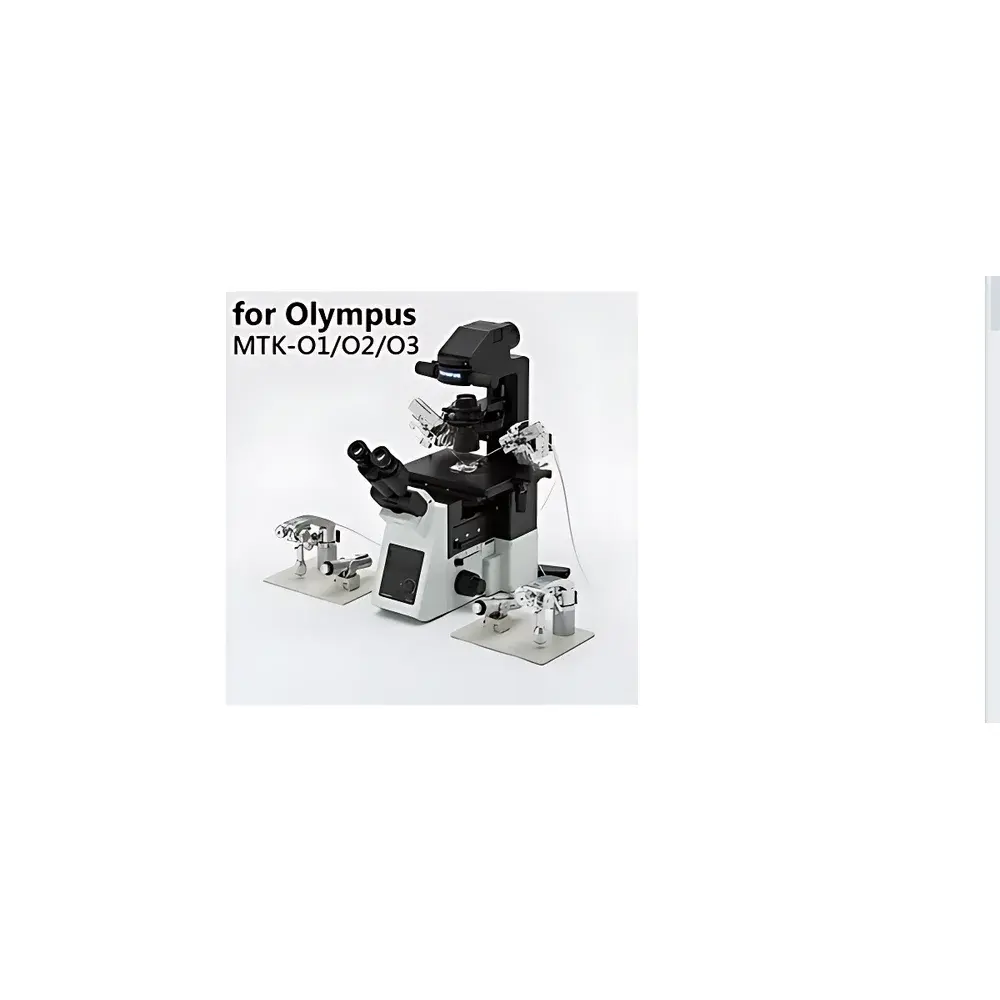
NARISHIGE MTK-1 Series Four-Dimensional Hydraulic Micromanipulator with Suspension Mount
| Brand | NARISHIGE |
|---|---|
| Origin | Japan |
| Model Variants | MTK-1/O1/O2/O3/N1/N2/N3/N4/Z1/Z2/L2 |
| Compatibility | Inverted Microscopes (Olympus IX70/IX71/IX73/IX83, Nikon TE2000/Ti/Ts2R/Ti2, Zeiss Axiovert 200/Observer 3–7/Axio Vert.A1, Leica DMi8) |
| Motion Control | Hydraulic (X/Y/Z/Rotation) |
| Positioning Resolution | X/Y/Z: 5 µm (fine), 250 µm (coarse) |
| Rotation | 20 µm (fine), 1000 µm (coarse) |
| Return-to-Origin Function | Mechanical + Hydraulic Memory |
| Angular Range | 15°–40° |
| Pipette Tip Retraction Margin | 50 mm |
| Weight | Control Unit ~1.9 kg |
| Hydraulic Tubing Length | 0.6 m |
| Included Accessories | Microscope-Specific Mounting Adapters, IP-Plate ×2, Hex Wrench, Anchor ×2, Pipette Ruler ×2 |
Overview
The NARISHIGE MTK-1 Series is a precision-engineered four-dimensional hydraulic micromanipulator designed specifically for high-fidelity intracellular and extracellular microinjection, patch clamping, and live-cell manipulation under inverted microscopy. Its core architecture integrates hydraulic actuation with mechanical suspension mounting to achieve stable, drift-free positioning of glass micropipettes in X, Y, Z, and rotational (θ) axes—enabling true 4D spatial control without mechanical backlash or thermal drift. Unlike conventional lever- or motor-driven manipulators, the MTK-1 employs a proprietary扇形 (sector-shaped) drive mechanism that maintains consistent pipette tip geometry relative to the optical axis across all angular orientations. This ensures minimal parallax error during real-time imaging and eliminates the need for repeated re-alignment when adjusting pipette angle—a critical advantage in time-sensitive electrophysiology and single-cell injection workflows.
Key Features
- Four-axis hydraulic control (X/Y/Z/θ) with dual-resolution actuation: fine adjustment (5 µm step size in X/Y/Z; 20 µm in rotation) and coarse movement (250 µm linear / 1000 µm angular) via tactile push-button interface.
- Suspension-mounted design decouples pipette motion from microscope stage vibrations, enhancing positional stability during long-duration recordings or imaging sessions.
- Pre-set anchor system with calibrated ring clamps enables repeatable pipette tip positioning—reducing setup time between successive experiments and ensuring inter-operator reproducibility.
- Optimized angular range (15°–40°) allows precise alignment of pipette trajectory with the objective’s optical path, minimizing occlusion and maximizing visibility of tip position within the field of view.
- 50 mm retractable stroke accommodates rapid, low-risk pipette exchange without requiring recalibration or repositioning—significantly reducing pipette breakage rates in routine cell handling protocols.
- Dedicated adapter kits (O1–O3, N1–N4, Z1–Z2, L2) provide plug-and-play integration with major inverted microscope platforms, including Olympus IX-series, Nikon Eclipse Ti/TE/Ts2R/Ti2, Zeiss Axiovert and Observer lines, and Leica DMi8—no custom machining or alignment required.
Sample Compatibility & Compliance
The MTK-1 series is validated for use with standard borosilicate and quartz capillaries (1.0–1.5 mm OD) used in whole-cell patch clamp, intracytoplasmic sperm injection (ICSI), oocyte enucleation, and CRISPR-Cas9 ribonucleoprotein delivery. Its passive hydraulic architecture meets ISO 13485-compliant laboratory infrastructure requirements for Class I medical device accessories. While not itself a regulated medical device, the MTK-1 supports GLP- and GMP-aligned experimental workflows through traceable positioning repeatability (±2 µm over 8-hour operation at 23 ± 1 °C) and compatibility with audit-ready microscope systems certified to FDA 21 CFR Part 11 standards when paired with compliant acquisition software.
Software & Data Management
The MTK-1 operates as a hardware-integrated peripheral—requiring no proprietary software stack. It interfaces seamlessly with third-party acquisition platforms including MetaMorph, NIS-Elements, ZEN Blue, and μManager via standard RS-232 or TTL trigger signals (optional). All positional parameters—including origin memory recall, angular offset presets, and pipette tip coordinates—are manually indexed and documented per experiment using the included IP-Plates and pipette ruler set. For laboratories implementing electronic lab notebooks (ELNs), the manipulator’s deterministic mechanical behavior supports metadata tagging of manipulation events (e.g., “Z-position = 12.4 µm at t=00:03:17”) within instrument log files generated by host imaging software.
Applications
- Electrophysiology: Stable, low-noise patch pipette positioning for voltage-clamp and current-clamp recordings in primary neurons, cardiomyocytes, and organoid-derived cells.
- Reproductive biology: High-success-rate ICSI and spindle transfer procedures on human and murine oocytes under time-lapse DIC or Hoffman modulation contrast.
- Single-cell genomics: Targeted cytoplasmic/nuclear delivery of Cas9 RNP complexes, fluorescent dextran tracers, or organelle-targeted biosensors.
- Developmental biology: Precise microinjection into zebrafish embryos, C. elegans gonads, or Drosophila syncytial blastoderms with subcellular spatial fidelity.
- Neuroscience: Dual-pipette simultaneous recording and stimulation setups where independent X/Y/Z/θ control of two electrodes is required.
FAQ
Is the MTK-1 compatible with upright microscopes?
No—the MTK-1 is engineered exclusively for inverted microscope configurations. Its suspension mount and angular range assume objective-bottom illumination geometry; upright adaptation would require redesign of the anchor interface and optical path clearance.
Can the hydraulic system be retrofitted with pressure sensors or digital readouts?
NARISHIGE does not offer factory-installed digital feedback options for the MTK-1. However, third-party analog pressure transducers (0–10 bar range) may be integrated into the hydraulic line with appropriate signal conditioning—though this voids warranty and is unsupported by NARISHIGE technical documentation.
What maintenance is required for long-term hydraulic performance?
Annual replacement of silicone-based hydraulic fluid (NARISHIGE P/N HYDRO-FLUID-SIL) and inspection of O-rings in the drive unit are recommended. No periodic calibration is necessary due to the manipulator’s purely mechanical displacement encoding.
Does the MTK-1 support motorized automation?
No—it is a manual hydraulic system. For automated workflows, users should consider the NARISHIGE MN-400 or MO-202 series, which feature stepper-motor actuation and RS-232/Ethernet programmability.
How is positional origin memory implemented?
Origin recall is achieved via physical detent stops and spring-loaded return mechanisms—not electronic memory. The “home” position is mechanically defined by the anchor clamp geometry and confirmed visually using the IP-Plate reference grid.




