
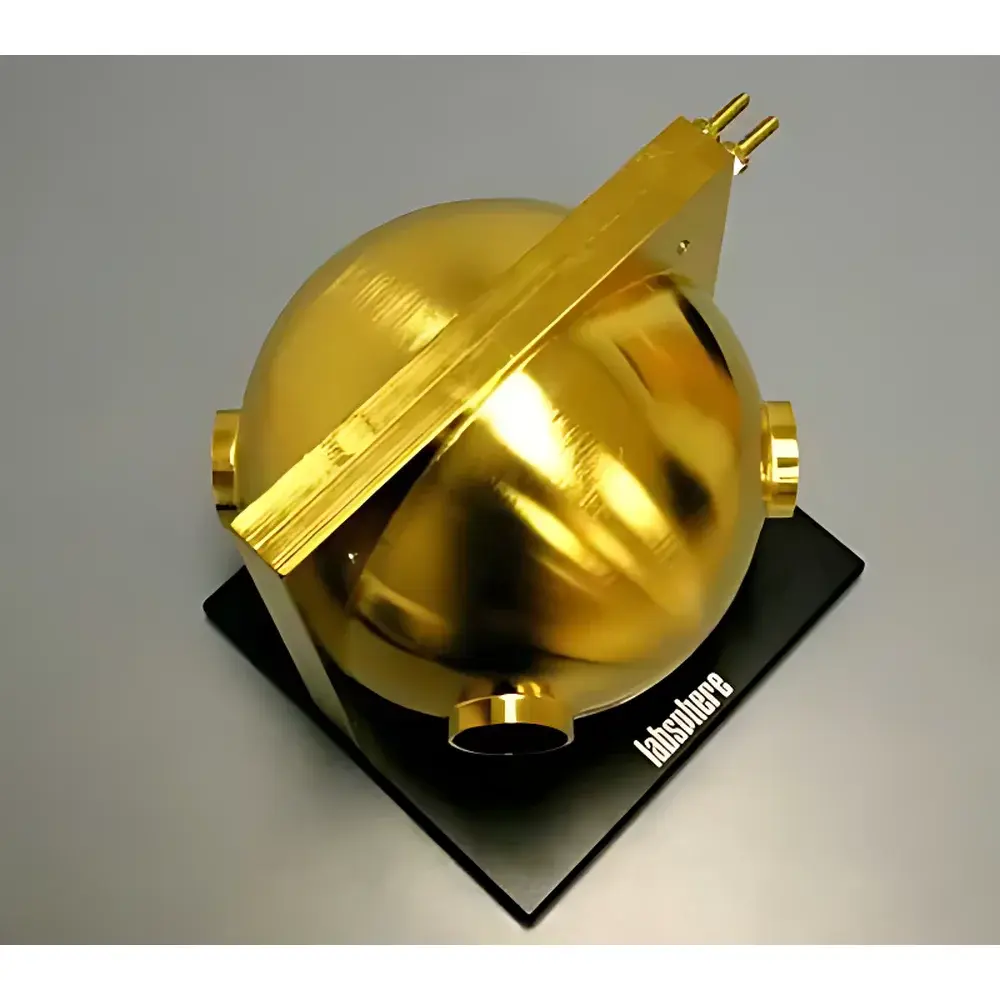
Labsphere LPMS High-Power Water-Cooled Gold-Coated Integrating Sphere
| Brand | Labsphere |
|---|---|
| Origin | USA |
| Model | LPMS |
| Coating Material | Infragold® |
| Cooling | Integrated Water-Cooling System |
| Spectral Range | 250 nm – 12 µm |
| Beam Acceptance Angle | Up to ±40° half-angle |
| Detector Compatibility | Dual-detector or spectrometer mounting ports |
| Thermal Management | Active water-cooling with user-selectable chiller interface |
| Target Plate | Integrated laser diffusing target plate |
| Compliance | Designed for ASTM E275, ISO/IEC 17025-aligned optical power measurement workflows |
Overview
The Labsphere LPMS High-Power Water-Cooled Gold-Coated Integrating Sphere is an engineered optical measurement platform designed for absolute radiant power quantification of high-intensity, highly collimated laser sources—including continuous-wave (CW) and pulsed lasers—in the ultraviolet through mid-infrared spectrum (250 nm to 12 µm). Unlike conventional integrating spheres relying on diffuse reflectance coatings optimized for visible light, the LPMS employs Infragold®—a proprietary, vacuum-deposited gold coating with >97% hemispherical reflectance across 800 nm–12 µm and stable performance under thermal load. Its core principle leverages Lambertian scattering within a precisely dimensioned spherical cavity to spatially homogenize incident radiant flux, enabling detector-independent, geometry-insensitive power measurement. The sphere’s design accommodates beam divergence angles up to ±40° half-angle without loss of collection efficiency, eliminating sensitivity to beam pointing instability or minor misalignment—a critical advantage when characterizing semiconductor laser diodes, fiber-coupled modules, or free-space CO₂ and Nd:YAG laser outputs. Integral thermal management ensures measurement stability during extended high-power operation, where absorbed energy would otherwise induce coating degradation or cavity deformation.
Key Features
- Water-cooled aluminum housing with integrated coolant channels and standardized quick-connect fittings for external chiller integration
- Infragold® coating providing broadband reflectance stability from UV to mid-IR, validated per ASTM E1331 spectral reflectance protocols
- Dual-port configuration supporting simultaneous installation of a calibrated thermopile sensor and a fiber-coupled spectrometer for concurrent power and spectral distribution analysis
- Removable, high-absorptance laser target plate (optional quartz or sapphire variants) to safely disperse and attenuate focused beams prior to cavity entry
- Optimized baffle geometry minimizing first-surface reflections and ensuring <0.5% spatial non-uniformity across detector field-of-view
- Modular port layout accommodating NIST-traceable calibration adapters, neutral density filters, and polarization-compensating waveplates
Sample Compatibility & Compliance
The LPMS integrates seamlessly into laser characterization workflows compliant with ISO 11554 (laser beam parameter measurements), IEC 60825-1 (laser product safety), and FDA 21 CFR Part 1040.10 (laser radiation safety standards). It supports direct measurement of CW laser diodes (up to 500 W), pulsed Nd:YAG systems (1064 nm, 10 ns pulses), CO₂ lasers (10.6 µm), and quantum cascade lasers (QCLs) without external attenuation in most configurations. The Infragold® surface meets MIL-STD-810G thermal shock requirements and retains reflectance integrity after 10⁴ cycles of 100 W/cm² irradiance exposure. All spheres are supplied with NIST-traceable calibration certificates (spectral responsivity and spatial uniformity) valid per ISO/IEC 17025-accredited laboratory procedures.
Software & Data Management
The LPMS operates as a hardware-agnostic optical subsystem compatible with industry-standard data acquisition platforms including LabVIEW, MATLAB Instrument Control Toolbox, and Python-based PyVISA frameworks. When paired with Labsphere’s optional PowerView™ software suite, users gain automated calibration traceability logging, real-time thermal drift compensation algorithms, and audit-ready export of measurement records compliant with FDA 21 CFR Part 11 electronic record requirements—including user authentication, electronic signatures, and immutable audit trails. Raw detector voltage outputs are referenced to primary standard-calibrated thermopiles traceable to NIST SRM 2210.
Applications
- Quantitative output power validation of high-brightness laser diode arrays used in industrial welding and medical ablation systems
- Stability monitoring of multi-kilowatt fiber lasers during manufacturing process qualification
- Spectral power distribution analysis of tunable QCLs in gas sensing instrumentation development
- Calibration transfer between reference standards and field-deployable laser power meters
- Thermal lensing effect evaluation in high-repetition-rate ultrafast amplifiers via time-resolved power decay profiling
- Compliance testing for Class 4 laser product certification per EN 60825-1 and IEC 60825-1
FAQ
What is the maximum average power the LPMS can measure without active cooling?
The LPMS requires active water cooling for all measurements exceeding 50 W average power; uncooled operation is limited to ≤10 W to prevent coating thermal desorption.
Can the LPMS be used with pulsed lasers?
Yes—pulse energy measurement is supported for pulse widths ≥10 ns and repetition rates up to 1 MHz, provided peak power density at the target plate remains below 1 GW/cm².
Is Infragold® coating susceptible to oxidation or sulfur tarnishing?
No—Infragold® is deposited under high-vacuum conditions and exhibits no measurable oxidation or sulfide formation under ambient lab conditions or inert purge environments.
How often does the sphere require recalibration?
Annual recalibration is recommended for GMP/QA environments; biannual recalibration suffices for R&D applications, with drift verification possible using internal reference LEDs.
Does the LPMS support polarization-insensitive measurement?
Yes—via optional integrated broadband depolarizing filters or by rotating the input beam azimuth relative to the sphere’s symmetry axis to average polarization-dependent response.




