
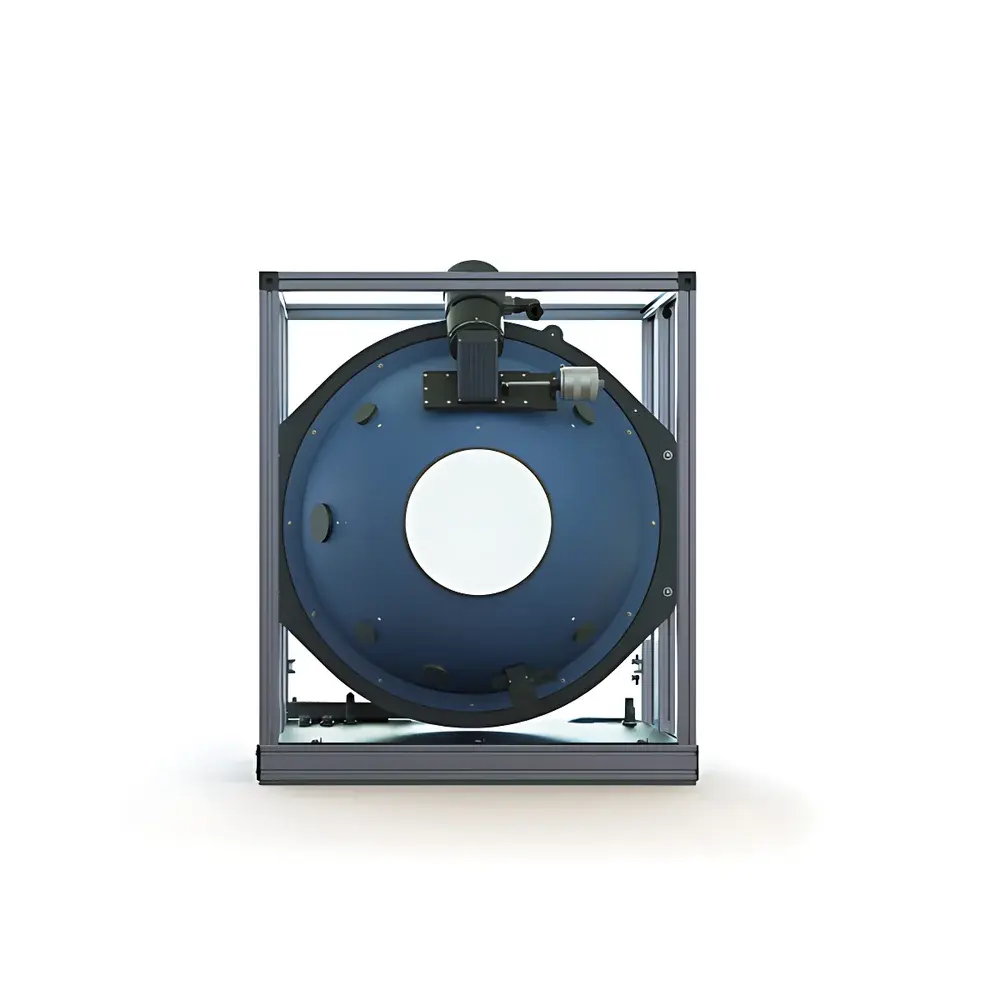
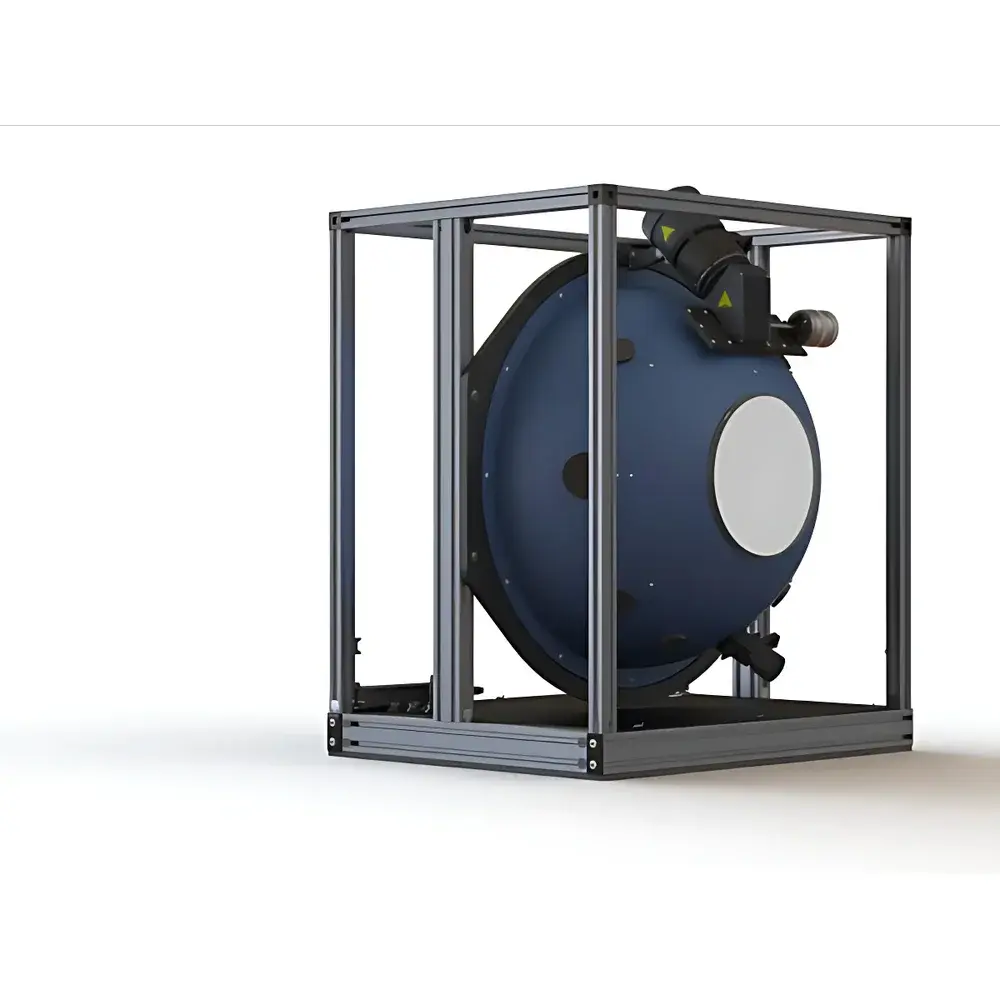
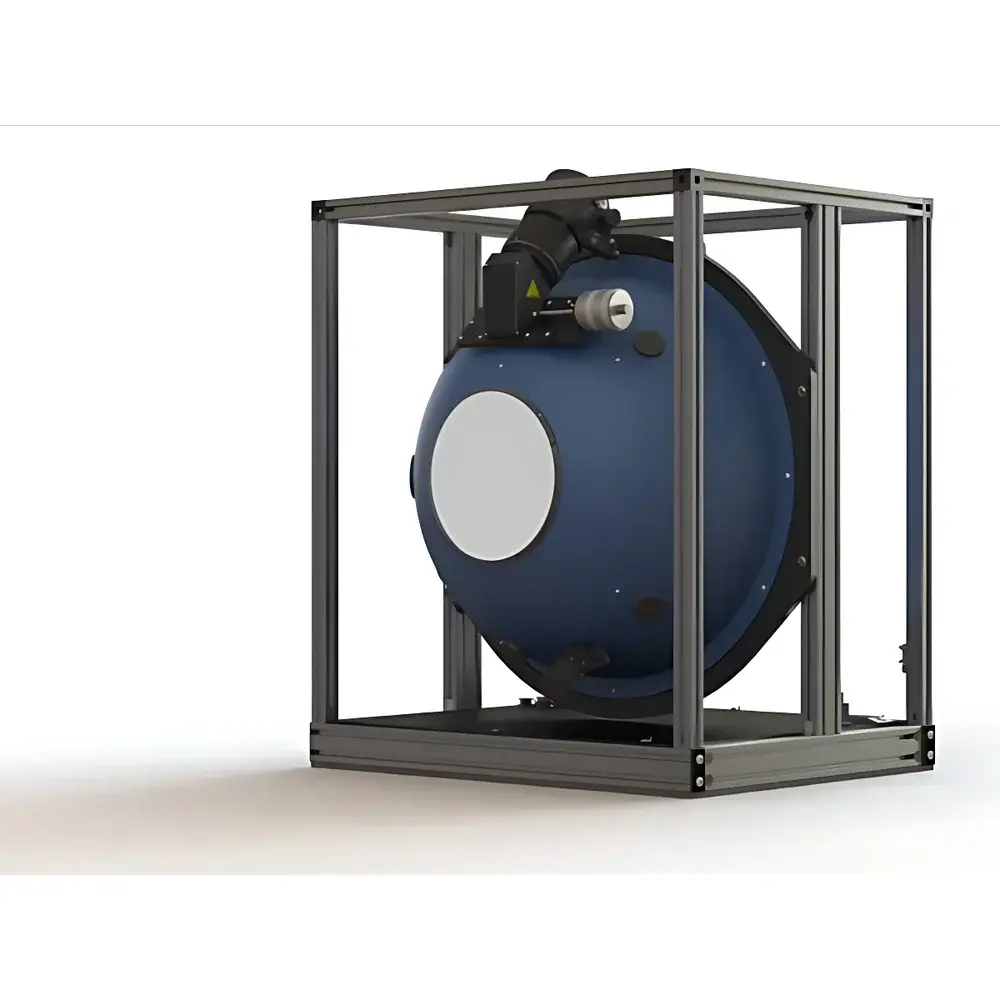
Labsphere Helios-V Series Variable Spectral Output Integrating Sphere Uniform Light Source
| Brand | Labsphere |
|---|---|
| Model | Helios-V Series |
| Origin | USA |
| Light Source Type | Tungsten-Halogen (3000K Blackbody Simulated) |
| Integrating Sphere Diameter | 12 in |
| Output Port Diameter | 4 in (0.1 m) |
| Luminance Range | 0.001–11,500 cd/m² |
| Illuminance at Port | Up to 36,000 lux |
| CCT | 3000K ±50K |
| Spectral Range | 300–2400 nm |
| Uniformity (FOV 35°) | ±2.0% |
| Attenuation Method | Manual VA-MM or Dynamic VAD |
| Attenuator Steps | 1.00E+04 (NMNN) / 1.20E+04 (NDNN) |
| Dynamic Range | 5.00E+04 (93 dB, 16-bit) / 1.20E+04 (81 dB, 14-bit) |
| Internal Coating | Spectraflect® |
| Compliance | ASTM E308, ISO/CIE 11664, NIST-traceable calibration options available |
| Software Interface | HELIOSense™ via Labsphere LSAPI |
Overview
The Labsphere Helios-V Series Variable Spectral Output Integrating Sphere Uniform Light Source is a precision-engineered optical calibration and sensor characterization system designed for laboratory-grade radiometric and photometric testing. Built upon the fundamental principle of Lambertian diffusion within a high-reflectance integrating sphere, the Helios-V delivers spatially uniform, spectrally stable, and temporally repeatable irradiance and radiance across its output port. Unlike broadband LED-based sources or filtered arc lamps, the Helios-V employs a thermally stabilized tungsten-halogen external source (HES) operating at a correlated color temperature of 3000K ±50K — closely approximating a Planckian blackbody radiator over the 300–2400 nm spectral band. This enables physically accurate simulation of terrestrial solar spectra (e.g., AM1.5G), low-light conditions (down to moonlight-level luminance), and intermediate irradiance levels required for dynamic range validation of imaging sensors, radiometers, spectroradiometers, and multispectral/hyperspectral systems.
Key Features
- 12-inch diameter integrating sphere with Spectraflect® coating (>98% reflectance from 350–2400 nm), ensuring high throughput and minimal spectral distortion
- 4-inch (0.1 m) output port with ±2.0% angular uniformity across a 35° field-of-view — verified per CIE 110 and ASTM E259
- Two attenuation configurations: manual variable attenuator (VA-MM) with 10,000 discrete steps or dynamic motorized attenuator (VAD) supporting 12,000 steps and automated intensity ramping
- Full-system dynamic range up to 5.0 × 10⁴ (93 dB) when configured with NMNN optics and 16-bit digitization, enabling single-setup characterization from 0.001 cd/m² to 11,500 cd/m²
- Thermally isolated HES housing with active cooling and vibration-damped mounting, delivering <0.2% RMS intensity drift over 1-hour operation
- Modular architecture supporting future expansion — including optional auxiliary ports, fiber-coupled inputs, and multi-source integration via LSAPI
Sample Compatibility & Compliance
The Helios-V series accommodates a wide range of optical devices under test (DUTs), including CCD/CMOS imagers, scientific cameras, remote sensing payloads, UAV-mounted sensors, and handheld radiometers. Its output port geometry and uniformity profile comply with ISO 14880-2 (optical test equipment), ASTM E308 (computing color using CIE system), and CIE Publication 127 (measuring LED intensity). All factory calibrations are traceable to NIST standards; custom spectral irradiance and radiance calibrations — including uncertainty budgets per ISO/IEC 17025 — are available upon request. The system supports GLP-compliant audit trails when used with HELIOSense software under 21 CFR Part 11–enabled environments.
Software & Data Management
HELIOSense™ serves as the native control and analysis platform for all Helios-V configurations. Built on Labsphere’s standardized Light Source API (LSAPI), it provides hardware-agnostic communication with integrated attenuators, power supplies, and optional reference detectors. Key capabilities include scripted intensity sweeps, time-stamped radiometric logging, spectral data export in IES, EDR, and CSV formats, and real-time deviation monitoring against user-defined uniformity thresholds. Calibration files (including spectral responsivity corrections and port-specific non-uniformity maps) are embedded directly into measurement sessions. Data integrity is preserved via encrypted project archives, version-controlled calibration metadata, and optional electronic signature workflows aligned with FDA 21 CFR Part 11 requirements.
Applications
- Radiometric and photometric calibration of spaceborne and airborne imaging sensors prior to environmental testing
- Dynamic range validation and linearity assessment of scientific CMOS and sCMOS cameras used in astronomy and biomedical imaging
- Uniformity mapping and dead-pixel identification in focal plane arrays (FPAs)
- Ground truth generation for reflectance factor (ρ) and bidirectional reflectance distribution function (BRDF) measurements
- Testing of automotive ADAS camera modules under varying ambient light conditions (e.g., dusk-to-dawn transitions)
- Development and verification of AI-driven image enhancement algorithms requiring controlled, repeatable input stimuli
FAQ
What spectral range does the Helios-V cover, and how is spectral stability maintained?
The system emits continuously from 300 nm to 2400 nm, with peak stability achieved through thermal regulation of the tungsten-halogen lamp and minimized thermal load on the integrating sphere wall. Spectral shape remains invariant across intensity settings when using the manual or dynamic attenuator — as attenuation occurs optically, not electrically.
Can the Helios-V be used for absolute radiometric calibration?
Yes — when paired with an NIST-traceable reference detector (e.g., Labsphere’s RS-5 or SR-5 series), the system supports full spectral irradiance calibration at the output port. Custom calibration reports include expanded uncertainties per GUM guidelines.
Is remote operation and integration into automated test benches supported?
Absolutely. HELIOSense exposes full LSAPI functionality over TCP/IP and LabVIEW-compatible DLLs. Third-party platforms (e.g., Python, MATLAB, TestStand) can initiate sequences, read real-time photodiode feedback, and log synchronized metadata.
How does the Helios-V differ from LED-based uniform sources?
Unlike narrowband or phosphor-converted LEDs, the Helios-V provides true broadband blackbody-like emission with no spectral gaps or spikes — critical for characterizing spectrally sensitive detectors and validating spectral response models.
What maintenance is required for long-term performance consistency?
Annual recalibration is recommended; lamp replacement intervals average 2,000 hours under standard duty cycles. Spectraflect coating integrity is monitored during calibration; recoating services are available through Labsphere’s ISO 9001-certified facility.





